The Pittsburgh Penguins did plenty right on Saturday night at Madison Square Garden. They built a two-goal lead, controlled long stretches of play, and received another solid outing from Stuart Skinner. Yet when the final horn sounded, it was the New York Rangers celebrating a 3-2 shootout win after completing a comeback.
For a Penguins team fighting for positioning and consistency, this was the type of loss that stings — not because they were outplayed for 60 minutes, but because they let control slip away. From blown momentum to special teams swings and ongoing shootout struggles, here are three takeaways from Pittsburgh’s defeat.
Playing “Cute” with a Lead Came Back to Bite Them
This would have been the ideal road start against a team that had lost five straight.
Related: 7 Cool Things About Sidney Crosby
Anthony Mantha opened the scoring 2:08 into the first period on the power play, tipping a point shot from Erik Karlsson. The Penguins came out sharp, playing a strong attacking game and getting the puck to the net quickly. Bryan Rust nearly extended the lead a few minutes later on another power-play chance before the goal was waved off on interference after a Rangers video challenge.
That was a turning point in the game.
Instead of going up 2-0 early and burying a Rangers team that had lost five straight, the Penguins remained tied at 1-0. Rust later hit the post on a rush, another chance to extend the lead that was missed. However, the Penguins were in control.
Ryan Shea made it 2-0 at 1:59 of the second period, spinning off pressure at the point and firing a wrist shot that deflected in. At that point, Pittsburgh was outshooting New York 12-2 and dictating play.
But rather than simplify their game and continue pushing north, the Penguins eased off.
Evgeni Malkin was candid afterward about what tends to happen when the Penguins get comfortable with a lead. “We (didn’t) play bad, we played OK, but we just need to play a little bit simpler sometimes,” Malkin said. “We try to play, like, beautiful sometimes. … When we lead, like, 2-0, we start to play a little bit cute.”
That assessment matched the eye test. Instead of continuing to pressure and keep the Rangers on their heels, the Penguins’ game loosened up. Pucks didn’t consistently get deep. Plays were forced through traffic. The structure that built the lead slowly eroded.
Against a team with elite talent and a goaltender like Igor Shesterkin, that margin for error is razor-thin. The Rangers didn’t need many openings — just a shift in momentum.
Special Teams and Momentum Swung the Game
The power play was both a positive and a turning point.
Pittsburgh’s early strike gave them control, but New York responded in the second period when Mika Zibanejad wired a power-play one-timer at 10:00 to cut the lead to 2-1. That goal came at a critical juncture — when the Penguins still had an opportunity to stabilize and close the door.
Instead, it ignited the Rangers.
From that moment on, New York’s energy level spiked. Skinner was forced into several key saves, and the Penguins began to defend more than attack. While Pittsburgh finished 1-for-3 on the power play (33.3 percent) and the Rangers went 1-for-2 (50 percent), the timing of New York’s goal proved decisive.
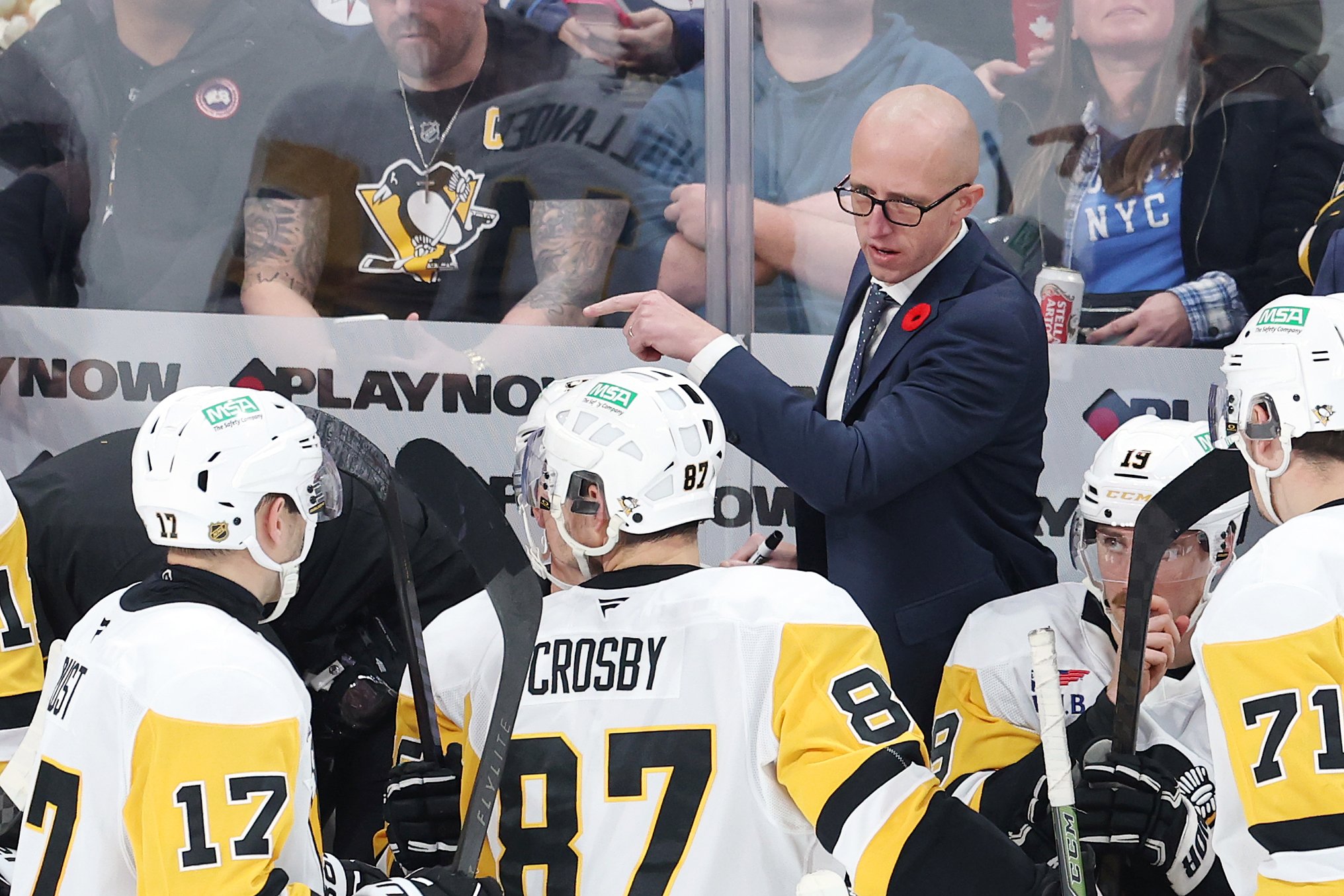
Head coach Dan Muse didn’t shy away from the bigger issue that surfaced after regulation — the shootout. “We’ll continue to work (on the shootout),” Muse said. “We’ll continue to look at it. It just hasn’t been good. It’s on all of us. We’ve got to keep looking at ways we can get better at it. We’ve tried some different guys, we’ve tried some different things, but the results are what they are.”
The results, again, were not good.
Vincent Trocheck scored in the first round for the Rangers. Shesterkin shut down Mantha and Egor Chinakhov, and Tommy Novak missed the net in the third round. Pittsburgh went 0-for-3 in the shootout.
For a team in a tight race, those extra points matter. This wasn’t just a one-off. It’s become a pattern. Muse’s acknowledgment that it’s “on all of us” reflects that it’s not simply about skill — it’s about preparation and execution in high-leverage moments.
Skinner Gave Them a Chance — Finishing Let Them Down
If there’s a silver lining for the Rangers, it’s this: Skinner wasn’t the issue.
He made 23 saves on 25 shots in regulation and overtime. Skinner made timely stops as the Blueshirts battled back. Zibanejad’s five-hole power-play one-timer, as well as Taylor Raddysh’s redirect early in the third period, were two quality goals Skinner made on the Rangers.

In overtime, both goalies were excellent. Shesterkin made five saves in overtime as the game extended into a shootout.
Simply put, Shesterkin just made the saves needed in overtime.
The Penguins had 33 shots on goal, dominated the early part of the game, had the disallowed goal by Rust, had a post, and had Novak’s breakaway in the third period, which was denied by Shesterkin’s pad.
In overtime, there were chances to win the game. But the Penguins didn’t.
Malkin mentioned the need to be more direct in protecting leads and closing out games. This isn’t a five-on-five issue; it’s an issue of burying a team when the chance to do so arises.
The Penguins, against a Rangers team that had lost five in a row prior to the contest, had the chance to put a team down, to step on an opponent, and to put their foot on the throat of the Rangers.
The Bigger Picture
This wasn’t a blowout, not a game in which the Penguins were dominated in the score column. In fact, at times, the Penguins were the better team in this one.
But sometimes, the little things matter, especially this time of year.
A non-call on the goal. A post. A power-play swing. A shootout attempt gone awry. A change in the way the Penguins were playing from north-south to the extra pass.
Malkin’s comments on playing “simpler” when up in the score column should be well-taken in the Penguins locker room. Muse’s candid assessment of the shootout attempt is one of a team trying to figure things out in big games.
The Penguins left Madison Square Garden with one point instead of two on the afternoon. While on its own, that is not the end of the world, it is the way the season adds up in the end.
Saturday night wasn’t a disastrous effort, not one in which the Penguins let one slip away in the final minutes of regulation or overtime.
It was one in which the Penguins let the opposing team celebrate the extra point in the shootout.