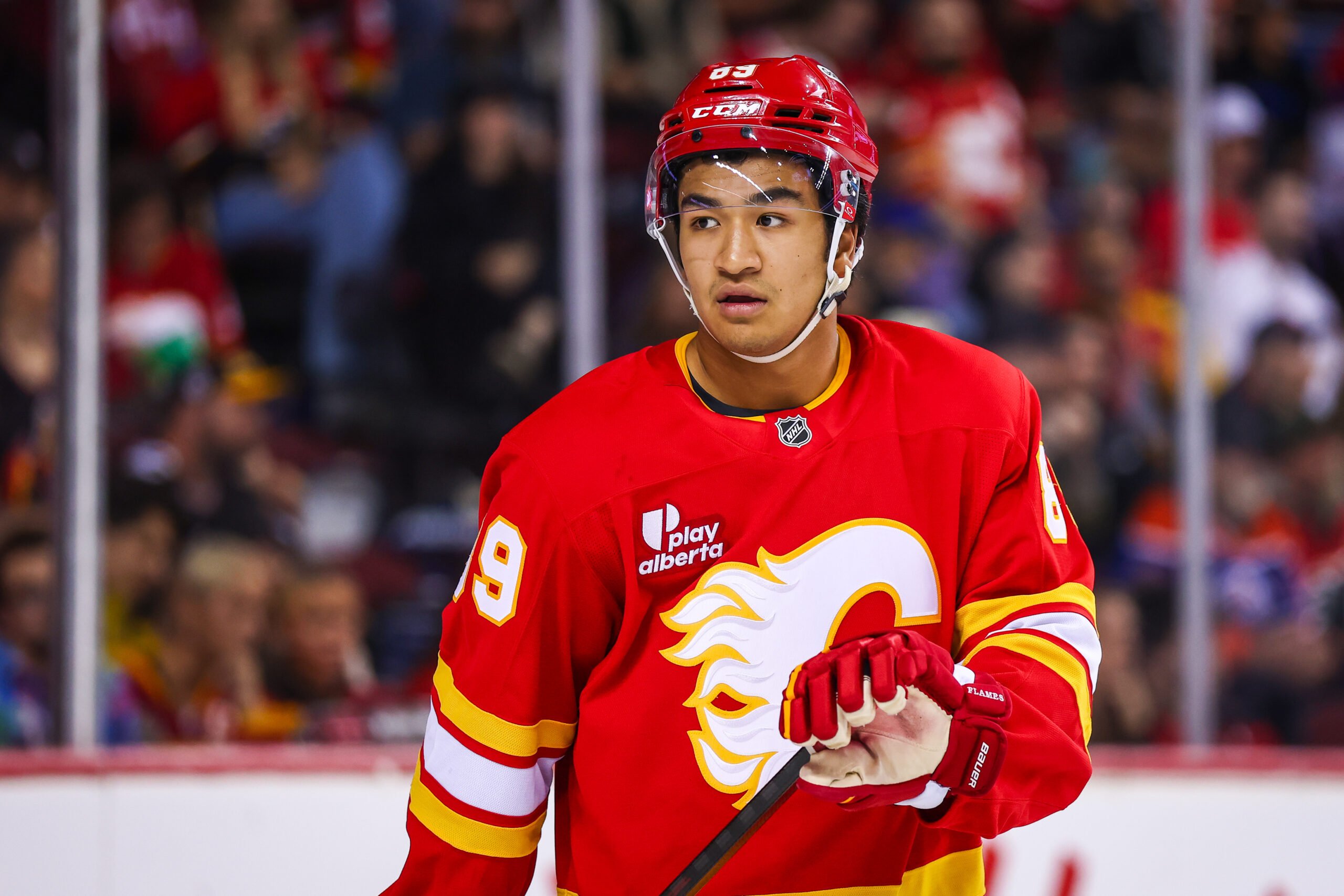
If you have been following the Calgary Flames at all this season, you know the organization is in a state of transition. But amidst the roster shuffling and the strategic retooling, one narrative has consistently demanded attention: the development of Zayne Parekh.
Parekh isn’t just another first-round pick with upside. He is a statistical anomaly in the best possible way. Parekh has been doing things from the back end that we simply haven’t seen in decades. And he’s finally returning to the Flames after injury, the World Juniors and a conditioning stint with the American Hockey League’s Calgary Wranglers.
Chasing the Ghost of Bobby Orr
To understand the hype surrounding Parekh, you have to look at his pedigree in the Ontario Hockey League (OHL). Junior scoring numbers can sometimes be deceiving — inflated by super-teams or over-aged players dominating teenagers — but Parekh’s production with the Saginaw Spirit stands up to the strictest scrutiny.

In his draft year alone, he put up 107 points — 33 goals and 74 assists — in just 61 games. He was producing offence at a rate usually reserved for elite first-line centers, all while playing defence. That performance earned him Canadian Hockey League (CHL) Defenceman of the Year honours, a nod to his dominance across all three major junior leagues.
Related – NHL Rumors: Panarin to Jets, Kadri Ready, McMann & Matthews Leaving Maple Leafs?
But the statistic that truly separates him from his peers is his consistency finding the back of the net. Parekh posted back-to-back 30-goal seasons in the OHL. The last defenceman to achieve that specific feat in the OHL/OHA? Hall of Famer Bobby Orr. When your name is being printed next to Number 4 in the record books, you aren’t just having a good season; you are operating in a different historical tier.
Wearing the Leaf: A Record-Breaking World Juniors
There is always a concern that junior dominance won’t translate to higher levels of competition. Critics will argue that what works on a Tuesday night in Saginaw might not work against the world’s best. Parekh answered those critics emphatically at the 2026 World Junior Championship.

Representing Canada, Parekh didn’t just participate; he took over. While Canada finished with a bronze medal, Parekh’s individual performance was historic. He tallied 13 points (six goals, seven assists) in just seven games.
This set a new Canadian record for points by a defenceman in a single tournament. In a tournament that has featured the likes of Scott Niedermayer, Alex Pietrangelo, and Drew Doughty over the years, Parekh outproduced them all. It was a showcase that proved his offensive game isn’t reliant on weak competition — it’s reliant on an elite skill set that scales with the pressure.
The Art of the Blue Line Walk
So, how does he do it? It’s not just about a heavy slapshot. In fact, watching Parekh play is a lesson in modern defensive agility.
Scouts and coaches consistently highlight his “blue line agility.” In the modern NHL, the ability to “walk the line” — shuffling laterally along the blue line to change the angle of a shot — is crucial. Parekh does this at an elite level. He manipulates passing lanes, shifting defenders out of position to create openings that didn’t exist a second prior.
Related – Flames Should Avoid Trading for Kraken’s Shane Wright
During his recent conditioning stint in the AHL, this creativity was on full display. He was scoring from difficult, low-percentage angles, not because he was forcing plays, but because his instincts allowed him to identify the only viable option. As noted during his time in the minors, he scored simply because he “didn’t have another play.” That is the mark of a pure offensive talent: creating something out of nothing when the system breaks down.
The Rasmus Andersson Ripple Effect
This brings us back to the current situation in Calgary. The developmental path for defencemen is notoriously slow. Usually, teams send their prospects back to juniors for as long as possible. However, the Flames kept Parekh around, splitting his season between the NHL, the World Juniors, and the AHL. It was a tacit admission that he had already outgrown junior hockey.

With Rasmus Andersson moved, a massive hole has opened up on the Flames’ power play. This is the role Parekh was drafted to fill. His recent stint in the AHL wasn’t a demotion; it was a tune-up. He notched five points in four games, rediscovering his rhythm and puck confidence after the stop-and-start nature of his early NHL scratching.
Now, the training wheels are coming off. The Flames have cleared the roster spot and the power-play minutes. Parekh has the historic pedigree, the international success, and the modern toolkit. The question is no longer if he can produce at the NHL level, but how quickly he can adapt his defensive game to match his historic offensive ceiling.
AI tools were used to support the creation or distribution of this content, however, it has been carefully edited and fact-checked by a member of The Hockey Writers editorial team. For more information on our use of AI, please visit our Editorial Standards page.