A Nova Scotian who won a Stanley Cup and a World Junior Hockey Championship — and later worked as a university professor and curling executive — is being remembered for his humility.
Paul (Boots) Boutilier’s death was announced Thursday by the NHL Alumni Association. No cause of death was given for the 63-year-old.
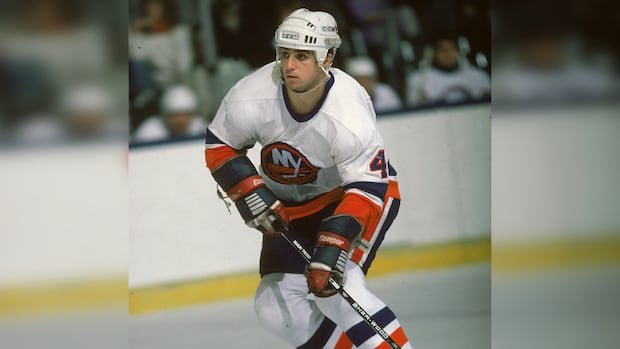
Born in Sydney, N.S., the defenceman was a first-round NHL draft pick of the New York Islanders in 1981. At the time, the team was in the midst of a dynasty that saw them win four straight Stanley Cups, making it an incredibly tough roster to crack — a reality Boutilier understood.
“I’ve no control over it, anyway,” he told the New York Times in 1981. “You don’t know what they’re thinking, so you keep going, keep working, gain the experience and show them the kind of attitude you have. You never know.”
While he played one game for the Islanders in the 1981-82 season, he split the following year between his junior team, the Saint-Jean Castors of the QMJHL, and New York, earning a Stanley Cup ring during the final championship of the Islanders’ run.

“You had to really pry to get info and stories out of him,” said Bruce Rainnie, president and CEO of the Nova Scotia Sport Hall of Fame.
“But he was one of those guys that when he came into a room, you always got your back slapped and you felt better leaving the room than you did when you came in and that was because of Paul’s gregarious nature.”
Boutilier played nearly 300 NHL games, including time with the Boston Bruins in the 1986-87 season.
Giving nature
After a morning skate at the Montreal Forum one day that season, Craig Seward met Boutilier. Seward’s father knew Boutilier through Cape Breton hockey circles.
As Boutilier left the ice, he greeted the pair with a handshake and then went down a tunnel to retrieve a stick from a dressing room — a Koho that Seward still has to this day.
“Despite my dad’s reluctance for fear of Paul getting into some hot water, Paul helped me over the rail into the tunnel and led me onto the ice of the Montreal Forum,” Seward wrote in a message to CBC News.
“Judging by the amount of security that came running mere moments later, I don’t think it was a welcome decision. Nevertheless, his kindness in that moment created a core memory for a 13-year-old kid that’s vividly remembered some 40 years later.”
It was one of the two times in Seward’s life that he encountered Boutilier.
Boutilier’s last NHL games came with the Winnipeg Jets in 1988-89, although he continued to play professionally for another two seasons.
Post-hockey life
His post-playing career trajectory was unique. It included coaching roles in the NHL, AHL, major junior and university levels.
He also taught international marketing at the University of Prince Edward Island and served as president of the World Curling Players Association, and worked as the executive director of the World Curling Tour.
“I think he was obviously smart enough to do anything he wanted, but to do it is different than being able to — and he just did it,” said champion curler Kevin Martin.
Boutilier’s passion for curling came from his parents, who competed in provincial and national events.
Martin said he first met Boutilier at curling events in the late 1990s. He said it was several months before he learned Boutilier was a former NHLer, let alone a Stanley Cup winner.
“He didn’t let the cat out of the bag,” said Martin. “That was the kind of person that Paul was. There’s no bragging.”

Boutilier believed curling had more in common with hockey than people would assume. Both rely on team play.
“When you think about it, you probably can make up the slack when one or two guys aren’t pulling their weight on a hockey team,” he told the St. John’s Telegram in 2001. “But when one member of a curling team isn’t doing the job, that’s 25 per cent and it’s tough to compensate.
“Plus, in hockey, when you had one or two bad games, it meant you were probably going to be out of the lineup for a while because there always seemed to be a few guys up in the press box prepared to take your job.”
On the surface, an ex-NHLer turned curling executive might seem unusual.
University degrees
But Boutilier had experience with the National Hockey League Players’ Association, an accounting degree and an MBA with a specialization in information technology. His master’s thesis was on the business of curling, the Cape Breton Post reported in 2002.
Boutilier’s time with the curling groups came amid significant challenges, including the Grand Slam of Curling losing its broadcasting partner, Sportsnet, in 2006.
Pierre Charette said he was golfing with Boutilier in Ottawa on the day it happened. After nine holes, Boutilier checked his phone and learned the news through emails.
“We never went to the 10th tee,” said Charette. “We just went back to the clubhouse and said, ‘What the hell are we gonna do?'”
Boutilier then helped negotiate an eight-year broadcasting deal with CBC.
Growing women’s curling
Another big moment was the inclusion of women in the 2006 Players’ Championship curling event.
“I would say women’s curling is as popular as men’s curling now and that all started with Paul when he invited them to play in the Players’ Championship,” said Charette.
He said Boutilier wanted to grow the sport, recognizing “you need to market your stars and we were missing the boat on half the stars — all the women stars.”
After stepping down from his executive curling roles in 2008, Boutilier returned to coaching hockey.
He spent this season working as a defensive consultant for the Moncton Wildcats and Quebec Remparts of the QMJHL.
MORE TOP STORIES