With the Carolina Hurricanes finally returning to action after a 12-day hiatus, it will truly cement the fact that the Philadelphia Flyers are now in offseason mode. The final game has been played, all the exit interviews conducted, and now there’s little on the calendar for the next month-plus until the NHL Draft in late June.
There may be some news before then, or perhaps it will wait until later. But there is legitimate momentum around the Flyers, perhaps at its highest level since the early 2010s. That doesn’t mean the Flyers must (or should) necessarily make a splash — sometimes the best way to unravel that is by forcing a move that isn’t there. Some moves need to be made before the team takes the ice next in a few months, however. Here are the key things to think about as the playoffs move on without the Orange and Black.
Pushing the Rebuild Forward
So, the Flyers have finally made it back to the playoffs for the first time since 2020. And you have to go all the way back to 2018 to find the last offseason when the Flyers were coming off a playoff appearance and the NHL landscape was in an ordinary place. The natural inclination would be to expect the Flyers to push to keep building on that progress. But don’t bet on it.
“From the time we started, we said it was going to be a rebuild, and that we needed patience. I think we’ve shown that that’s what we’ve done,” said general manager (GM) Daniel Brière during his May 14 exit interview. “Now, if there’s a chance to help improve the team, and something that makes sense for the long run, yes, we will jump on it.
“But as far as I’m concerned, it’s the same thing, we’re still in the growth part of the rebuild.”
Part of that is the big picture the Flyers find themselves in. Brière admitted they didn’t expect the unrestricted free agent (UFA) market to dry up as much as it has this season. None of the top 20 scorers is a full-time center, which is Philadelphia’s biggest weakness. Darren Raddysh fits a roster need (power-play quarterback), but betting on a 30-year-old off a career season feels misguided for where the Flyers stand.
The best GMs learn from the mistakes of their peers and predecessors. On July 1, 2018, the Flyers signed one of the top UFAs, reuniting with James van Riemsdyk for five years at $7 million per season. It wasn’t a disastrous deal, but the Flyers only qualified for the playoffs once during that contract, and JVR was scratched more often than he scored in that run.
Chuck Fletcher couldn’t have predicted the pandemic-caused flat cap, but it meant the Flyers were unable to offload van Riemsdyk in the final year of his deal with the team out of contention. That was arguably the last straw in the regime change that put Brière and president of hockey operations Keith Jones in charge.
As for the trade market, the Flyers do have a lot to give up. There’s this year’s 21st-overall pick, plus the luxury of having two first-round picks in one of the next two seasons (likely 2027) after adding one from the Toronto Maple Leafs in the Scott Laughton trade last year. Philadelphia’s prospect pool ranked eighth in Scott Wheeler’s latest rankings, so they have options to trade from there, as well as from their NHL roster (from “NHL prospect pool rankings 2026: Scott Wheeler’s evaluations of all 32 teams’ systems,” The Athletic, April 8, 2026).
Even if a true superstar like Auston Matthews became available via trade (definitely not a guarantee), the Flyers haven’t progressed far enough to be a priority destination for players who will settle for nothing less than a Stanley Cup chase. Someone like Robert Thomas would be a more realistic and cheaper (but still expensive) target who still qualifies as high-end, but trading for someone of that caliber now means giving up assets that could be better spent in a bigger blockbuster down the road.
Deciding Which Goalie(s) Sign New Deals
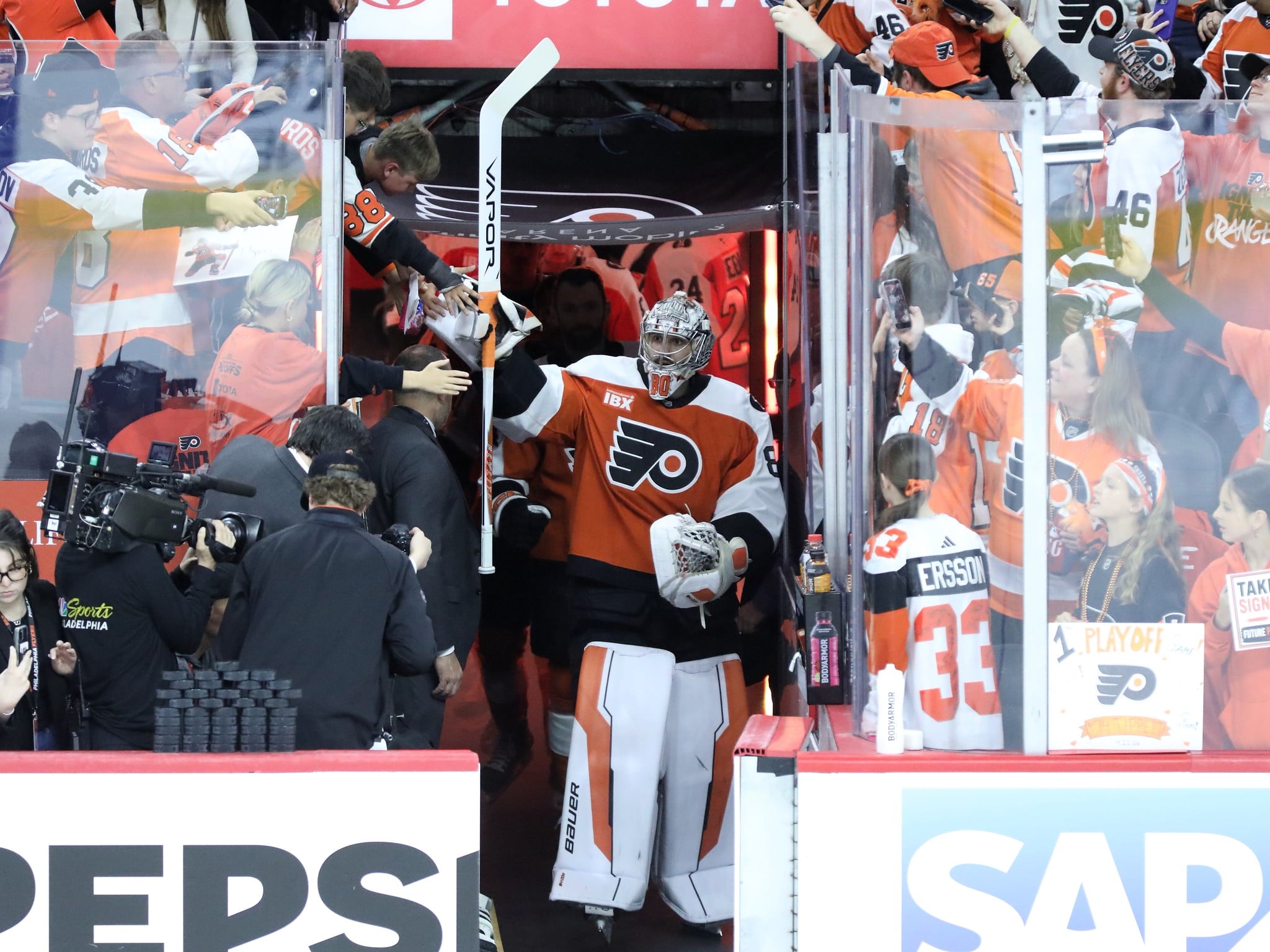
Unlike last season, the Flyers already know who their starting goalie will be on opening night. Dan Vladař has left no doubt about his role after saving 13.8 goals above expected in the regular season (per Moneypuck.com), the most by any Flyer since Steve Mason in 2015-16 (16.8). Unlike Mason, he followed it with a quality playoff run. Now, the question is whether the 28-year-old’s one season as a full-time starter is enough to earn another deal a year out from going back on the market.
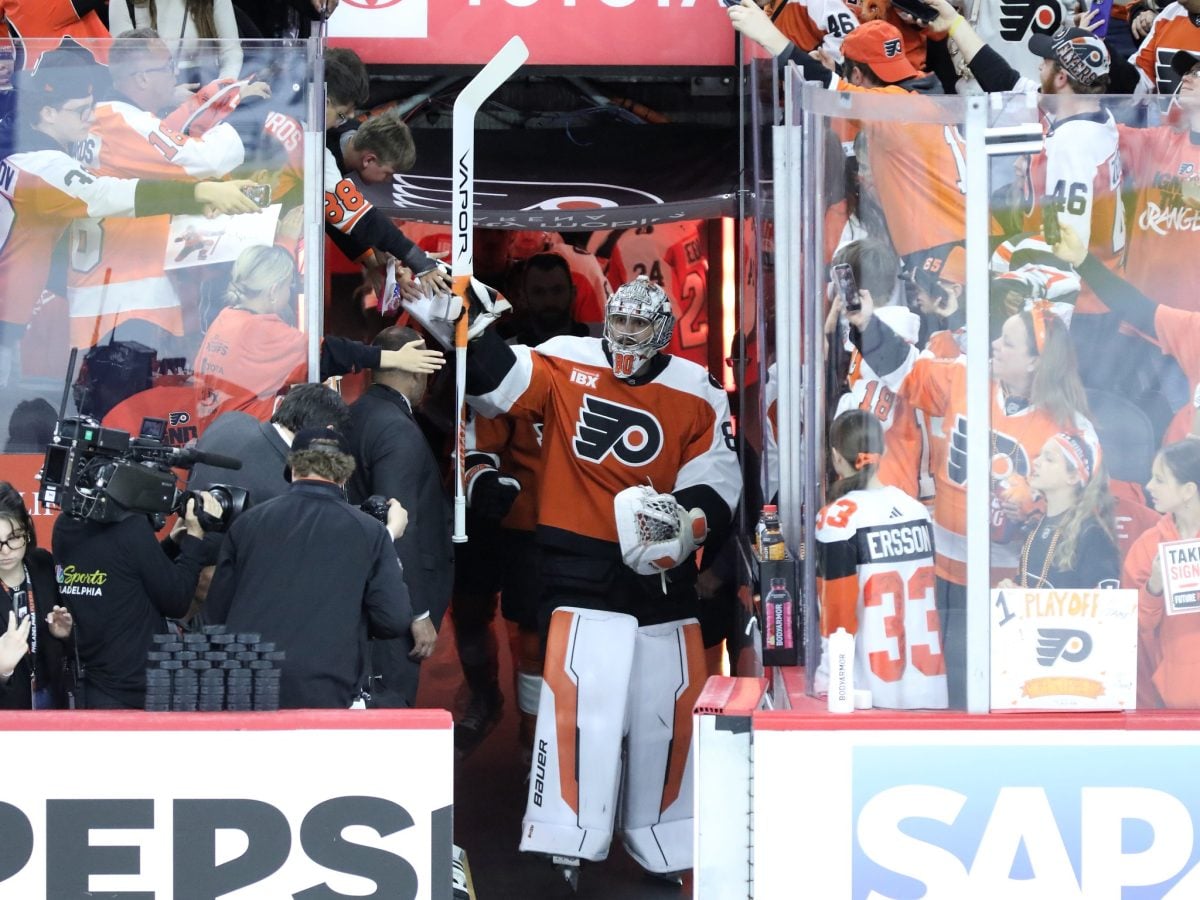
There’s no question Vladař will be in the Flyers’ crease on night one in the fall. The bigger question, at least in the short term, is who will be on the bench wearing a ball cap. The Flyers have already re-signed prospect Aleksei Kolosov on a one-year, $850,000 deal. Incumbent backup Sam Ersson’s rights remain with the team, but there’s no guarantee Brière exercises his $1.6 million qualifying offer (or re-ups him on a fresh deal).
At the Olympic break, Kolosov and Ersson were the two worst goalies by save percentage (min. four games played). It wasn’t all bad; Kolosov improved his American Hockey League stats from last season, while Ersson was legitimately good in his final nine games. But it would be a dice roll to depend on either one, or prospects Carson Bjarnasson and Egor Zavragin (the latter of whom is still under contract in the Kontinental Hockey League) as the primary number two.
“We have to evaluate, and look, it was a tough start for Sam, but we also have to give him credit [for] the way he stuck with it, the way he found a way to bounce back, to win some really big games down the road to get into the playoffs,” Brière said. “That was impressive. That wasn’t easy.
“And Sam, first of all, he’s a great teammate. The guys love him. We’ve invested a lot of years in him. So we want to sit down and discuss [his future].”
There are a couple of decent names in free agency. Daniil Tarasov and David Rittich were respectable backups this season. Stuart Skinner and Connor Ingram entered the playoffs as starters and may look for a larger role than the Flyers can offer, but then again, Vladař was supposed to be a tandem goalie until he wasn’t. Maybe that successful signing emboldens the Flyers to try to catch lightning twice.
RFA Negotiations for Zegras, Drysdale
The Flyers have 13 restricted free agents (RFAs) this summer, a much higher number than most fans would think. With apologies to the cast of primary Lehigh Valley Phantoms and NHL depth players like Ersson, Emil Andrae, and Nikita Grebenkin, Trevor Zegras and Jamie Drysdale are in a league of their own here.
It’s worth remembering that both players had lengthy negotiations the first time they were RFAs. Maybe that’s not a surprise considering both players were on the Anaheim Ducks at the time, and Pat Verbeek’s front office was named the league’s hardest to deal with in a poll of 23 NHL player agents (from “NHL agent poll: Best and worst-run teams, biggest contract, future commissioner,” The Athletic, Apr. 13, 2018).
But it wasn’t until October 2023 that both players signed, and perhaps that will affect how their first contract negotiations with Brière’s regime play out. An interesting part of the Zegras negotiation is that he spent the year playing two different positions. His offensive numbers slightly fell off when he moved from mostly a winger before the Olympics to typically a center after the Games (from 0.87 points per game to 0.72). Moving to the middle arguably offsets that drop, though.
Drysdale’s offensive game also oscillated throughout the season. He was more of a playmaker early in the season, with 18 of his 24 assists in his first 51 games. However, five of his eight goals came in his last 27, and he added two of each in the playoffs. He’s lowered his floor dramatically the last two seasons; now, the big question is how much better the 24-year-old can get, particularly on the offensive end.
AFP Analytics projects a five-year deal for Zegras at roughly $8.2 million per season, which would make him the team’s second-highest-paid player behind Travis Konecny. Drysdale comes up a bit cheaper; at six years, the estimated average annual value is about $7.3 million. There’s also a one-year projection for each player: it’s approximately $5.3 million for Drysdale and $5.9 million for Zegras. A contract that short feels pretty unlikely, though.
“There’s not an order. When it can get done, it gets done. It all depends on the synergy and sometimes you make ground faster with one and the other, and things change along the way. It depends on the traction,” Brière said when asked about handling those negotiations. “I have nothing that really worries me at this point.
It’s worth remembering that this is the last summer teams can re-sign players to eight-year contracts. Once the new collective bargaining agreement comes into place in September, players will be limited to seven years at re-signing and six years for UFA deals. There’s a good chance that doesn’t matter too much for either negotiation, but it’s something to keep in mind.
Sorting Out the Wing, Defense Depth
How much depth is too much depth? It’s always better to have a surplus than get caught scrambling. But for a young team like the Flyers, you don’t want players unable to develop due to a lack of reps or unable to play in the role they’re best suited for.
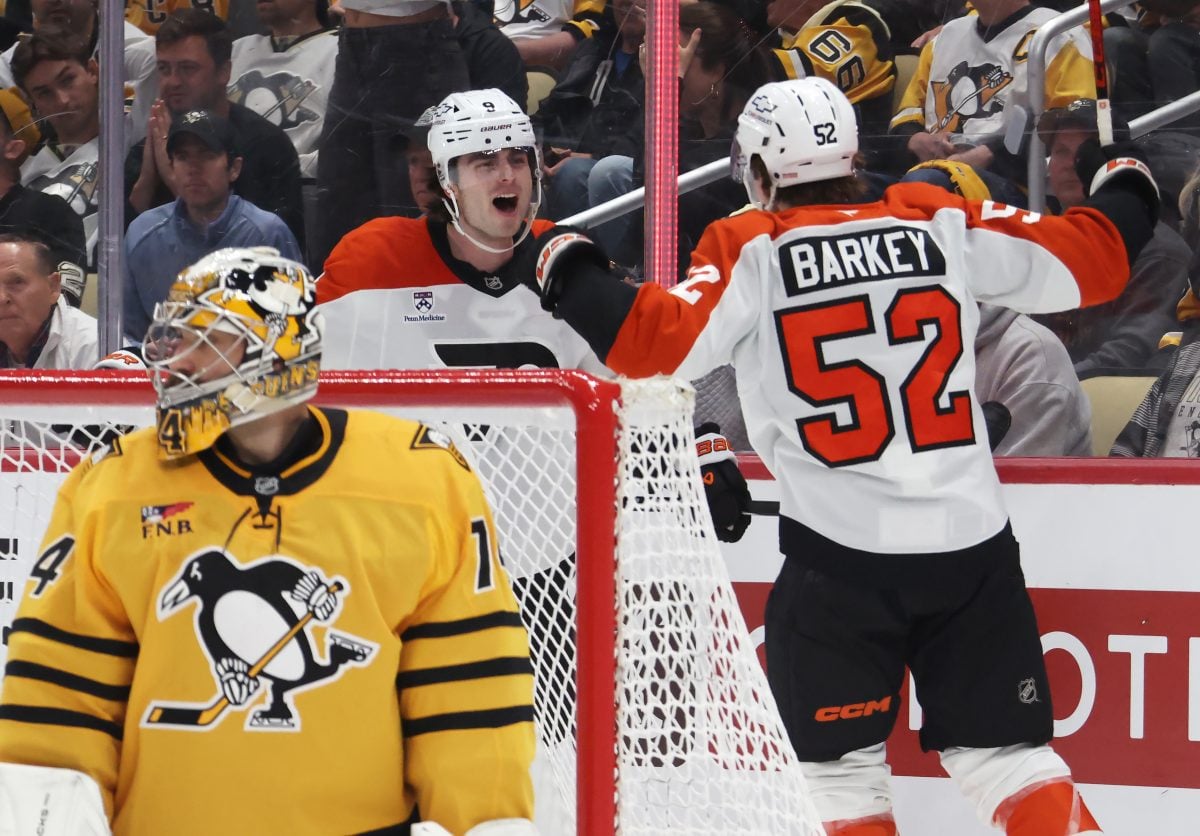
Right now, you could argue the Flyers have 10 top-nine forwards. There are ways to alleviate that without a transaction. For example, Denver Barkey or Alex Bump could play on the fourth line. Would they get enough minutes and offensive opportunities if one or both are consistently playing there? Is Grebenkin still in the team’s plans after a decent first season as a Flyer before an injury in March ended his season (and could still linger into training camp, per Brière)?
The same logjam exists on defense. Trade deadline acquisition David Jiříček is no longer waiver-exempt, and the return for Bobby Brink is almost a lock to make the team as a result. Would the Flyers be comfortable rotating him and Andrae on the third pair? Does Nick Seeler need to remain an everyday player entering the last two seasons of his deal (which loses its trade protection on July 1) if both play well? Does that make it easier to justify trading Rasmus Ristolainen as he enters his contract’s final season?
It’s a delicate balancing act that Brière will have to evaluate. It could also affect UFA decisions, of course, such as whether or not to bring back 37-year-old Luke Glendening. If the Flyers only care about having right-handed center options, Jett Luchanko and Cole Knuble are on the depth chart, of course. But prioritizing their growth by getting them top-six AHL minutes could easily open the door.
Scouting the Playoffs
With the conference finals beginning Wednesday night, there’s still a lot of great hockey left to watch. As you’re soaking it all in, here’s a player on each remaining team that the Flyers could take a look at.
It’s tempting to concoct a scheme that opens up one of the high-end players, but there’s no clear candidate. Both Carolina and the Montréal Canadiens used three goalies this season. Pyotr Kochetkov and (especially) Sam Montembeault likely won’t be playing, but with one year left at $2 million and $3.15 million, they’re reasonable bounceback candidates, especially behind Philadelphia’s stingy defense.
The Western Conference Final doesn’t offer as much that stands out. If the Flyers want a right-handed fourth-line center option but don’t want to bring back Glendening, perhaps Colton Sissons could be an option. The Vegas Golden Knights veteran is two years removed from a 15-goal season and would probably come cheap.
If the Colorado Avalanche need to clear cap space, maybe Ross Colton could be a buy-low candidate after his worst offseason season. A run of four straight 16-plus goal seasons ended this campaign, and his one-year, $4 million contract shouldn’t be too heavy a lift. He’d probably hurt the forward logjam more than he’d help at present, but if Brière swings a big trade and needs to backfill a spot, the 2021 Stanley Cup-winning goal scorer could be an option.
Free Newsletter
Get Philadelphia Flyers coverage delivered to your inbox
In-depth analysis, breaking news, and insider takes – free.
Subscribe Free →