Seeing as the Montreal Canadiens retained salary upon trading Brendan Gallagher to the Vancouver Canucks, he technically could be eligible for consideration on this list of the Habs’ worst contracts for 2026-27. He would have at least been a candidate, based on how he had found himself at the top (or more accurately bottom) of the same list the last few seasons.
That’s nothing necessarily against him, as someone needs to have the worst contract, even in as healthy a salary structure as one will find in the NHL. Furthermore, with each passing season since Gallagher had signed his current six-year, $39 million contract in 2021, it became less and less of a burden. Now, with a single season left on it, he wouldn’t have been as much of a shoo-in, at least not for top spot. Here is how the top (bottom) five actually shake out:
Noah Dobson ($9.5 million)
If any New York Islanders fans are reading this, you can practically hear them salivating upon seeing defenseman Noah Dobson included here. However, it comes with a caveat: The Canadiens got what they wanted when they traded two 2025 first-round picks and Emil Heineman to the Isles last summer for Dobson. In fact, they got what they absolutely needed in a right-handed defenseman capable of eating minutes and contributing at both ends of the ice.
And, if the Islanders for whatever reason want to run a victory lap over how the Canadiens are paying Dobson an average annual value of $9.5 million for “just” 47 points (a co-Canadiens-defense-leading 12 goals), maybe they had better backtrack instead. Whereas Dobson scored his career-high 70 points in 2023-24 while just about leading the Isles in power-play ice time (2:59 per game, which translated into 24 power-play points, one off the team lead), the Habs played him a miniscule 1:31 per game in 2025-26, relying more so on seven skaters ahead of him for their 23.1% success rate on the man advantage. That’s not why they needed him.
Instead, Dobson scored most of his points at even strength (39), when only Mathew Barzal, Matthew Schaefer and Bo Horvat scored more for the Islanders. In fact, Dobson came as advertised, making his contract a necessary evil. It’s not even bad per se, based on where the market is headed. It’s just less than ideal. And, on a team with so many huge contracts that actually provide great value, Dobson just doesn’t quite fit in on that list, as the player with the highest salary on the team. So, “less than ideal” is all it takes for him to slot in on this one instead.
Sorry, Islanders fans.
Mike Matheson ($6 million)
Similar to with Dobson, defenseman Mike Matheson’s five-year, $30 million deal isn’t horrible. It’s just not great. A few seasons after scoring a career-high 62 points in 2023-24, his production has taken a serious hit, not necessarily based on anything he did wrong. It’s simply the emergence of Lane Hutson, who has proven himself capable of doing what Matheson did better.
So, to a degree, Matheson became expendable, prompting speculation he would be trade bait. Instead the Canadiens re-signed him to his current contract early last season, as he was entrenching himself in more of a shutdown-specialist role, ultimately leading all players in the entire NHL in average shorthanded time on ice per game (3:56).
While that’s admirable, the team’s penalty kill was just 78.2%. In 2024-25, when he played 3:28 per game shorthanded, it was somewhat better (80.9%), but it’s hard to look at Matheson and see a stay-at-home specialist when it’s clear his strength lies in driving play in the other direction. And it’s hard to look at the 37 points he scored and see the offense he provides as being worth $6 million per season. Granted, that’s not the point as he’s contributing at both ends of the ice, but you’d just prefer to see him excel at one thing rather than be just okay at two.
Josh Anderson and Phillip Danault ($5.5 million)
If you had to place one of Josh Anderson and Phillip Danault ahead of the other in terms of worth to the organization, you’d probably give the edge to Anderson based on his speed, physicality and leadership. However, it’s worth noting, as a centre, especially one with elite defensive acumen and prowess taking faceoffs, Danault ultimately stabilized the team upon his re-acquisition midway through the regular season.
So, it’s far from clear-cut, especially when they have the same cap hits and one-year terms remaining on their respective contracts. Neither one is a player the Canadiens would want to trade, but would probably hesitate to re-sign especially at their current hits, but that’s true of any high-priced trade-deadline acquisition. And, as the Habs head into a season in which they probably have ambitions of competing for a Stanley Cup, it’s critical to assess the contributions of each of Anderson and Danault through that lens. They’re still valuable, putting in perspective how few legitimately bad contracts the Habs have on their roster. In reality, it’s (maybe) just one.
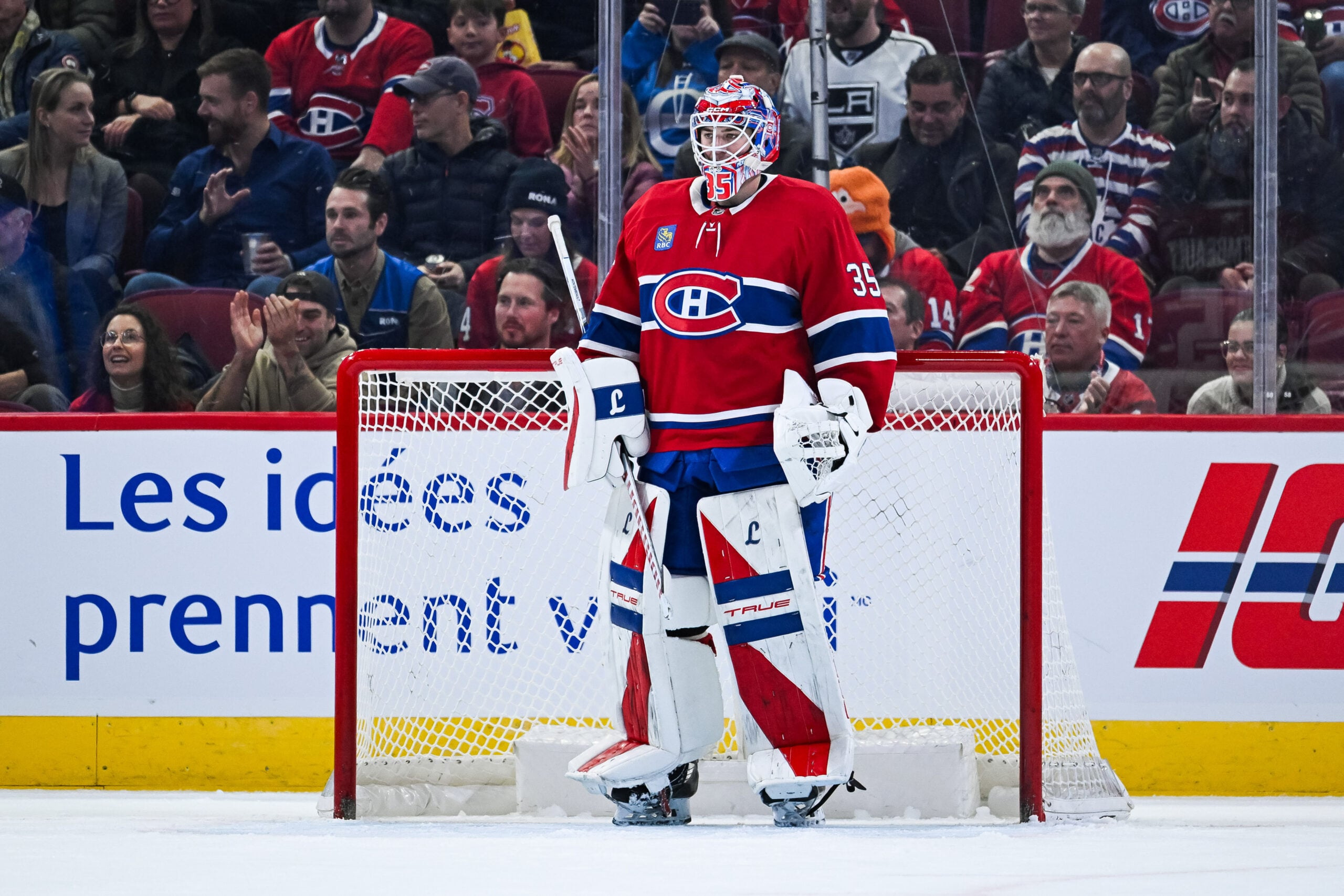
Sam Montembeault ($3.15 million)
Heading into 2025-26, goalie Sam Montembeault was perceived to have a great contract. He had seemingly established himself as the team’s No. 1 the previous season on the strength of a 31-24-7 record and impressive underlying analytics, all of which contributed to a Canadian roster spot at the 4 Nations Face-Off. Unfortunately, the 29-year-old’s play fell off in a big way.

In 2025-26, Montembeault went 10-8-4 with a 3.43 goals-against average and .872 save percentage. Whereas he had effectively earned the honour of being Canada’s third goalie the previous season, he got relegated to the third string on his own team, behind playoff-starter Jakub Dobes and back-up Jacob Fowler.
Montembeault is proof that anything can happen for better or worse. So, it’s not an entirely bad thing the Canadiens have three NHL-calibre goalies on their roster in the event of injury, and it’s not like the Habs are seriously handicapped as a result of the reasonable cap hit that had at one time been seen as a huge bargain. It’s just excessive at this juncture, pointing more realistically to a situation where he gets traded, similar to with Gallagher.
It’s probably what was best for Gallagher. The same is probably true for Montembeault, as he looks to build himself back up. For a team that is moving out of the rebuild stage though, Montembeault, who was objectively seen as a transitional starter after Carey Price’s departure, is simply put no longer a good fit, even if only with a single year left. That doesn’t make his contract bad, just a bad one for the Canadiens.
Free Newsletter
Get Montreal Canadiens coverage delivered to your inbox
In-depth analysis, breaking news, and insider takes – free.
Subscribe Free →