When general manager Kent Hughes and executive vice president Jeff Gorton made their summer media rounds, the tone wasn’t about “learning how to win” or “building habits.” It was about taking the next tangible step in the Eastern Conference hierarchy. Following a 2025-26 season where head coach Martin St. Louis’ group proved their playoff appearance was no flash in the pan, the 2026-27 Canadiens enter training camp with legitimate expectations on their shoulders.
For a franchise where pressure is as much a fixture as the banners hanging from the rafters, navigating those expectations will define this campaign. Here is a breakdown of what lies ahead for the key drivers at forward in Montreal’s lineup.
The Top Line: Standard-Bearers and Production-Drivers
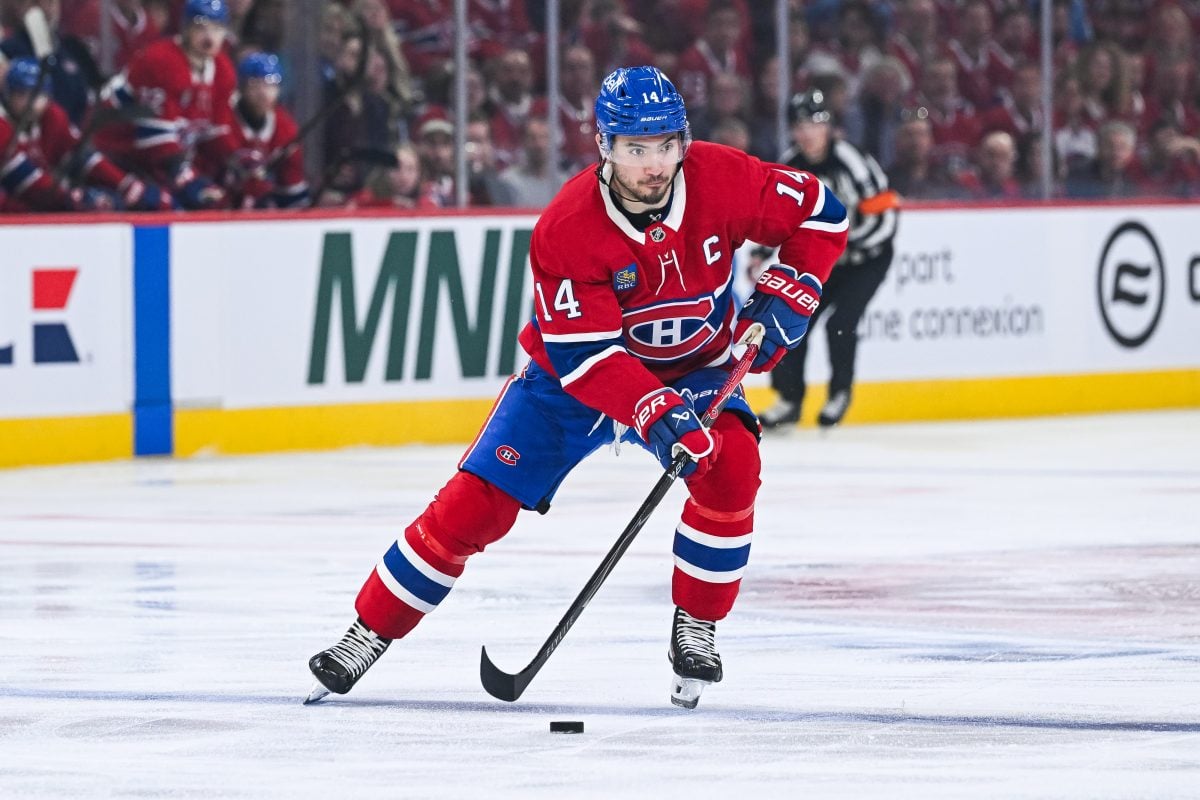
If there is one absolute certainty on St. Louis’ whiteboards, it is the top unit of Nick Suzuki, Cole Caufield, and Juraj Slafkovsky. Their performances have been the basis of the club’s success, and the oddsmakers rightfully look to this trio as the basis for their 2026-27 season predictions.
Before looking at individuals, a quick look at the overall team culture, led by this young core trio, will play a key role. Recent comments by Slafkovsky solidify what Hughes has been building: a winning culture that will fuel their desire to build on prior individual successes, not for money, but only so that they can meet their ultimate team-based goal.
“We’d rather just focus on collecting those (Stanley Cup) rings, because that’s a much bigger number, and I don’t think any amount of money can top that.”
– Juraj Slafkovsky
Last season cemented this trio not just as Montreal’s top line, but as one of the most dangerous first lines in the Atlantic Division. Suzuki, entering his fourth season as captain, has set a gold standard for durable, two-way excellence. Winning the Selke Trophy as the top defensive centre while also recording 101 points set a new benchmark. Expecting 80 to 85 points while eating head-to-head defensive matchups against opposing elite centres is no longer a best-case scenario; it is the baseline expectation.
For Caufield, after a 51-goal season, the mandate is clear: he must touch the 40-goal threshold, at minimum. His playmaking growth has rounded out his game, but his calling card remains that lightning-quick release from the left circle. With the power play operating at a higher level of tactical sophistication, Caufield will get his looks.
Meanwhile, Slafkovsky’s transformation into a dominant, puck-retrieving power winger has changed the line’s whole dynamic. His ability to win 50-50 puck battles along the wall and create secondary space for Suzuki and Caufield gives Montreal’s top line an identity. The expectation for Slafkovsky isn’t just point totals (hovering around the 70-point mark); it’s consistently asserting his 6-foot-3 frame on every shift, regardless of the opponent.
The Canadiens finished the season as the seventh-highest scoring team in the NHL with 279 total goals, and this line accounted for 110 of those. That is nearly 40% of all of Montreal’s scoring, on one line. That is why the performance of the second line will become crucial to continuing the team’s success.
From Prospects to Game-Changers
For all the progress Montreal made last season, the Atlantic Division remains a ruthless arms race where relying exclusively on a single dominant unit is a direct path to a mid-season slump. The top line proved it can go toe-to-toe with the NHL’s finest, but elite opposition coaches inevitably figure out how to hard-match and neutralize one unit over the course of an 84-game schedule.
If the Canadiens expect to turn last spring’s deep postseason run into sustained, year-over-year standing in the Eastern Conference top four, the front office and coaching staff know the primary mandate is building a lethal secondary wave of offence.
Ivan Demidov’s rookie campaign, earning him a landmark eight-year contract extension that won’t even come into effect until the 2027-28 season, gave the league a taste of his jaw-dropping edge work, deceptive vision, and game-breaking creativity. The expectation for 2026-27, however, is a transition from high-highlight rookie to consistent, second-line playmaking engine.
Driving his own line away from the top unit is a heavy ask, but Demidov possesses the rare puck-retention ability that makes players around him better. Whether feeding cross-seam passes on the primary power-play unit or dissecting neutral-zone traps with subtle head-fakes, Demidov is expected to hover near the point-per-game mark this coming season.
St. Louis will give him the freedom to make plays, but the coaching staff will also demand defensive accountability when the puck turns over. Demidov’s defensive abilities are advanced for a player of his age, but he is still in need of support on that front. If Demidov represents the highlight reel, Oliver Kapanen represents the defensive glue the line will require.
Kapanen’s 2025-26 regular season set a solid baseline for what he can provide when firing on all cylinders: a dependable 22-goal, 37-point campaign where he proved he can handle full-time top-nine minutes. However, his postseason performance underscored the realities of the NHL learning curve. Held scoreless across seven playoff appearances and eventually rotated out of the lineup, Kapanen hit a clear wall as the physical intensity ramped up.
Context is critical here: 2025-26 marked the very first time in Kapanen’s career navigating the gruelling NHL schedule, a drastic jump in games played from European league calendars.
Heading into 2026-27, expectations for Kapanen center on turning those conditioning and pacing lessons into consistent, year-round execution. Capable of playing both center and wing, Kapanen gives St. Louis a reliable, high-IQ option anywhere in the middle six. While his regular-season shooting percentage will likely normalize, another 20-plus goal campaign is expected. Also, he will need to be the defensive backbone of that line and find ways to match up against other teams’ secondary lines.
Without Hughes making a trade for a proven, seasoned, second-line centre, Kapanen’s mature positional play and quick stick make him the ideal, low-mistake safety valve for a higher-risk playmaking linemate like Demidov.
The Bottom-Six Forwards: Defining Identity and the Opportunity for Youth
A team’s success over a full season grind rarely hinges entirely on its stars; it comes down to depth, situational execution, and a third and fourth line that know precisely who they are. For Montreal, the bottom six enters 2026-27 needing to establish a distinct, predictable identity, one that bridges the gap between veteran matchup stability and energetic, high-tempo execution.
The third line, anchored by veterans like Josh Anderson and Jake Evans, is designed to act as the team’s defensive security blanket. Tasked with absorbing heavy defensive-zone starts, generating offensive zone time and chipping in some offence as well.
Yet, the expectation here isn’t measured in point totals, but in goal differential at five-on-five and short-handed execution on the penalty kill. When Anderson and Evans are controlling play, they tilt the ice, starve opposing stars of high-danger looks, and buy crucial rest for Montreal’s top offensive weapons.
On the fourth line, however, the door is wide open for a stylistic shift, and that creates a legitimate opportunity for young prospects like Owen Beck to force their way onto the full-time roster. He is no stranger to this opportunity, as he has been called up in the past and performed above expectations.
Coming off back-to-back seasons of development with the Laval Rocket alongside brief NHL stints, Beck represents exactly what St. Louis values in a young bottom-six forward: elite faceoff mechanics, a relentless motor, and high-IQ positional awareness.
With the coaching staff demanding that the fourth unit play a direct, straight-line game, Beck’s two-way detail and penalty-killing capabilities give him a realistic blueprint to claim a permanent spot.
Ultimately, the bottom six cannot afford passenger shifts or defensive lapses. Whether it is Beck earning a job outright or energetic wingers setting the physical tone, the mandate from the coaching staff is simple: zero free passes, heavy forechecking pressure, and dependable shift-after-shift execution that keeps momentum firmly on Montreal’s side.
Coming off a captivating run to the Eastern Conference Final, the Canadiens enter the 2026-27 campaign no longer content as an up-and-coming underdog. While the dominant top line remains the engine of the offence up front, Montreal’s ultimate success will hinge on the evolution of its secondary scoring around Ivan Demidov and a bottom six defined by grinding two-way identity.
If young pieces like Owen Beck step up and the forward depth holds its end of the bargain, this team won’t just navigate its rising expectations; it will solidify its status as a permanent, high-octane contender in the East.
Free Newsletter
Get Montreal Canadiens coverage delivered to your inbox
In-depth analysis, breaking news, and insider takes – free.
Subscribe Free →