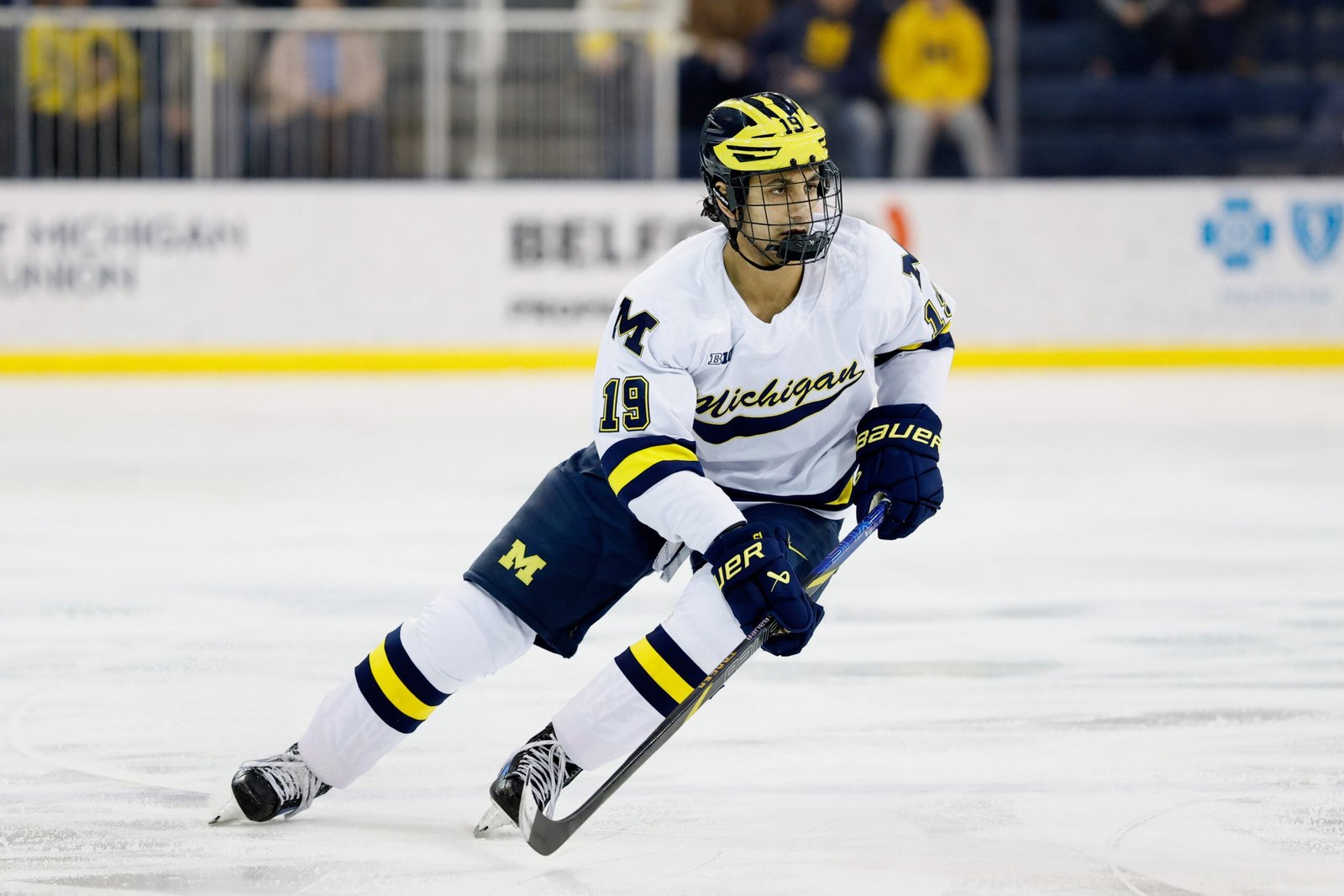
There is an inescapable pull that comes with wearing the Montreal Canadiens’ crest, even when you are hundreds of miles away in a college town in Michigan. When the Canadiens drafted Michael Hage 21st overall in the 2024 NHL Draft, they didn’t just add a high-upside offensive centerman; they added a player who understands what it means to carry expectation on his shoulders.
But long before Hage steps through the doors of the Bell Centre in the Bleu-Blanc-Rouge sweater, his focus remains squarely on a different prize: bringing the NCAA championship back to Yost Ice Arena.

For Hage, the decision to refine his craft with the Michigan Wolverines rather than rushing into the professional ranks isn’t to delay; it’s a deliberate, strategic step in his evolution. The mission in Ann Arbor is clear: dominate. Head coach Brandon Naurato didn’t mince words when describing what it takes to translate college promise into NHL stardom, noting that if Hage wants to make that leap seamlessly, he needs to be the undisputed best player on the ice night in and night out.
Hage’s Unfinished Business
Chasing a national championship provides the exact crucible Hage needs. In college hockey’s pressure cooker, the stakes mirror the intensity he will eventually face under the spotlight in Montreal. Learning how to win, leading a team through single-elimination battles, and carrying the burden of top-line expectation are non-negotiable prerequisites for playing center in the NHL.
But what are his odds? Hage is returning to the Wolverines. So are Will Horcoff, Adam Valentini and Henry Mews. Michigan will also add Landon DuPont, the highly-touted defenseman projected to be the No. 1 pick in the 2027 NHL Draft. They also added 19-year-old defenceman and Memorial Cup champion Cameron Reid.
Reid’s steady defensive play and leadership will be an important addition, and he knows how important it is to have Hage back as well. In an exclusive interview with Marco D’Amico at R.org, he explained that he knows what it feels like to leave a season wanting another chance.
“We have an opportunity to have a good year, but it’s the same mentality, we want to win this, and we believe we have a team that can win it. That sets a fire in you, the guys who are returning are going to have it, and I think it’ll rub off on everybody.”
-Cameron Reid
While Hage is clearly well supported on the ice, support off the ice will be essential as well.
Max Pacioretty‘s Mentorship
If there is anyone on the Michigan bench who understands the unique pressure of wearing the Canadiens’ sweater and transitioning from NCAA to professional hockey in Montreal, it is special assistant coach Max Pacioretty.
Drafted 22nd overall by the Canadiens in 2007 following a standout freshman year in Ann Arbor, Pacioretty spent a decade in Montreal, including three turbulent seasons wearing the “C”. Having a former captain and 335-goal scorer in his corner gives Hage a rare mentor with exact experience. Pacioretty knows firsthand what it means to go from a high-profile NCAA prospect to navigating the intense media glare and demanding fan expectations in hockey’s most passionate market.
On the ice, Pacioretty’s insights are tailor-made for Hage’s development. As a finesse winger who made his living in the high-danger areas, Pacioretty can work directly with Hage on how to use a physical frame to shield pucks under heavy cycle pressure, how to manipulate defenders off the rush to open up high-grade scoring lanes, and how to maintain a quick-release shooting mentality in tight spaces.
Off the ice, Pacioretty provides the operational blueprint for professionalism in Montreal. He knows what it takes to earn the trust of a coaching staff, how to insulate oneself from outside noise, and how to lead a locker room when the lights are brightest. For Hage, having a direct sounding board who has walked every step of the exact path he is on is an invaluable advantage that few NHL prospects ever enjoy.
The Incubator of the Top-Line Center
Centermen who drive play in the NHL do not materialize overnight; they are forged through heavy minutes against grown men. NCAA hockey emphasizes defensive systems, structured zone coverage, and physical battles because of its older, more physically developed player pool. This contrasts with major junior hockey, where a younger demographic and a gruelling 68-game schedule naturally foster a higher-risk, skill-driven style centred on individual transition play.
For Hage, operating as Michigan’s top-line center means facing every opponent’s shutdown pairing, taking defensive-zone faceoffs, and steering game flow when the ice shrinks, which will be critical to his development this season.
“That’s always the type of player I’ve wanted to be, someone who the guys can rely upon in the big moments to step up, make a play and break the game open.”
-Michael Hage
That responsibility is priceless for his long-term projection with the Canadiens. Montreal’s management team, led by director of hockey development Adam Nicholas, will track Hage’s growth while letting him take ownership of his development. Playing top-line minutes will allow him to build the operational rhythm expected of a top-six NHL centerman: distribution off the rush, wall play under heavy physical play and managing the middle of the ice.
“I feel like when you can dominate a level as good as college hockey is right now, it proves that you’re going to be alright at the NHL level. Obviously, it’s a big adjustment; it’s still very difficult, and those guys dominated at the college level before they left. But, at the same time, it’s the reason why I took this path. You’re playing against older, stronger guys. That’s as close as you’re going to get to pro hockey.”
-Michael Hage
The transition from junior to the NCAA forces players to face physically mature opponents, offering a stepping stone that simulates pro pacing better than almost any other league.
Refining His Game in the NCAA
With a quiet offseason, Montreal faced criticism for not making any big-name signings or trades, but the internal pipeline, led by Hage, is why those actions weren’t absolutely necessary. While his elite skating, vision, and release were never in question, scouts flagged clear areas for growth before his collegiate career. Namely, physical strength along the boards, defensive-zone engagement, and consistency in puck battles. To his credit, Hage hasn’t shied away from those scouting reports. Instead, he has actively targeted them.
Recognizing that skill alone cannot survive in the NHL, especially if your goal is to play in the dirty areas and survive for a long period of time, Hage made significant off-ice investments, adding muscle and transforming his physique. Last season, he made sure to add the strength needed for his development, as noted by his head coach Brandon Nauruto.
“When he was getting leaned on, it wasn’t like he was losing the puck all the time, but he wasn’t able to break that pressure consistently. Now he’s put on nine pounds of lean muscle, he’s lost two per cent body fat. Credit to him, credit to our strength coach, just putting in the work. I think it’s helping him a lot.”
-Brandon Naurato
The added strength will allow Hage to hold off defenders, win one-on-one battles down low, and protect the puck on the cycle, traits essential for a center aiming to play inside the dots at the professional level.
Equally critical has been his work in his own end. Early scouting evaluations noted moments where his defensive play appeared overly relaxed. In response, Hage has made a concerted effort to turn two-way responsibility into a core strength. By sharpening his defensive positioning and increasing his relentless compete level off the puck – aided by the daily standard set by Pacioretty and the University of Michigan staff – Hage is erasing the lingering question marks in his scouting profile.
Hage’s Road Ahead
For a player who grew up cheering for the Canadiens, the draw to fast-track his journey to the NHL is undoubtedly strong. Yet, Hage’s patience reflects a maturity beyond his years. He recognizes that arriving in Montreal as a fully formed product, capable of driving play rather than merely surviving it, is far more valuable than arriving early.
Pursuing a national title with Michigan offers the ultimate proving ground. When the NCAA tournament arrives, games are decided by the finer details. Details such as defensive-zone structure, wall clears under pressure, winning crucial faceoffs, controlled zone exits and entries, along with making the decisive play when fatigue sets in.
If Hage can lead Michigan to the top of college hockey, especially with a supporting cast of star prospects, while absorbing the wealth of knowledge provided by an experienced coaching staff, he won’t just arrive in Montreal as a promising prospect – he will arrive ready to fulfill a desperate and long-standing need for the franchise: a center built to sustain high-level success in the NHL.
The path is clear. The work is ongoing in Ann Arbor, and for Hage, the prize of a national title is the perfect final prep for the bright lights in Hockey’s Mecca.
Free Newsletter
Get Montreal Canadiens coverage delivered to your inbox
In-depth analysis, breaking news, and insider takes – free.
Subscribe Free →