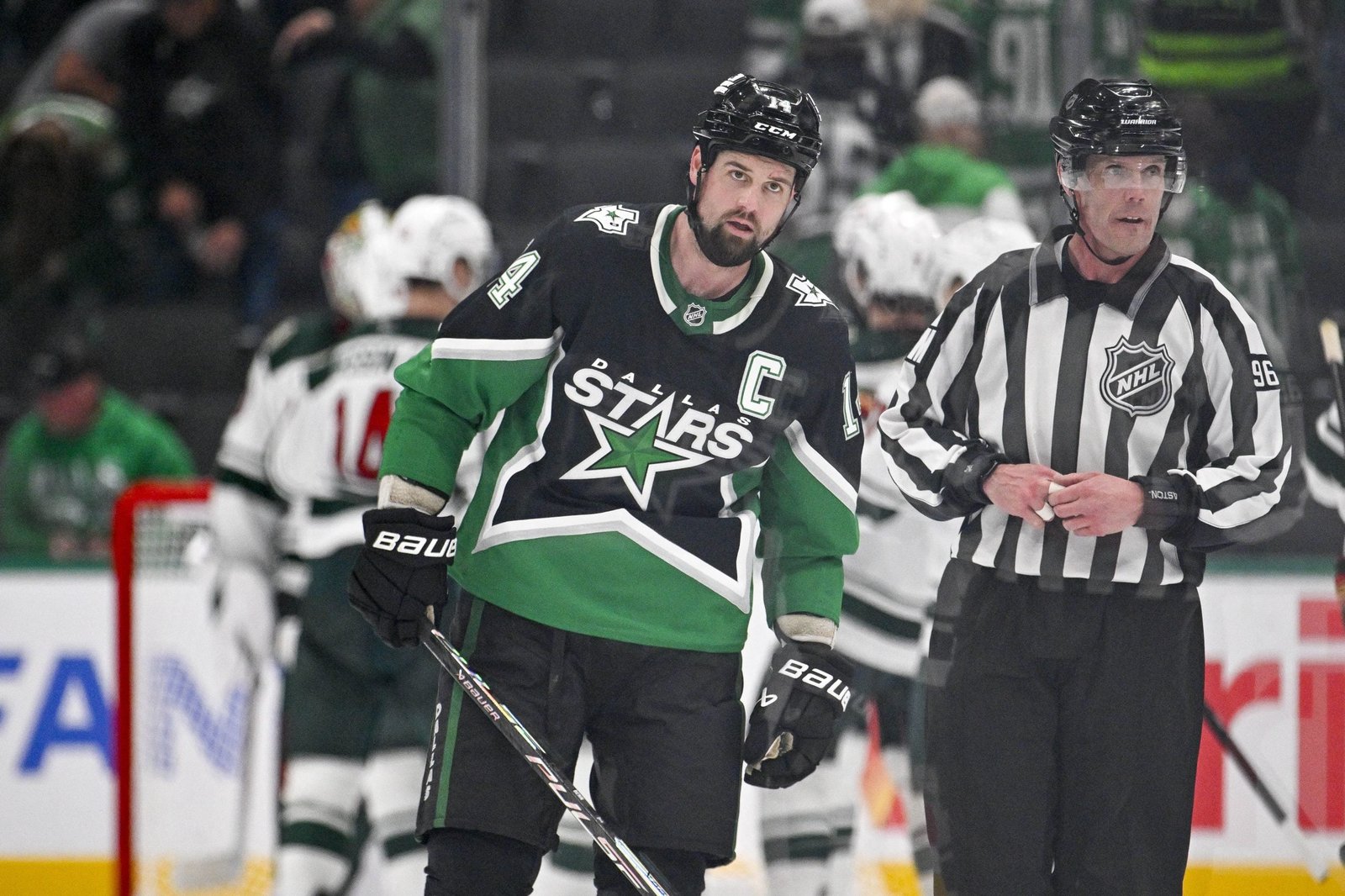
When the Dallas Stars packed up after a first-round loss to the Minnesota Wild in the spring, general manager Jim Nill kept coming back to one thing: the team was never fully healthy. Head coach Glen Gulutzan, for his part, faulted his group for not defending well enough in the series.
A Game 6 exit invites a dozen theories, and both of those mentioned by Nill and Gulutzan are verifiable as we prepare for the regular season. The postseason is a small and unforgiving sample, but it is the one place you can hold a claim like “injuries did it” up to the light.
When I look back and do my checks, Nill’s version mostly survives. Gulutzan’s does not, because the defense was one of the few areas of Dallas’s game that held up. The bigger problem is the one neither one of them named: a lack of depth scoring, and this offseason, it only got worse.
Stars’ Regular Season Was the Real Team
Before the injuries piled up in the spring, the Stars were one of the best teams in the NHL. They finished the regular season with 112 points, second in the Central Division and third in the league, on a plus-53 goal differential.
Jason Robertson and Wyatt Johnston scored 45 goals apiece. The power play finished second in the NHL. That team defended, scored in waves, and had Jake Oettinger in goal to back them up. Whatever went wrong in April did not show up during the 82-game schedule.
Playoffs, Injuries, and a Team Ready For Dallas
In six games against Minnesota, only six players scored, and just one of them came from outside the top of the lineup. Dallas managed four even-strength goals in the entire series and went more than three full periods without scoring at five-on-five.
The healthy part of the lineup did not fold. Robertson stayed in the lineup and got better, not worse. His on-ice share of five-on-five expected goals rose from the regular season, and his line outscored the Wild at even strength. If the Stars had a talent problem in the series, it was not coming from their healthy players.
Gulutzan singled out the defense, but that was not the issue, either. Dallas finished the regular season second in the NHL in goals against, the mark of a team built to hold up in exactly this kind of series. What sank the Stars was their inability to finish. They scored on three of 117 shots at five-on-five against the Wild, a rate no team sustains and no team plans for. With 117 looks on goal across six games, you should not run out of the building. The Stars failed to bury their chances, which is the most injury-sensitive problem a lineup can have.
There is a sharper counterargument that deserves a mention. The problem might not have been health, but pace, and if I can steal a term from David Castillo, who covers Dallas in great depth, the Stars need to raise their ceiling instead of patching their floor. The evidence is there.
Dallas spent the season among the league’s lowest in scoring chances generated per 60 and ranked among the worst remaining playoff teams in rush chances and clean breakouts. That is a standing critique, and I’ll come back to it, but the 2025 Playoffs complicates the argument.
Not All Injuries Cost the Same
A year earlier, the Stars won two rounds of the postseason more banged up than they were in 2026, and that is what the counterargument leans on. Look closer, and it cuts the other way. Dallas beat the Colorado Avalanche in seven games without Robertson, their leading scorer, and without Miro Heiskanen, their No. 1 defenseman, for the entire round.
Robertson hurt his knee in the regular-season finale on April 16 and did not play a single game against Colorado. Heiskanen had knee surgery after a Jan. 28 collision and did not return until the second round.
The Stars survived because of two things that were missing in 2026. First, depth scoring. Mikael Granlund had five goals that spring, and Mason Marchment, Evgenii Dadonov, and Sam Steel all chipped in from the bottom of the lineup. Second, the team’s one irreplaceable weapon was healthy. Mikko Rantanen went off for nine goals and 22 points in 18 games, a run a hurt roster could hide behind.
In 2026, both of those supports were gone, and the injuries hit the middle of the team instead of the edges. Roope Hintz, the only true No. 1 center on the roster, missed all six games. Rantanen was the hurt one this time, playing through a knee injury, and his scoring told the story: from 0.50 goals per game healthy in 2025 to 0.17 on one leg in 2026. The knee took his shot; the passing survived. And the depth that carried the 2025 team was just not there. Granlund, Marchment, and Dadonov were all elsewhere, and the players who replaced them did not score a goal in the series.
Robertson, on the other hand, was hurt in 2025, and Dallas won two rounds. He was healthy in 2026, and Dallas lost in the first. The result was flipped, which means he was likely not the variable. What mattered was whether a healthy Rantanen and a functioning bottom six stood next to him. In 2025 they did. In 2026 they did not.
The Offseason Added Health and Subtracted Depth
Which brings us to what Dallas actually did about it. This summer’s headline was about keeping Robertson, re-signed on July 22 for one year at $12 million after both sides avoided arbitration. Around him, the moves were small. Jamie Benn, Joel Kiviranta, and Arttu Hyry all came back on cheap one-year deals.
To add Robertson’s raise, Dallas subtracted. Mavrik Bourque and Ilya Lyubushkin went to the Nashville Predators on July 1, and Michael Bunting, Adam Erne, and Nathan Bastian left in free agency. The right-shot defenseman the team has needed for two seasons never came, and the team now sits roughly $1.36 million over the cap, close enough that they may need long-term injured reserve to be compliant on opening night.
They have a top six that is the same as last season but healthier, since a healthy Hintz and a healthy Rantanen are the closest thing to additions the roster has, with a bottom six that is thinner than the one that couldn’t score. The only depth forward who did score against the Wild, Bourque, is the one they traded. The system did not change either, which keeps both the elite defense and the sluggish even-strength rush attack intact.
Getting Hintz and Rantanen back fixes half the problem that sank the 2026 Playoffs, and it is the bigger half. It does nothing for the pace and breakout issues that have dogged Dallas for two springs, and it leaves the depth scoring worse than it was.
A healthy Dallas is still a contender on paper, but running it back is a bet on the team’s floor, not on their potential ceiling, and management answered the depth problem by getting thinner. Luckily, the Central Division did not change much. The gap between the four top teams and the four bottom teams still exists.
The number worth watching is not in the standings. It is whether, the next time Dallas reaches the postseason with Hintz and Rantanen in the lineup, they cannot afford to lose either of them to injuries because of their lack of depth, especially if they are hoping for a deep playoff run.
Free Newsletter
Get Dallas Stars coverage delivered to your inbox
In-depth analysis, breaking news, and insider takes – free.
Subscribe Free →