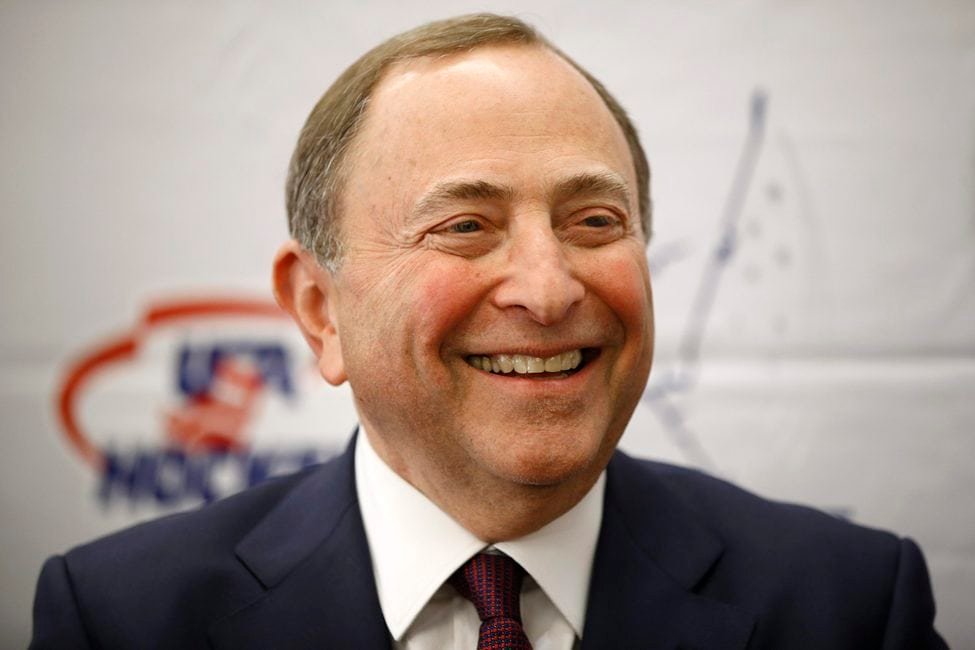
Whenever NHL commissioner Gary Bettman walks onto the ice to present the Stanley Cup, announces a draft pick or appears in front of a crowd, fans know what to do. Booing Bettman has become an NHL tradition.
Canadian fans, in particular, have plenty of reasons for their complicated relationship with the commissioner. No Canadian team has won the Stanley Cup since the Montreal Canadiens in 1993, the same year Bettman took office. The Quebec Nordiques relocated to Colorado in 1995, and the original Winnipeg Jets moved to Phoenix a year later. Meanwhile, the NHL aggressively expanded its footprint throughout the United States.
Put together, it’s easy to understand why many Canadian fans see Bettman as an enemy of hockey north of the border. The problem is that history doesn’t support that narrative. Bettman’s tenure has included controversial decisions, three lockouts and plenty worth criticizing. But when it comes to the survival and competitiveness of Canadian franchises, he has arguably done far more good than he receives credit for.
Bettman’s Canadian Assistance Plan Helped Save Franchises
One of the most overlooked acts of Bettman’s legacy came during the 1990s when Canadian NHL clubs faced a financial crisis. The Canadian dollar was extremely weak against the U.S. dollar, creating a significant disadvantage for Canadian organizations because much of their revenue was in Canadian dollars, while player salaries were in U.S. dollars. The Edmonton Oilers, Calgary Flames, Ottawa Senators and Vancouver Canucks were particularly vulnerable.

The NHL responded with the Canadian Assistance Plan, which provided financial support to small-market Canadian organizations, like the Oilers, Flames, Senators and Canucks, who received roughly $2 million to $3 million annually through revenue-sharing payments from 1995 through 2004. The significance of the program can’t be understated.
Former Canucks executive Brian Burke has credited Bettman for implementing the plan at a time when Canadian organizations were struggling with an exchange rate that saw their dollar fall to roughly 61 cents U.S. Burke went as far as to say that without the Assistance Plan, Canada likely wouldn’t have retained all of its teams.
Government records from the period also show the NHL operating programs designed to offset currency disadvantages for smaller Canadian markets. It’s impossible to know exactly what would have happened without those measures, but Canadian hockey fans should remember just how uncertain the situation was. The possibility of losing additional teams wasn’t some hypothetical talking point. It was a legitimate threat.
Bettman Didn’t Want Edmonton and Other Canadian Teams Moving South
The relocation of the Nordiques and Jets understandably damaged Bettman’s reputation in Canada, but those moves shouldn’t erase his subsequent efforts to prevent more Canadian franchises from following them south.
Edmonton is perhaps the best example. During testimony before a House of Commons committee in 1998, Bettman said the NHL had “consistently opposed and discouraged” franchise relocation and specifically pointed to the league’s efforts to keep the Oilers in Edmonton.
“Our goal is to make sure we have six strong, healthy, vibrant and very competitive Canadian teams in the NHL,” Bettman told the committee. At the time, the threat was real. Oilers owner Peter Pocklington had previously threatened relocation if the team’s financial situation didn’t improve, while several American cities were interested in acquiring NHL franchises.
Yet the Oilers stayed. So did Calgary. So did Ottawa. So did Vancouver. And eventually Winnipeg returned to the NHL in 2011. Bettman’s preference throughout much of his tenure has been to keep franchises in their existing markets rather than using relocation as the first solution. He reiterated that philosophy publicly in 2017, saying the NHL’s preference was to help teams solve arena and financial problems locally to ensure they remain where they are.
The Salary Cap Has Been Good for Canadian Teams
Bettman’s biggest battle may have become his biggest contribution to competitive balance. The 2004-05 lockout was brutal. An entire season disappeared, and Bettman deservedly absorbed significant criticism. But the resulting collective bargaining agreement introduced the NHL’s hard salary cap.
Before the cap, payroll disparities between wealthy and smaller-market franchises could be enormous. Bettman later recalled teams carrying payrolls of $80 million or $90 million while others operated around $20 million. That system presented an obvious problem for markets such as Edmonton, Calgary and Ottawa. The cap changed the equation.
Instead of determining competitiveness largely through spending power, every franchise now operates within essentially the same payroll framework. The Toronto Maple Leafs and Canadiens generate significantly more revenue than the Oilers or Jets, but they can’t simply spend an extra $50 million on players. The cap was initially set at $39 million for the 2005-06 season and has grown substantially alongside league revenue.
For Canadian fans outside Toronto and Montreal, that’s especially important. A league without meaningful cost certainty could have made it increasingly difficult for smaller Canadian markets to retain stars and build championship-calibre rosters, as the Oilers have done recently.
Canadian Teams Have Had Chances to Win
Then there is the argument that Bettman somehow doesn’t want a Canadian team winning the Stanley Cup. It’s entertaining conspiracy material. It’s much harder to defend seriously. Canadian teams have repeatedly reached the doorstep during Bettman’s tenure.
The Canucks went to Game 7 of the 1994 Stanley Cup Final and again in 2011. The Flames came within one victory of winning the Cup in 2004. The Oilers reached Game 7 in 2006 and have since returned to the Final in 2024 and 2025. Ottawa reached the Final in 2007, while Montreal made its run to the championship series in 2021.
The NHL’s official records show Edmonton has made nine Stanley Cup Final appearances in franchise history, Calgary three, Vancouver three and the modern Senators one. Canadian teams haven’t been prevented from winning. They’ve gotten close and lost. That’s a very different argument.
If anything, the salary-cap system has created an environment where Edmonton, Winnipeg, Calgary and Ottawa can realistically build contenders without having to compete dollar-for-dollar with the New York Rangers, Los Angeles Kings or Maple Leafs.
Bettman Has Made the NHL Much Healthier Financially
Bettman’s strongest argument might simply be where the NHL stands today compared with the league he inherited in 1993. The NHL has expanded from 24 teams when he became commissioner to 32, while league revenues and franchise values have exploded. Reuters noted that the average NHL franchise was valued at approximately $2.2 billion as of 2026.

The league is also projecting somewhere between $7.5 billion and $8 billion in revenue for the 2025-26 season. Bettman said corporate sponsorship, television ratings and gate receipts have all contributed to the NHL’s continued growth. That financial strength benefits everybody.
It increases the salary cap. It increases player salaries. It strengthens revenue sharing. Most importantly for Canadian hockey, it reduces the likelihood that teams in smaller markets face the existential financial problems that threatened them during the 1990s. There was once genuine uncertainty about whether Edmonton, Calgary and Ottawa could remain NHL markets. Today, relocation conversations surrounding those franchises are almost unimaginable.
Canadian Fans Don’t Have to Love Bettman
None of this means Canadian fans need to suddenly become Bettman supporters. His tenure has included legitimate controversies. Losing an entire season in 2004-05 remains a stain on the league’s history, and the NHL has experienced multiple work stoppages under his leadership. There are also fair debates about expansion, officiating, playoff formatting, international hockey, television rights and numerous other decisions.
But Bettman’s legacy in Canada deserves more nuance than simply blaming him because a Canadian team hasn’t lifted the Stanley Cup since 1993. When Canadian franchises were struggling, his league helped finance them. When relocation threatened markets such as Edmonton, he worked to keep teams where they were. When enormous payroll disparities threatened competitive balance, he pushed for the hard salary cap that continues to give smaller markets a legitimate opportunity to contend.
And under his watch, the NHL has become considerably stronger financially. So when Bettman inevitably walks onto the ice and gets showered with boos again, fans can continue participating in one of hockey’s strangest traditions. But they should also remember something. Some of the teams whose fans are booing him might not be where they are today without decisions he helped make.
Free Newsletter
Get Hockey History coverage delivered to your inbox
In-depth analysis, breaking news, and insider takes – free.
Subscribe Free →