SEC commissioner Greg Sankey started with the high points, winding his way through his usual football media days state-of-the-union address.
He pointed to the league winning a record 13 team national championships; that it was putting in additional programming to fight the growing influence of sports gambling; that its live viewership hours during football season accounted for 40% of those consumed by the Power Four leagues.
And then, the questions began.
“How real are the conversations within the SEC about potentially breaking away from the college structure as we know it?” a reporter queried.
“They’re real,” Sankey answered flatly. “People have talked about that. They’ve opined about the frustrations that bring them to the point of saying we should look at something significantly different. I do not believe that is a leverage point. I think that’s just honest communication.”
The threats of a “breakaway” are, in fact, quite real.
Angst from administrators and presidents has pushed the SEC and, to a lesser degree, the Big Ten to a point where each has explored what self-governance at the conference level might look like — sentiments that have been broadcast more publicly over the past six months.
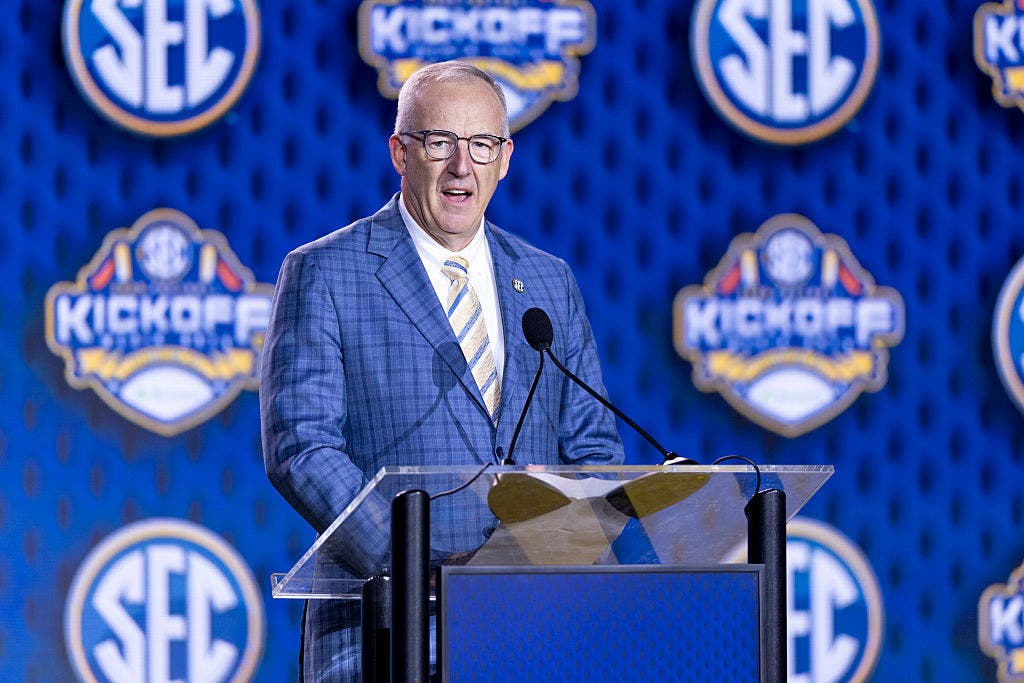
At SEC media days in July, league Commissioner Greg Sankey answered questions about the future of college sports regulation and even potentially breaking away from the NCAA. (Photo by Parker S. Freedman/Getty Images)
Stakeholders have fundamentally taken issue with the lack of actual enforcement of rules laid out in the House settlement and by the College Sports Commission and NCAA.
The solution, at least to some, is to take on more regulation at the conference-level and allow leagues to set their own rules around eligibility, revenue-sharing caps and other pieces to college sports’ ever-evolving jigsaw puzzle of a future structure.
But as eligibility lawsuits litter the news cycle, the SEC, in particular, is providing an early test case for how feasible regulating anything at the league level in this new era ultimately is.
And it’s a fight brewing on the bayou that has everyone paying attention.
“I can’t speak for the entirety,” one league source told me, “but I would say [the SEC’s] charge is to defend the rules that everyone voted on as members.”
 Where Else Could This Drama Play Out Than Baton Rouge?
There are certain places that are almost too good, too cliché, too Spielbergian to be the setting for the stories they tell. Louisiana, college sports and a good old-fashioned power struggle are certainly that.
These are complicated times in Baton Rouge; times wrought with regime changes and political interference — albeit that can often be the norm around these parts.
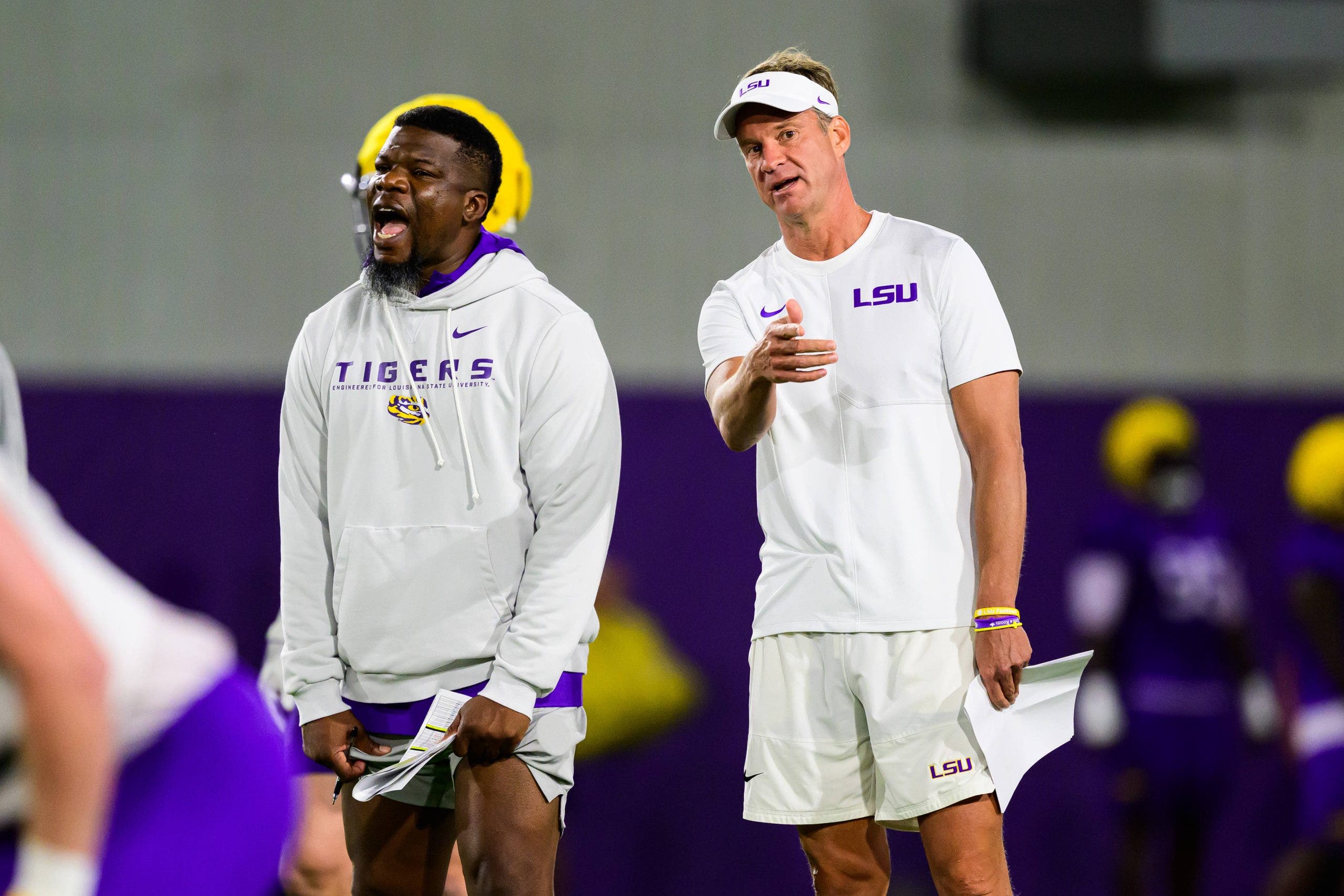
BATON ROUGE, LOUISIANA – MARCH 24: Head Coach Lane Kiffin and Associate Head Coach Kevin Smith of the LSU Tigers in action during spring practice at the LSU Football Operations Center on March 24, 2026 in Baton Rouge, Louisiana. (Photo by Gus Stark/LSU/University Images via Getty Images)
Gov. Jeff Landry was squarely involved in running off athletics director Scott Woodward and football coach Brian Kelly in October 2025. Then in March, Gov. Landry pushed to get men’s basketball coach Matt McMahon fired and to bring controversial castoff Will Wade back to town as McMahon’s successor.
There was also the live mascot debacle of 2024 — another Landry-driven agenda item intended to return a living, breathing tiger to the sidelines in Death Valley.
Even earlier this month, the governor’s residence played host to a meeting of LSU boosters to discuss a new-look equity approach to fundraising for the school’s athletic programs.
So, of course, it was in a Baton Rouge courtroom last week when a Louisiana state judge granted a handful of athletes an additional year of eligibility, including several players who had recently signed NFL contracts. To little surprise, two of those athletes — tight end Dae’Quan Wright and defensive lineman Zxavian Harris, formerly of the Cleveland Browns and New Orleans Saints, respectively — were expected to head to LSU and play for Lane Kiffin, their former head coach at Ole Miss.
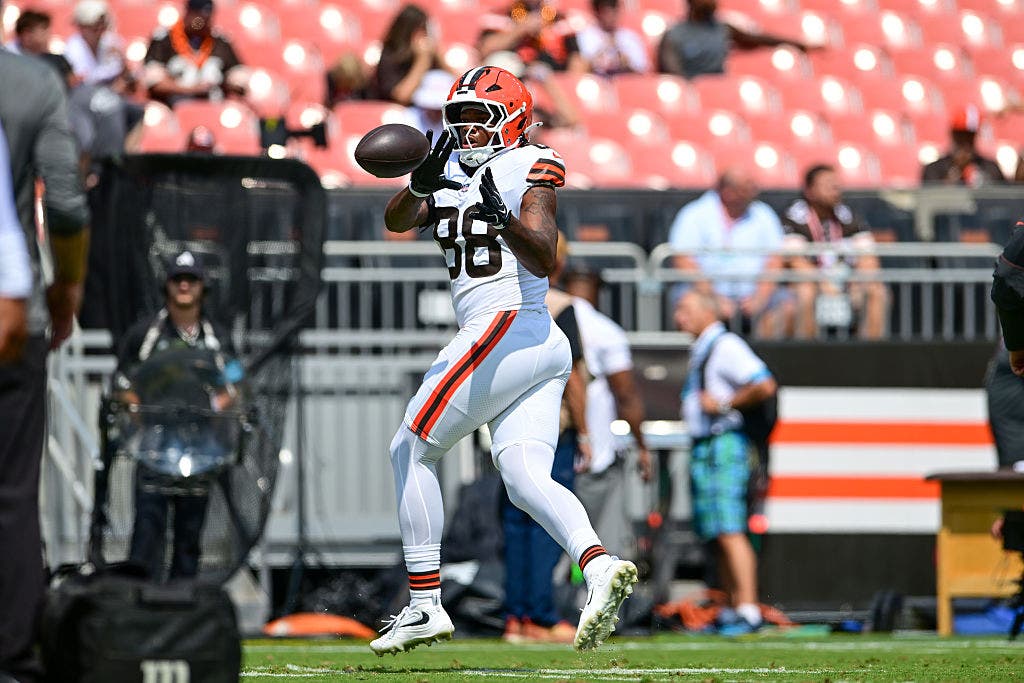
Dae’Quan Wright suited up for the Browns in a preseason game against the Buffalo Bills last week. Could he be returning to college football this fall? (Photo by Nick Cammett/Diamond Images via Getty Images)
These reprieves were matched in gravity and wide-ranging condemnation via a separate ruling from a different Louisiana judge on Tuesday that granted an additional year of eligibility to former All-American basketball player RJ Luis Jr. After starring for St. John’s, Luis went undrafted in the 2025 NBA Draft, signed a two-way contract with the Utah Jazz and played in three NBA preseason games.
“These athletes generated value under the prior framework and should not be denied the additional year the NCAA itself created for others,” attorney Darren Heitner, who represents Wright, told me. “Roster and portal management gets messy for schools, but that is a problem of the NCAA’s own making.”
Exiting the courtroom on Monday, a smile crested on Luis’ face in a moment captured by a local reporter. It was there in the lobby of this place of law and order that his past and future collided.
Adorning a purple polo and thrusting his arms wide, Wade, the Tigers’ second-term head coach, offered Luis a full embrace with a smirk to match.
No consternation here. LSU got its star.
“Because of these rulings, they’re either going to play for you or they’re going to play for someone else around the country,” Kiffin said at a press conference on Monday. “So we’ve made the decision to recruit [Harris and Wright] like probably most people are.”
That those in Baton Rouge are flashing smiles can’t be said for the rest of College Sports, Inc.
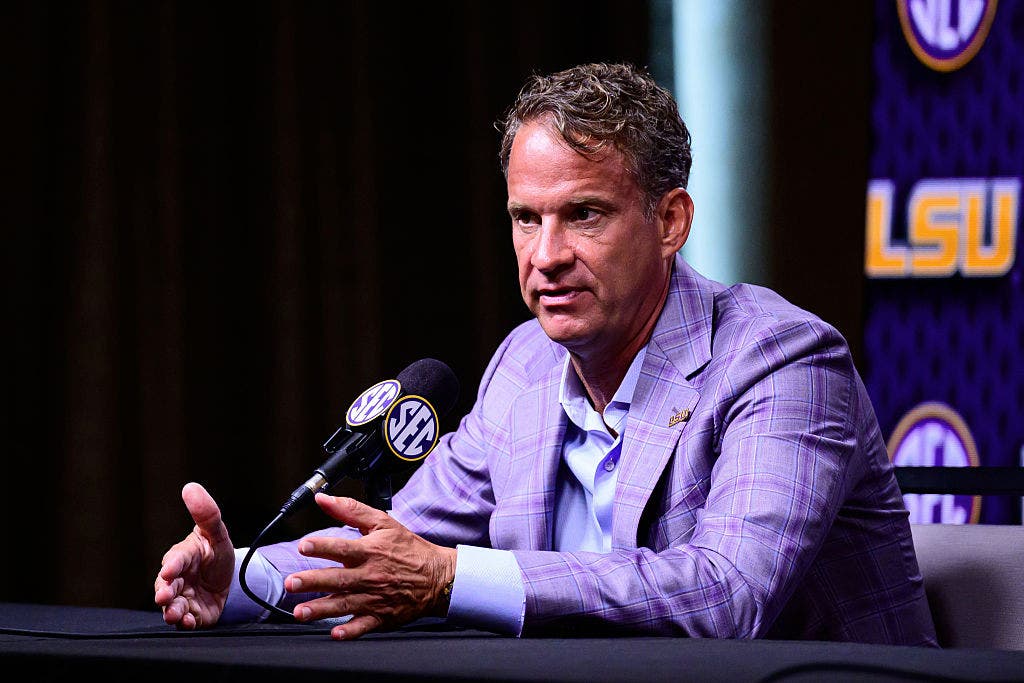
LSU coach Lane Kiffin argues that if he doesn’t recruit star players deemed eligible by the courts, they’ll wind up playing for someone else. (Photo by Gus Stark/LSU/University Images via Getty Images)
The Big Ten was the first league to pass a sweeping ban on professional athletes returning to college sports. The SEC, Big 12 and ACC have since followed suit, while conversations persist elsewhere across the FBS.
The SEC pulled together a call among its presidents and chancellors on Monday ahead of two days of pre-scheduled meetings between that group and the league’s athletics directors. It closed the evening by pushing out a statement condemning the situation.
“Fundamentally, everybody needs to move on,” a second Power Four source told me. “If you’re going to support and believe in NCAA rules, then you better start playing by them yourself.”
These are not new issues, of course.
It’s only six months past that Alabama basketball player Charles Bediako was brought back from professional basketball, granted an injunction and swiftly dismissed again. It was that action that prompted the usually buttoned-up and generally savvy Sankey to sign an affidavit supporting the NCAA against the Crimson Tide hooper.
That this saga is bubbling up on the banks of the mighty Mississippi River once more, however, isn’t so much about LSU or two football players or even the omnipresent college sports villains that are Kiffin and Wade. No, this is about grander aspirations and efforts to control an ecosystem that has proved to be ungovernable as it currently exists.
“We’ve got a simple choice to make: Do we want to be governed or not?,” Texas A&M athletics director Trev Alberts posited during SEC spring meetings in May. “We are sending a very strong message that college athletics refuses to be governed. That’s all I can say.”
 Is Regulation At The Conference Level Possible?
The Big Ten and SEC have been embroiled in conversations about how to best operate within an uncontrollable world for months.
Their hopes for order currently reside on Capitol Hill, where the Protect College Sports Act remains in limbo until the Senate returns from its recess on Sept. 14. That has its own challenges.
Where the buck stops in the lingering eligibility lawsuits ought to provide at least some clarity around leagues’ longer-term ambitions and whether regulation at the conference level is possible.
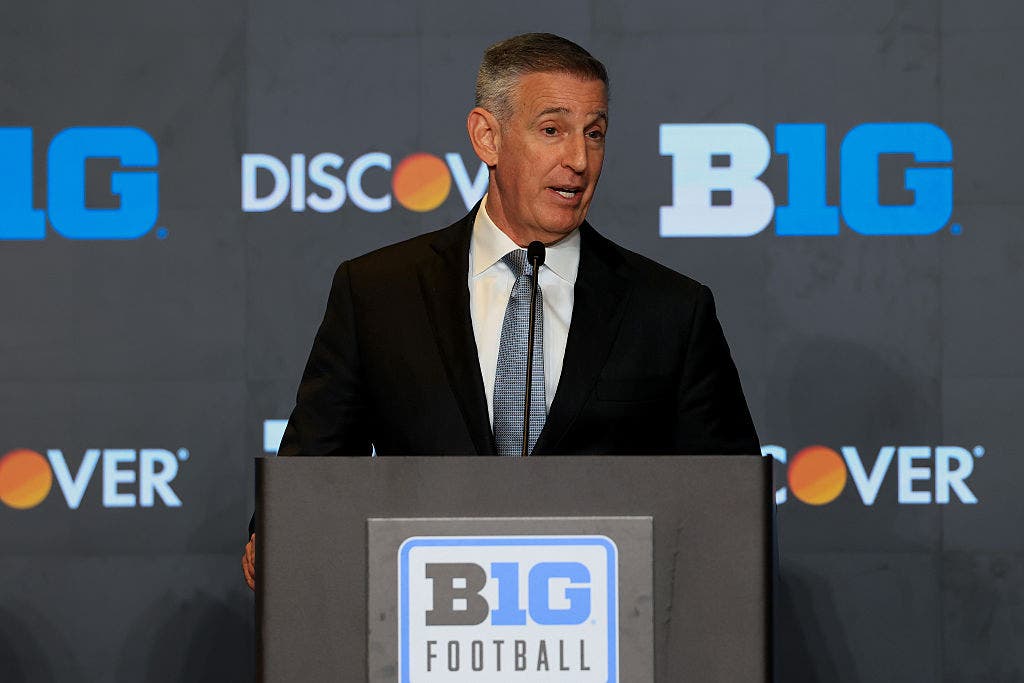
Big Ten Commissioner Tony Petitti, who recently signed an extension through 2033, isn’t talking breakaway, but he recognizes the need to create a set of rules to regulate the new college sports landscape. (Photo by Justin Casterline/Getty Images)
“‘Breakaway’ is a word that creates a lot of emotion,” Big Ten commissioner Tony Petitti said from the pulpit at his own football media days last month. “I’ve never heard that anybody doesn’t want to play anybody else. We want to schedule more good games that our fans expect.
“We’ve just got to get to a system that allows us to do that.”
Buried in the jargon of the SEC’s wider ban on professional athletes on Tuesday night was a note that Sankey is “authorized to enforce this expectation with penalties against member institutions.” A shot across the bow, perhaps.
The league’s bylaws include language that prevents players from transferring intra-conference outside the portal window. LSU’s additions of Wright and Harris would run directly counter to that edict. As would former Kentucky basketball player Mark Mitchell’s move to Missouri, which comes after he won his own eligibility lawsuit granting him an extra year two weeks ago.
The SEC itself has also now been thrust into the legal proceedings as attorneys amended their complaint in Louisiana state court on Thursday evening to include the league and Sankey.
So the standoff has started — and whether the SEC can actually enforce its own rules is where this story really begins.
Laissez les bons temps rouler. Let the good times roll.