At least the Canadiens got a point. And at least it wasn’t a must-win. Nevertheless, the Habs shouldn’t make excuses to forgive what was an incredibly unfortunate team performance over the visiting New York Islanders on Thursday, which saw them:
- Waste a two-goal, prove-a-point performance by Noah Dobson against his old team.
- Give up that two-goal lead… and then another one-goal lead late for good measure.
- Lose in overtime and then lose ground to the Detroit Red Wings and Boston Bruins.
As far as disasters go, the game admittedly could have been worse. However, even if you look at the glass as half-full, the lessons the Canadiens can take away from this performance have been recurring in nature this season. They just fail to learn from the same mistakes:
5. Relying on Sam Montembeault
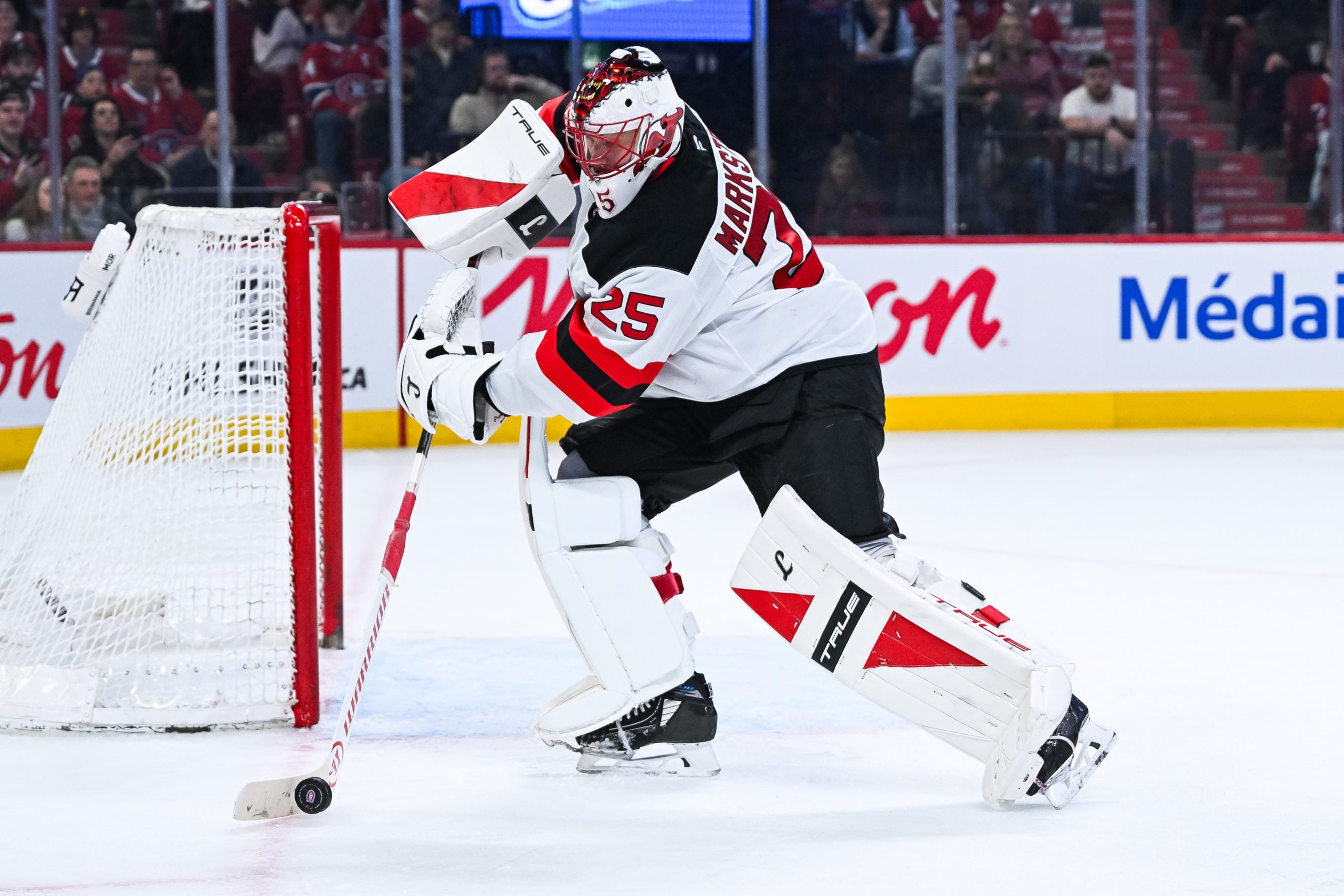
Even Canadiens hockey operations isn’t innocent here, as they continue to go back to goalie Sam Montembeault. He responded by allowing four goals on 26 shots… a mediocre showing, to be kind.
Now, Montembeault wasn’t exactly to blame for the loss to the Islanders. One goal came on a five-on-three man advantage. The next, just after the second penalty had expired. The third, as the Islanders were dominating possession in the offensive zone with an extra man and his counterpart, Ilya Sorokin, pulled. The game-winning goal came on a breakaway in overtime.
However, by the same token, Montembeault obviously didn’t play like a No. 1 goalie, which has been a recurring trend. He’s 10-8-3 (effectively below .500) with a 3.37 goals-against average (GAA) and .874 save percentage (SV%).
Montembeault may have had a good game right before the Olympic break, a 5-1 win over the Winnipeg Jets. However, Jakub Dobes had been better, leading the Canadiens to a 3-0-1 record immediately before that one victory. And that was after he had seemingly taken the reins from Montembeault following a heartbreaking 4-3 loss to the Boston Bruins on Nov. 24, in which the maligned goalie absolutely did share in the blame. Clearly, the Canadiens know better though, right?
Related: Canadiens’ Laine Represents a Low-Risk Trade Deadline Addition
You can understand the justification in the Canadiens’ minds. Following the 4 Nations Face-Off last season, Montembeault went 7-0-1 in his first eight games, with a .922 SV%. However, circumstances were drastically different, even though he didn’t play in that tournament either. He had been still been named to the Canadian team, albeit as a backup goalie. He played his way out of the discussion to be renamed to Team Canada at the Olympics this season, though.
In effect, Montembeault is not the same goalie he was last season. The Canadiens have had ample opportunity to recognize that. Yet they continue to go back to their weaker goalie. That’s an undeniable unforced error they keep making and will be forced to address (if they want a better chance at improving on last season’s five-game first-round finish).
4. Giving Up Leads
While Montembeault wasn’t the direct reason behind the loss to the Islanders, he did give up a late lead for the second straight time (against a playoff-calibre team; the Jets don’t count). And, obviously, at least in this specific case, that’s on the team as a whole.
The Canadiens do own something of an identity of a team that never quits. They do after all lead the league in comeback victories this season. However, it’s perhaps more accurate to say their identity is that of a team that plays a volatile brand of hockey. Of their now-26 losses (including in overtime/shootout), they’ve held the lead in 16 of them. In seven of those, they’ve held leads late in the third period (with less than 10 minutes to go).
There’s a definite debate to be had as to whether or not it’s better to hold a lead in an eventual loss or just lose from start to finish. At least in the former case, a team is in it and has a chance to win (only to obviously screw the pooch). What’s especially egregious here is that this has happened in their last three losses: to the Islanders, to the Minnesota Wild on Feb. 2 and to the Bruins on Jan. 24. A week and a half prior, on Jan. 13, they also did the same against the Washington Capitals. So, there is an undeniable trend at work, here.
3. Horrible Second Periods
The Canadiens’ inability to play a full 60 minutes reared its ugly head again against the Islanders. They started off slowly and ended on an even sourer note. It was the middle part that arguably cost them the most, though (as has become tradition this season).
The Canadiens’ list of poor second-period performances have been well-documented. Heading into the Olympic break, they had a -8 goal differential in the middle frame, which, for a team that has been playing on the whole as one of the 10 best in the entire league, sticks out like a sore thumb. You can make it -9 now, after they gave up two late goals to rookie Matthew Schaefer.
For additional context, the Canadiens played a great first (even taking into account the goal they allowed that thankfully got called back). They limited the Islanders to five shots on goal and entered the second with an admittedly precarious 1-0 lead. Dobson added to it with his second the game midway through the frame, which should have served as a stepping stone to greater dominance. Instead, of building on their early-game success though, they gave 12 shots overall, more than double what they did in Period 1.
Two obviously ended up in the back of the net.
2. Lack of Discipline
You can argue about the circumstances surrounding the Islanders’ comeback all you want. It still doesn’t take away from the fact the Canadiens have themselves to blame for being two men down in the first place, a costly five-on-three disadvantage that led to Schaefer’s two goals.
The Canadiens’ penalty differential is now -23, meaning they’ve taken 23 more penalties than they’ve drawn, which is the third-worst mark in the league. Certainly, there are extenuating circumstances that can’t be wholly explained by a simple lack of discipline, but no one can blame the referees here. The penalties they took to allow the Islanders to get back in it were fairly clear-cut.
Maybe Juraj Slafkovsky’s interference penalty on Tony DeAngelo, where he slashed the defenseman’s stick out of his hands, doesn’t get called if the latter has a tighter grip. However, Canadiens defenseman Mike Matheson’s high-sticking penalty on Mathew Barzal mere seconds into that penalty is something the referees have to call 100% of the time. And it certainly didn’t help that the Habs rely on Matheson to the degree they do on the penalty kill.
Why again?
1. Bad Penalty Killing
As was alluded to on Thursday night’s RDS broadcast, there are times Matheson stays out the length of a two-minute disadvantage. He leads the Canadiens in shorthanded (and overall) ice time with 4:15 per game playing on the penalty kill. That may be impressive, but the penalty kill isn’t. It’s a 26th-ranked 76.6% successful.

Now, it’s not all on Matheson, but you’d think the Canadiens would shake things up seeing as their formula for success leaning on him isn’t exactly working. Dating back to the team’s re-acquisition of Phillip Danault, the hope had been that the forward would help out with faceoffs and with defense, including on the penalty kill, as he plays the second-most amount of any Habs forward thereon (2:52, second to Jake Evans’ 3:05). In his 22 games with the team, the penalty kill has gone 54 for 72 opportunities (75%), which is obviously slightly worse.
It’s not all bad, though. There was a seven-game span soon after Danault joined the team during which they literally allowed one power-play goal in 24 opportunities. So, the Canadiens do have the capability to ice a capable penalty-killing unit. For whatever reason, in the 11 games since, it’s just fallen off a cliff, which makes it something the Canadiens must analyze. Otherwise, during the postseason, when things become tighter and killing off man disadvantages becomes more critical, this will come back to bite them.

Against the Islanders, the one official power-play goal against obviously wasn’t a back-breaker. The one they gave up soon thereafter, once the penalty had elapsed, could have been, but thankfully the Canadiens rebounded. However, it was for all intents and purposes a power-play goal on the part of the Isles, as was the late game-tying goal, with the extra man on, making it arguably the primary culprit for the defeat. However, all the above things, together?
The Canadiens are lucky to have gotten a point. Glass half-full and all.