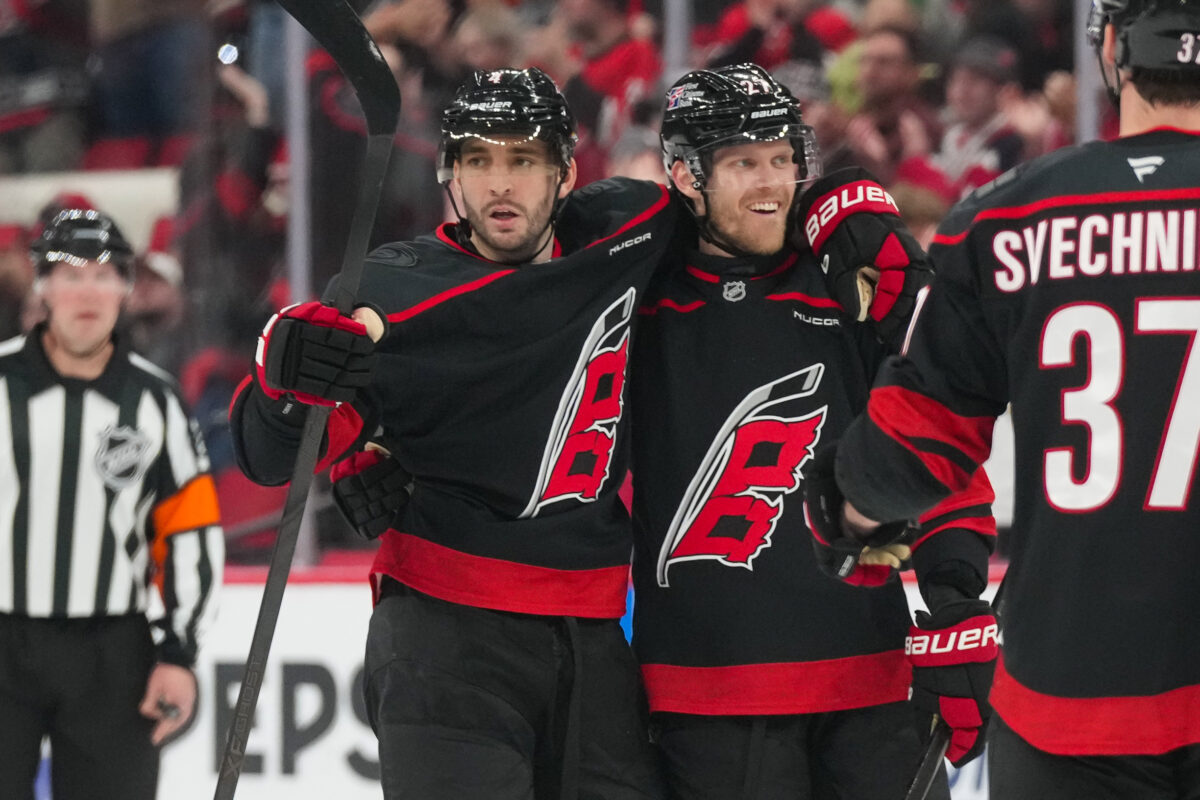
In an era when there is no guarantee of making the Stanley Cup Playoffs, the Carolina Hurricanes have remained competitive and are on their way to making their eighth straight postseason appearance. Before Rod Brind’Amour stepped behind the bench, the Hurricanes missed the playoffs for a decade.
Since 2018-19, the franchise has always been in playoff contention. They have been helped by management’s draft wizardry, finding hidden gems in later rounds to play alongside their first-round stars. Development, culture and identity have been priorities each season.
Also, age and contract management have helped keep the Hurricanes’ window open, and it’s not closing anytime soon. How did the Hurricanes manage to become one of the top-tier playoff contenders over the last eight seasons?
Hurricanes Sign Reasonable Contracts & Find Age Balance
No Hurricane is making $10 million or more per season. Unlike the Toronto Maple Leafs or other franchises with a few players taking up the bulk of their cap space, Carolina has managed to maintain roster depth while adding talent across the board. Sebastian Aho makes $9.75 million per season, the most on the team. Jaccob Slavin, the best defensive defenseman in the NHL, could be making close to $10 million per season, but he’s being paid $6.396 million per season, with deferrals.
Related: Hurricanes’ Andrei Svechnikov Is Back as Their Dynamic Power Forward
Solid roster management of the core, veterans and young players has given the team flexibility to stay in contention while bringing in talent every offseason. Carolina has signed contracts at a fair price and hasn’t been stuck with bad deals that eat up cap space.
Here are the team’s contracts for players 27 or older:
| Player | Annual Average Value (AAV) | Years Remaining |
| Sebastian Aho | $9.75M | 6 (2032) |
| Nikolaj Ehlers | $8.5M | 5 (2031) |
| Taylor Hall | $3.166M | 2 (2028) |
| Jordan Martinook | $3.05M | 1 (2027) |
| Jordan Staal | $2.9M | 1 (2027) |
| William Carrier | $2M | 4 (2030) |
| Nic Delauriers | $1.75M | 0 (UFA on July 1) |
| Eric Robinson | $1.7M | 3 (2029) |
| Mark Jankowski | $800,000 | 0 (UFA on July 1) |
| Jaccob Slavin | $6.396M | 7 (2033) |
| Sean Walker | $3.6M | 3 (2029) |
| Shayne Gostisbehere | $3.2M | 1 (2027) |
| Jalen Chatfield | $3M | 1 (2027) |
| Mike Reilly | $1.1M | 0 (UFA on July 1) |
| Frederik Andersen | $2.75M | 0 (UFA on July 1) |
| Brandon Bussi | $1.9M (starts in 2026-27) | 3 (2029) |
Players over 30 have contracts that offer the team flexibility to acquire talent to fill holes, especially with the cap going up over the next two seasons. Only two players aged 30 or older have contracts longer than four years, Ehlers and Slavin, and both are still major contributors to the Hurricanes. At 31, even William Carrier’s $2 million AAV won’t break the bank, even with four more years on his deal.
General manager Eric Tulsky, along with former GM Don Waddell, has managed to keep contracts reasonable to ensure the roster is balanced. The Hurricanes have the seventh most available cap space at $8,443,643. That’s before the cap goes from $95.5 million this season to over $104 million the next two seasons.

If that isn’t impressive enough, most Hurricanes 26 or younger are signed to reasonable contracts and team-friendly deals. The team’s future core, Logan Stankoven, Jackson Blake, and Seth Jarvis, has some high-end potential and contracts that are below market value.
| Player | Annual Average Value (AAV) | Years Remaining |
| Andrei Svechnikov | $7.75M | 3 (2029) |
| Seth Jarvis | $7.42M | 6 (2032) |
| Jesperi Kotkaniemi | $4.82M | 4 (2030) |
| Jackson Blake | $5.117M (starts in 2026-27) | 8 (2034) |
| Logan Stankoven | $6M (starts in 2026-27) | 8 (2034) |
| K’Andre Miller | $7.5M | 7 (2033) |
| Alexander Nikishin | $925,000 | 0 (RFA on July 1) |
| Pyotr Kochetkov | $2M | 1 (2027) |
Management signed their young players at the right time, before their AAVs would rise after a successful season. Blake is on pace for a career sophomore campaign and could reach 25 goals and 55 points. He will be making less than $5.2 million per season starting in 2026-27. Jarvis, despite missing time due to injury, could set career highs again this season, and he is making less than $8 million. Stankoven is emerging as a solid second-line center and will be making way below market value for the next eight seasons starting in 2026-27.
Tulsky and the front office have managed to read their players’ potential, know when they’ll improve, and sign them before they become too expensive for the roster. Even after reaching the Eastern Conference Final in two of the last three seasons and three times over the last seven seasons, the Hurricanes should be able to keep their contention window open for the next decade.
Related: Hurricanes’ Young Guns Taking Games to Another Level
The Detroit Red Wings clinched a playoff berth for over two decades from 1991 until 2016. With the way their roster is constructed, the Hurricanes could be the next team to reach that milestone. When there is arguably one not-so-great contact on a roster with a strong balance of veterans and young players, the Hurricanes are set to remain playoff contenders for the foreseeable future.
The reason Carolina is so successful is that they have the perfect formula for remaining competitive without handcuffing the team financially and keeping the right mix of veterans and young players who are still developing to avoid any need for a retool or a rebuild.