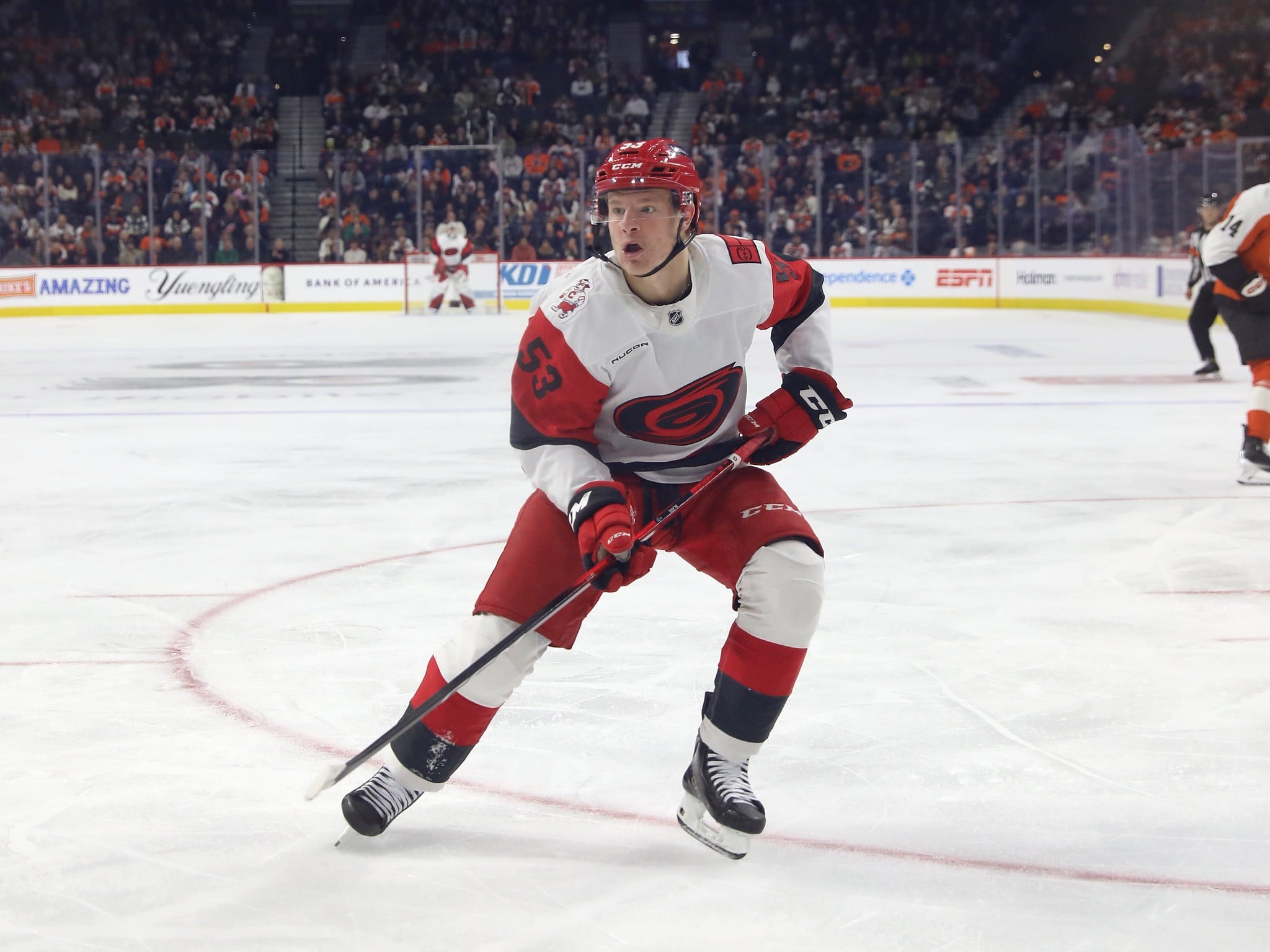
A lot of people were upset when the Carolina Hurricanes only made a minor move at the 2026 Trade Deadline. A known issue in the second-line center slot was something many fans wanted addressed, but general manager Eric Tulsky and the Carolina Hurricanes front office decided that maintaining the status quo amidst the extreme trade costs was the correct course of action. There wasn’t a deal that made sense for Carolina so that second line of Logan Stankoven, Jackson Blake, and Taylor Hall will continue to go as a unit as the Hurricanes begin preparations for the postseason.
In the past, the Hurricanes have been top-heavy in the playoffs and the top line usually carries the load. Carolina’s bottom six is unique in that it’s not built to score; it’s built to stop scoring at both ends. Jordan Staal has held the shutdown role in Carolina since head coach Rod Brind’Amour took over and the Hurricanes broke through their glass ceiling in 2018-19. That means there is an increased pressure to perform on Carolina’s second line, especially in the playoffs. How does it stack up to the other second lines the Hurricanes have had, and the other second lines of Stanley Cup Contenders?
Hurricanes Second Line
Let’s start with the Hurricanes’ second line. According to MoneyPuck, the Hurricanes’ trio of Hall, Stankoven, and Blake is eighth in the NHL for expected goals for per 60 (xGF/60) for any line that has played at least 200 minutes together. Carolina’s top line is 13th, and a slight alteration to the second line, with Nikolaj Ehlers instead of Hall, is behind them in 14th. That’s a good sign for the Hurricanes’ depth: the level of scoring is where they want it to be. Well, hockey isn’t played in expected goals. What about their actual goals for per 60 (GF/60)? Well, they’re also 14th there with 3.79. They score a lot together, which is a good sign.
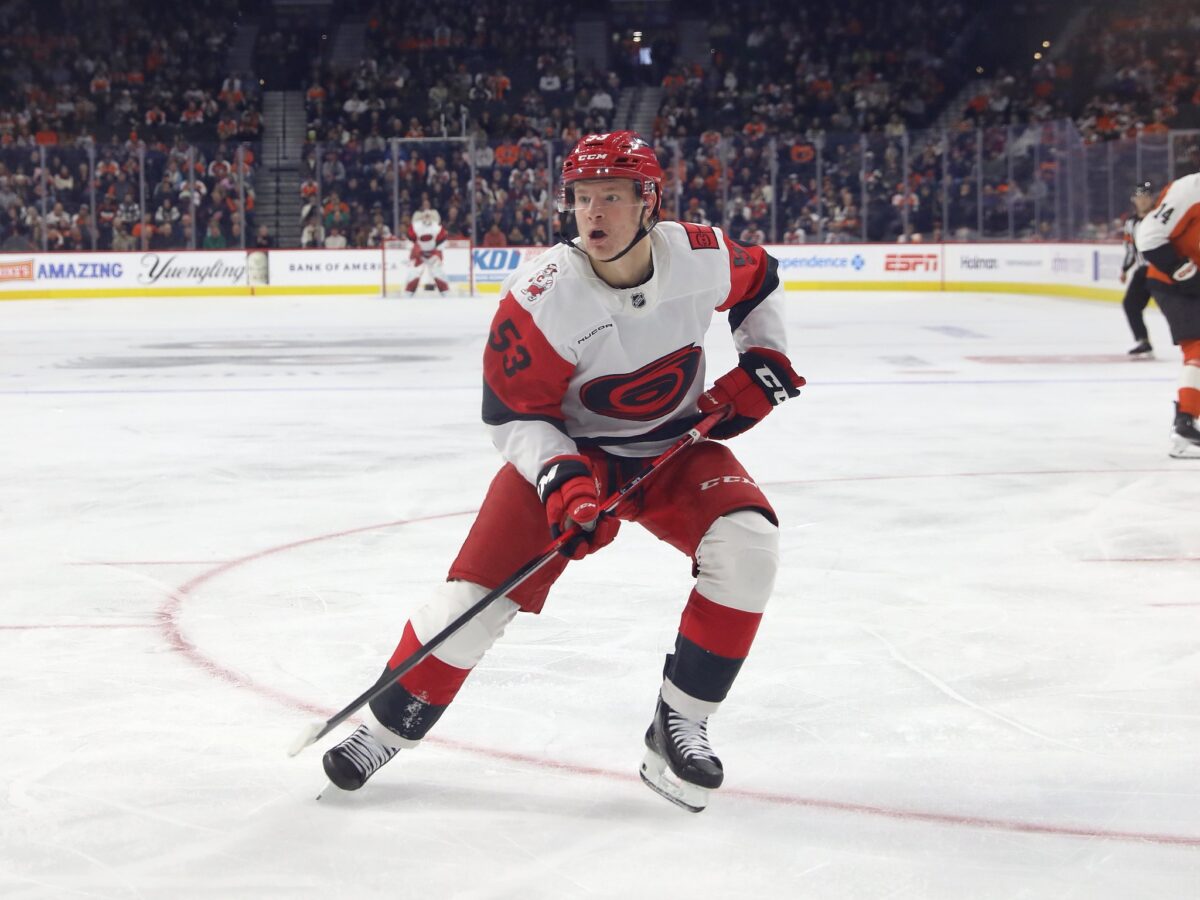
Can that trio hold their own defensively? Its goals against per 60 (GA/60) is 2.31, 28th among the 50 lines with 200 minutes together. It’s not ideal, but the other iteration of this line with Ehlers instead of Hall is the second-best defensive line among the bunch in GA/60. In the expected goals against per 60 (xGA/60), Hall, Blake, and Stankoven are 32nd. That’s a concern. They’re outscoring their problems right now, but there is still a lot of growth needed in the defensive zone.
In terms of goal percentage, the trio with Ehlers sits 11th with 66.7% of the on-ice scoring together, while the Hall trio sit 20th, just below the Hurricanes’ top line with 62.2% of the goals when they’re on the ice together. In terms of the expected goals percentages, Carolina’s current second line sits 20th, while the other version with Ehlers again sits fourth. It’s a good sign that they can dominate play, but they still need to improve defensively.
Let’s just focus on the two that will definitely be there. Blake and Stankoven have spent 683 minutes together at 5-on-5 and have been a staple of the Hurricanes’ top six this season. They score 3.07 GF/60 and allow just 1.84 against per 60 minutes at 5-on-5, per Natural Stat Trick. The duo has an xGF/60 of 3.41 and an xGA/60 of 2.49; still a little shaky defensively, but they’re generating more than they give up. They have a GF% of 62.50 and an xGF% of 57.79. Analytically, they’re performing very well. There is a reason Carolina’s brain trust likes that second line.
Hurricanes’ Previous Second Lines
I mentioned that the Hurricanes have had scoring issues in the playoffs due to their depth. Last postseason, the Hurricanes’ top line had five goals, while no other trio had more than two. Hall and Stankoven, with Jack Roslovic, were the only non-Aho or Staal line to play at least 40 minutes together that postseason, and they had just one goal together. They only had 1.7 expected goals, so it’s not like they were underperforming, but that Hurricanes roster wasn’t the same as this one. That team got as far as it did through willpower after everything it lost, so let’s go back before that.
In 2023-24, only one line didn’t have Staal or Aho on it and played 40 minutes: Jack Drury with Jordan Martinook and Martin Necas. They registered 2.9 expected goals and four actual goals as a trio. That was probably the best line the Hurricanes had in a disappointing second-round exit to the New York Rangers. That line had a good postseason, but other issues emerged that led to the Hurricanes’ downfall.
Related: Hurricanes’ Young Guns Taking Games to Another Level
In 2022-23, two lines had at least 40 minutes together, one of which was Paul Stastny in his retirement tour with Derek Stepan and Jesse Puljujarvi. I think it’s fair to call that the fourth line, so the other line was Martinook with Jesperi Kotkaniemi and Jesper Fast. They had 6.3 expected goals and seven actual goals as a trio, so they worked quite well. However, they struggled in the third round against the Florida Panthers — stop me if you’ve heard that before — and were swept in the Eastern Conference Final.
Since they cemented themselves as contenders, the Hurricanes’ second line has continued to fade. Now, an injection of young blood is what the Hurricanes hope will reverse the decline. They need more depth scoring to compete against the best teams at the highest level. When the stakes are greatest, other teams step up. How do the Hurricanes compare to the lines of past champions?
Past Champions Comparison
Last season, the Panthers’ had two lines that could beat teams in addition to the top line. The Brad Marchand, Eetu Loustarainen, and Anton Lundell line was technically their third line, but had an 8.9 expected goals and 13 actual goals. Their actual second line of Matthew Tkachuk, Sam Bennett, and Evan Rodrigues had three goals, but an expected goals of 5.1. They dominated games.
In 2022-23, the Vegas Golden Knights had Brett Howden with Chandler Stephenson and Mark Stone. They had a 7.8 expected goals and 13 actual goals together. They were one of the reasons Vegas reached the Stanley Cup Final. Vegas’ depth scoring was not as impressive as Florida’s, but it still highlights the need to have players that are difficult to shut down even if they are not as productive as you’d like them to be.
The Hurricanes need to find a way to produce that level of scoring in the toughest games. When the playoffs roll around, their offence has failed to produce, and if they are going to change their role as the gatekeepers of the Eastern Conference, they must find a way to have their depth contribute at a higher level. Is keeping their current second line together the right decision? We’ll have to wait and see.