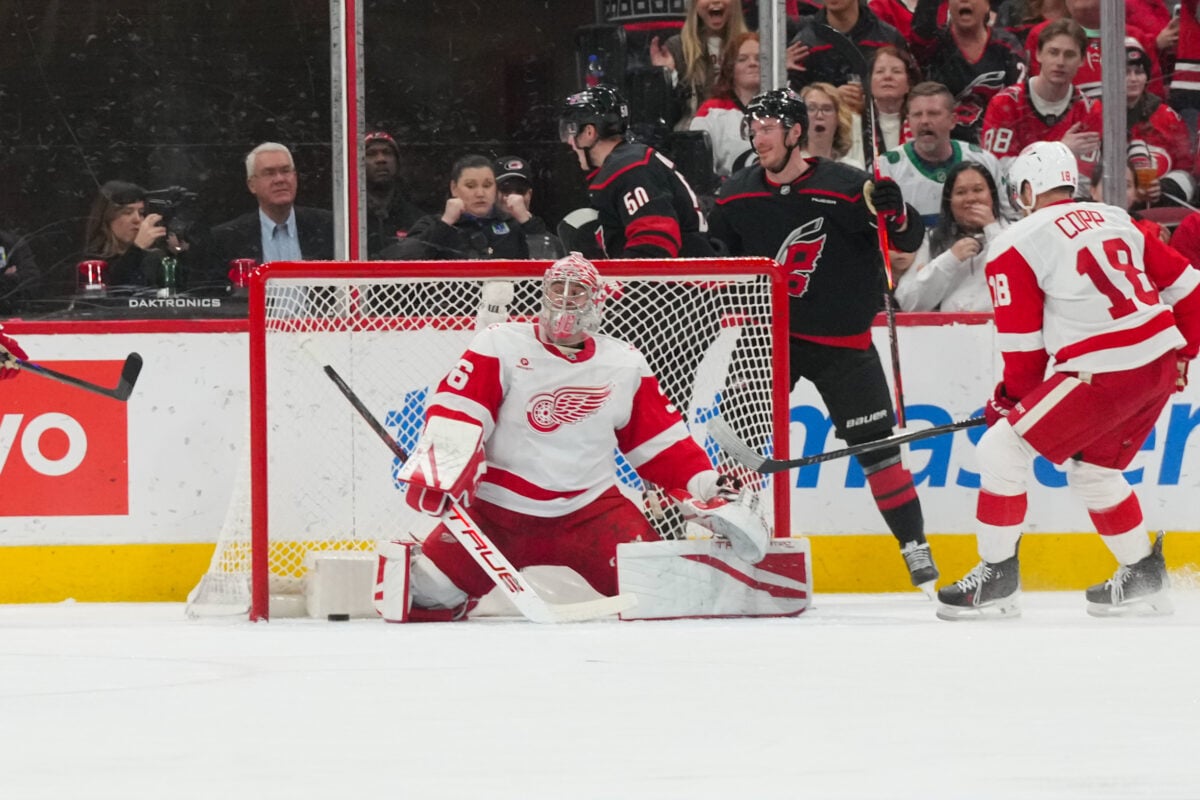
Regardless of how the rest of the season plays out, the Detroit Red Wings are in for change this offseason. They simply should not be in the position they are in, and only have themselves to blame for their current predicament.
At one point, the Red Wings sat atop the Atlantic Division and were pushing for the top spot in the Eastern Conference. That was in late January. February featured only four games, making the timing of what followed even more jarring.
What came next wasn’t just a slump – it was a collapse. And after years of late-season fadeouts, this one should finally force the organization to re-evaluate everything: personnel, coaching, and how decisions are made at the top. The status quo isn’t working.
Offense & Execution Are the Root Problems
Heading into the Olympic break, the Red Wings averaged just 2.11 goals per 60 minutes at five-on-five, ranking 27th in the NHL.
That number never passed the eye test, and it was quietly masked by two things: an elite power play and strong goaltending. Detroit was winning games, but not in a way that felt sustainable.

After the Olympic break, the cracks widened into fractures. The power play cooled off. Goaltending regressed to the mean. And suddenly, the lack of five-on-five offense became impossible to ignore. When Dylan Larkin went down, the problem only intensified.
Simply put, you cannot score at that level at five-on-five and expect to survive a playoff race.
To their credit, Alex DeBrincat and Patrick Kane elevated their play in Larkin’s absence. But that only underscored the larger issue: Detroit’s depth failed them at the exact moment it was needed most.
Related: Red Wings Must Answer the Patrick Kane Question This Offseason
And that brings us to the more concerning problem: this isn’t just about scoring. Detroit’s lack of compete, inconsistent execution, and inability to handle adversity are just as damaging – and arguably more telling.
Motivation, compete level, and execution are tightly connected. When one slips, the others tend to follow. And, right now, the relationship is out of sync. There’s a clear disconnect between what’s being asked of the players and what’s showing up on the ice.
“[Eighteen] seconds in, we win a draw and we’re getting scored on because we—what word do I use?—lollygag around and don’t advance the puck,” Todd McLellan noted to reporters about Minnesota’s first second period goal in Sunday’s 5-4 loss. “So now it’s in our net, and our team right now, as soon as it doesn’t go our way, we crumble for a while, and then we pick ourselves up off the mat, but it’s too late, and we did it again today.”
That’s not a systems issue – that’s a mindset issue. And that’s a damning comment to make 77 games into a season.
A tough couple of months for the @DetroitRedWings has them on the verge of falling completely out of the #StanleyCup Playoffs picture. @KevinWeekes and @EJHradek_NHL break down the situation in Detroit.
📺: #NHLTNFirstShift weekdays at 4p ET on NHL Network pic.twitter.com/Z5dovDT911
— NHL Media (@NHLMedia) April 6, 2026
Good teams absorb pressure and push back. Playoff teams stay structured when things go sideways. The Red Wings don’t have these traits. They sag after mistakes, lose focus in critical moments, and take too long to recover.
At this point in the season, games should resemble playoff hockey: tight, detailed, urgent. That’s how Detroit’s playoff competition is playing. The Red Wings are not playing that way, though.
Final Word
Between a paltry five-on-five offense, poor focus and execution in critical moments, and a continued inability to respond to adversity, the Red Wings are not built to succeed in high-pressure hockey. That’s the reality the organization has to confront this offseason.
This isn’t about just sneaking into the playoffs anymore – it’s about building a team that can actually compete once it gets there. If that’s the goal, then meaningful change isn’t just likely this offseason. It’s necessary.
Data courtesy of Natural Stat Trick.