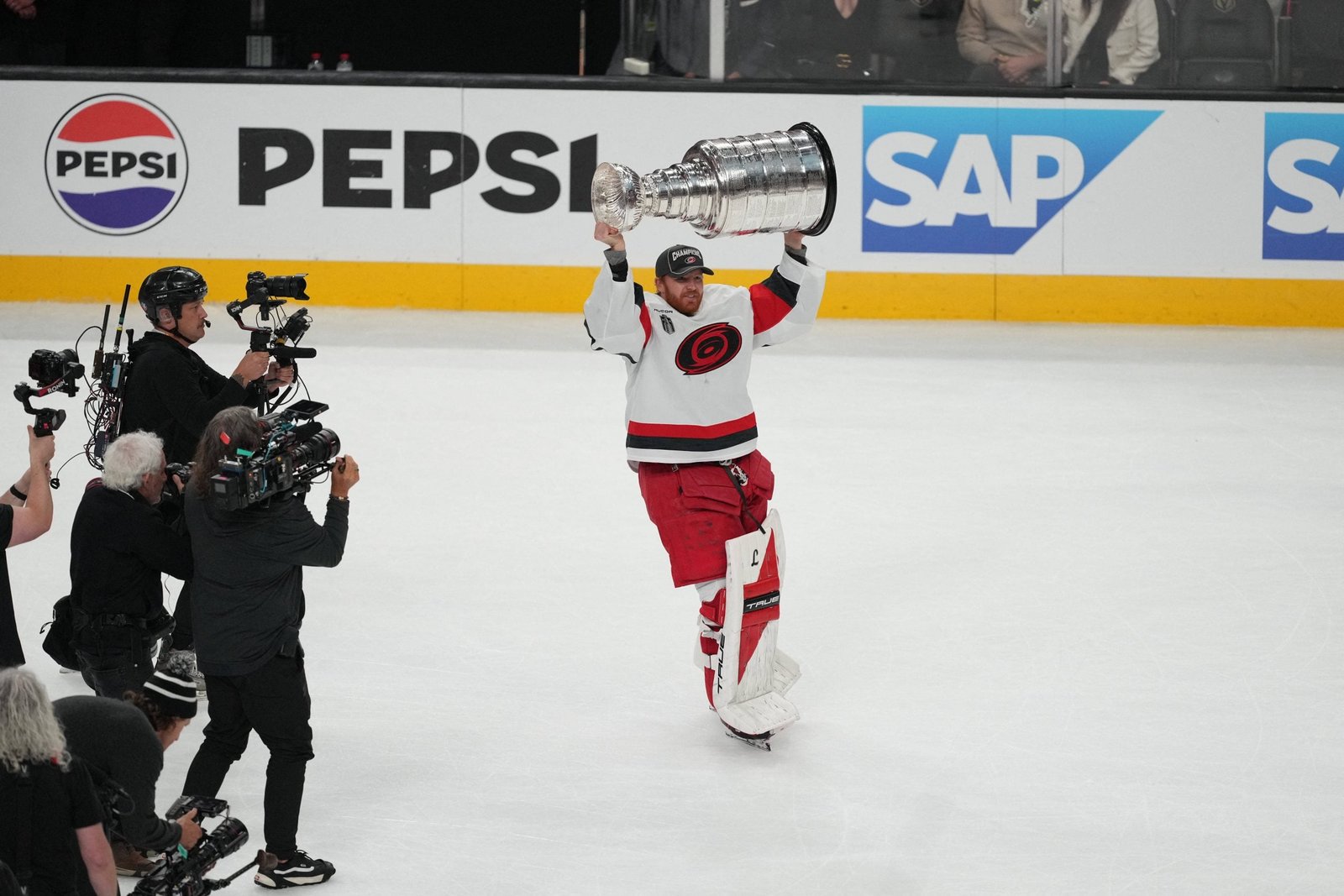
Frederik Andersen has already lived through one version of life as Mike Babcock’s starting goaltender. It involved 66 starts in consecutive seasons, public pressure in Toronto, and enough trust for Babcock to travel to Denmark to meet Andersen’s family after a playoff elimination.
The Edmonton Oilers are not asking the 36-year-old to recreate that workload in 2026-27. Andersen has acknowledged that those days are behind him, and Edmonton enters training camp expecting some form of rotation between him, Tristan Jarry, and Devon Levi. The history between Andersen and Babcock still gives the newest Oilers goaltender something neither competitor possesses: a coach who already knows how he responds when his game slips, how much responsibility he can handle, and what type of communication works with him.
That familiarity should not guarantee Andersen the opening-night start or make him Edmonton’s automatic number one. It could, however, matter in a crease where Babcock must establish trust quickly and where none of the three goaltenders arrives with an undisputed claim to the job.
Babcock Stuck With Andersen Through a Brutal Toronto Start
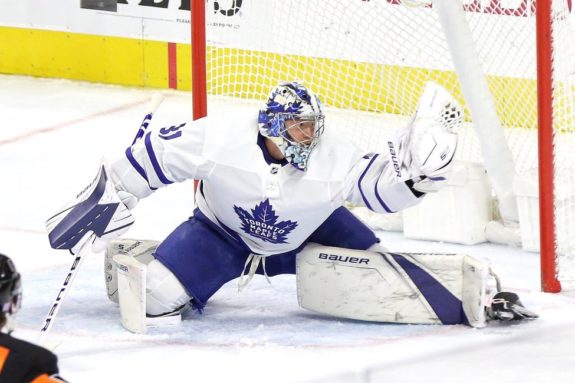
Babcock’s trust in Andersen was tested almost immediately after the Toronto Maple Leafs acquired the Danish goaltender from the Anaheim Ducks in 2016.
Andersen allowed 22 goals through his first five starts, including seven on 24 shots against the Tampa Bay Lightning. The adjustment to Toronto was ugly enough that Sportsnet described it as the worst start of his NHL career, while Andersen admitted he did not feel comfortable in his new surroundings.
Babcock’s response is relevant nearly 10 years later because he did not immediately reduce Andersen’s role. After the seven-goal loss, Babcock called him “my guy” and explained that leaving him in the game gave Andersen a chance to battle through the adversity rather than escape it from the bench.
The patience paid off. Andersen recovered to finish 2016-17 with a 33-16-14 record, 2.67 goals-against average (GAA), .918 save percentage (SV%) and four shutouts while helping a young Toronto team reach the playoffs. He started 66 games that season and another 66 in 2017-18, when he established a career high with 38 victories.
Those seasons offer useful context for Edmonton because Andersen is arriving after another year containing dramatic swings. He struggled during the 2025-26 regular season with the Carolina Hurricanes before rediscovering his game after the Olympic break, then went 13-2 with a 1.89 GAA and .910 SV% during the Carolina Hurricanes’ Stanley Cup run.
Babcock has already seen Andersen move through difficult stretches without permanently losing his game. That history could make him more willing to stay patient if Andersen has an uneven week in Edmonton rather than treating every poor start as another reason to rearrange the rotation.
Andersen and Babcock Built Trust Beyond the Crease
Their Toronto relationship eventually moved beyond simply filling out a lineup card.
Following the Maple Leafs’ 2018 first-round playoff loss to the Boston Bruins, Babcock traveled to Herning, Denmark, and visited Andersen at his childhood home. Andersen’s parents joined the conversation, and the meeting included a discussion about areas in which the goaltender could continue improving despite having just finished fourth in Vezina Trophy voting.
Andersen later described the visit as unusual for an NHL player-coach relationship because the two normally did not interact much away from the rink. Babcock said he was impressed by Andersen’s commitment and wanted him to become more of a leader through his conditioning, practice habits, and mental approach.
That history makes their Edmonton reunion more interesting than a coach simply being reunited with a former player.
Andersen told NHL.com after signing with Edmonton that his previous experience with Babcock had been positive. He specifically pointed to Babcock’s tactical ability and said the coach largely allowed his goaltenders to work with the goalie coach without unnecessary interference.
For a veteran entering a complicated three-goalie competition, that established understanding could be valuable. Andersen does not need to learn how Babcock handles difficult stretches or wonder what the coach expects from him between starts, while Babcock does not need an entire training camp to learn Andersen’s personality.
Edmonton Cannot Recreate Andersen’s 66-Start Seasons
The obvious difference is workload.
Babcock once treated Andersen like an unquestioned workhorse. The goaltender started 132 regular-season games across his first two seasons in Toronto, facing more shots than any other NHL goalie during that stretch.
That version of Andersen no longer exists, and he is not pretending otherwise.
The Oilers’ own Andersen feature noted that he believes the era of carrying those extended workloads is over. He played 35 regular-season games for Carolina last season, and Edmonton expects him to share the crease with Jarry and Levi rather than chase anything resembling 60 starts.
That makes Babcock’s challenge almost the reverse of what it was in Toronto. He once needed to determine how much Andersen could handle as an unquestioned starter. Now he must determine how to extract Andersen’s best hockey without asking too much from an older goaltender.
The veteran has already embraced that reality. Andersen said he is comfortable being part of a rotation and believes Edmonton can benefit from keeping all three goaltenders fresh over the NHL’s new 84-game schedule.
The Oilers’ recent camp battle outlined how difficult establishing the initial hierarchy could become. Jarry carries the largest cap hit and needs to rebound from a disastrous finish, while Levi was acquired because Edmonton believes his American Hockey League (AHL) development has prepared him for greater NHL responsibility.
Andersen does not need Babcock to treat him like the 27-year-old he coached in Toronto. He needs the coach to remember what allowed that younger version to succeed while understanding how dramatically the assignment has changed.
Babcock’s Familiarity Could Give Andersen the Early Edge
Andersen still has to outperform his competition. His history with Babcock should not become a substitute for current results, especially with Edmonton trying to solve a position that helped undermine last season.
Jarry therefore enters camp trying to rebuild trust rather than defending an established position. Levi presents the opposite case as the youngest goalie and the one with the greatest long-term upside, but his NHL résumé remains much shorter than those of Andersen or Jarry.
That uncertainty is where familiarity could become significant.
Babcock has coached Andersen through a bad start, two 66-game seasons, and playoff pressure in Toronto. He knows what the goalie looks like when he is struggling and when he is confident. He has also seen Andersen respond to direct criticism and heavy expectations without allowing one rough stretch to define an entire season.
There is no comparable history with Jarry or Levi. That could make Andersen the easiest option for Babcock to trust early, particularly if preseason performances are relatively even. Coaches often lean toward information they already possess when making close decisions, and Babcock possesses years of it with Andersen.
Edmonton’s goalie gamble remains too uncertain for any relationship to settle the competition by itself. Jarry could rediscover his Pittsburgh form, Levi could force his way into a larger role, and Andersen’s age or health could prevent him from becoming anything more than a complementary veteran.
The advantage is familiarity, not immunity.
Andersen Reunion Gives Babcock a Head Start
The most interesting part of the Babcock-Andersen reunion is that neither needs the relationship to resemble what it once was.
Toronto needed Andersen to start almost every important game. Edmonton needs him to provide quality starts, championship experience, and stability within a rotation that could change throughout the season.
Babcock already understands the player behind the numbers. Andersen already understands the coach making the decisions. That removes one layer of uncertainty from a goaltending situation filled with it.
Their history suggests Babcock will not panic after one bad Andersen start, but it also suggests he will expect preparation, conditioning and mental resilience from a goalie he challenged to improve in those areas years ago.
Almost a decade after back-to-back 66-start seasons made Andersen one of the NHL’s busiest goaltenders, the reunion is built around a very different question. Babcock no longer needs to decide whether Andersen can carry the crease by himself; he needs to determine how much of the crease Andersen should carry at all.
In a three-goalie battle without an obvious favourite, knowing the answer better than anyone else could give Babcock and Andersen an important head start.
Free Newsletter
Get Edmonton Oilers coverage delivered to your inbox
In-depth analysis, breaking news, and insider takes – free.
Subscribe Free →