The Edmonton Oilers have spent the offseason reshaping their roster, but one unusual addition remains before the 2026-27 season begins.
Under the NHL’s new collective bargaining agreement (CBA), every team must employ a full-time emergency backup goaltender, commonly called an EBUG. Unlike the local amateurs previously assigned to each arena, the new EBUG will travel and practice with one specific club while remaining available for home and road games.
An OilersNation report on Edmonton’s EBUG search stated that the team is believed to have selected a local candidate, although the Oilers have not announced the appointment. If that report is accurate, Edmonton may have already completed its final unconventional offseason signing behind the scenes.
This will not be another salary-cap transaction or a fourth NHL goaltender competing for a roster spot. The EBUG will be a team employee approved by the league and used only when both dressed goaltenders become unavailable.
The chances of that person entering a game are extremely small. The new arrangement can still provide the Oilers with a useful practice goaltender, another resource for their coaching staff, and additional support throughout an expanded 84-game schedule.
New CBA Replaces the NHL’s Local EBUG System
The NHL’s previous system required the home team to have an emergency goaltender available for both clubs.
That arrangement produced some of the league’s most unusual stories. Accountant Scott Foster stopped all seven shots he faced for the Chicago Blackhawks in 2018, while Toronto-area arena operator David Ayres helped the Carolina Hurricanes defeat the Maple Leafs in 2020.
The position was unpredictable by design. The designated goaltender normally watched from the stands and expected to leave without appearing on the bench, much less entering the game.
That changes in 2026-27.
An official NHL explanation of the new CBA states that EBUGs will become team employees who are approved by the league and present for both home and road games. They can also participate in practices and morning skates, creating responsibilities that extend far beyond waiting for an unlikely emergency.
The new system sacrifices some of the charm surrounding a local amateur unexpectedly receiving an NHL opportunity. It should create greater reliability for teams.
Instead of depending on whichever qualified goaltender is available in the home city, the Edmonton Oilers will have someone who understands their practice structure, equipment procedures, travel schedule and organizational expectations.
That familiarity could become more valuable than the emergency aspect of the job.
EBUG Eligibility Rules Limit Oilers’ Options
Edmonton cannot simply hire a recently retired NHL goaltender to give itself an experienced third option.
The CBA contains several restrictions intended to prevent teams from using the position to store legitimate professional players outside their active rosters.
According to PuckPedia’s breakdown of the EBUG policy, an emergency goaltender cannot have played an NHL game under a standard player contract, appeared in more than 80 professional games or played professional hockey during the previous three seasons.
The candidate also cannot have another contractual obligation preventing him from serving the Oilers or appear on an NHL team’s reserve or restricted free-agent list.
Those restrictions remove most recently retired professional goaltenders and current prospects from consideration. Edmonton cannot assign the role to someone from the Bakersfield Condors or use it as another stage of prospect development.
The ideal candidate instead sits between amateur and professional hockey.
Edmonton should target someone with substantial junior, college, or university experience who has remained active enough to handle NHL practices. The goaltender must be comfortable facing shots from some of the world’s best players without possessing enough recent professional experience to violate the eligibility rules.
That is a narrow profile.
Finding someone capable of performing the job is only the first step. The Oilers also need a candidate willing to accept the travel demands and irregular workload attached to the role.
Oilers Should Prioritize Practice Value
The emergency portion of the EBUG role will receive the most attention, but practice availability should influence Edmonton’s decision more heavily.
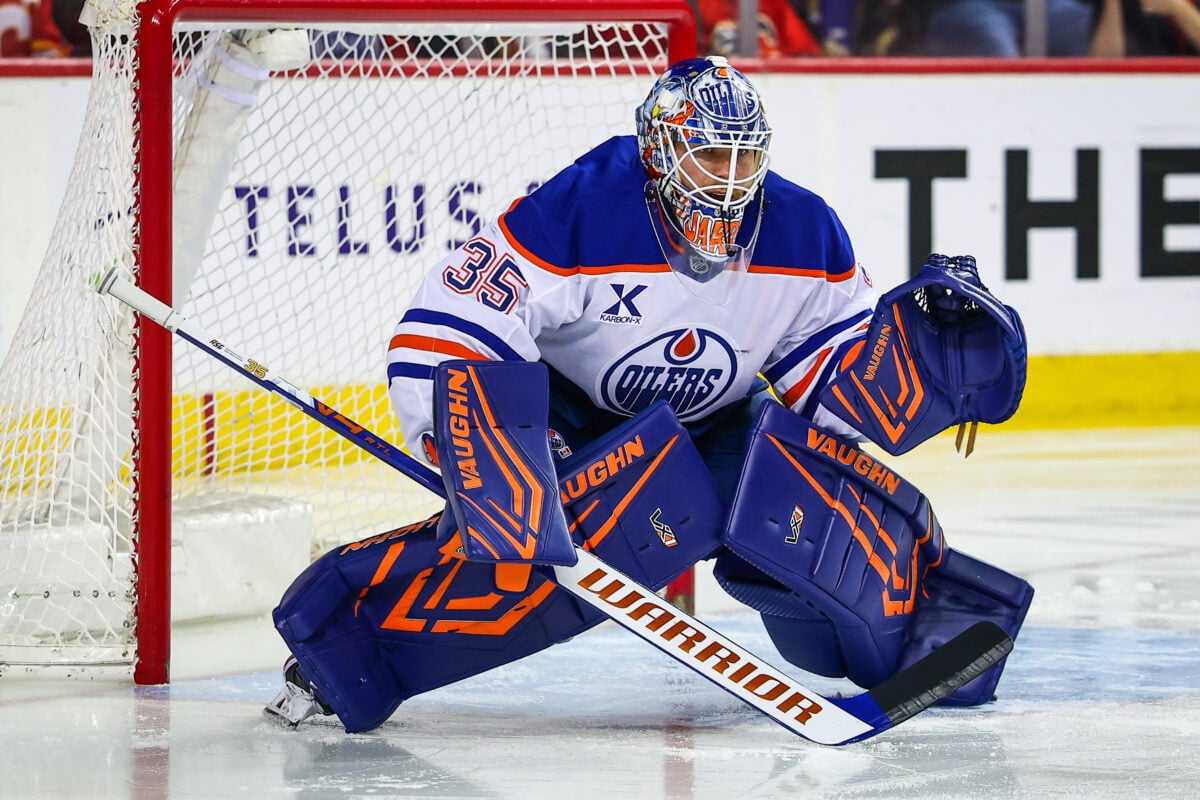
The Oilers are preparing to manage a complicated goaltending situation featuring Frederik Andersen, Tristan Jarry, and Devon Levi. The Hockey Writers has already examined why Edmonton could use a three-goaltender system throughout the season, but injuries, assignments and workload decisions will prevent all three from being available at every practice.
A full-time EBUG gives the coaching staff another option. The goaltender could handle one end of the ice during special-teams work, remain available when one of Edmonton’s roster goalies receives a maintenance day or support injured players who need additional work outside the regular practice schedule.
Boston Bruins goaltending coach Bob Essensa described the practical benefit while his organization evaluated potential candidates during the 2025-26 season.
“I think it’s probably long overdue,” Essensa told the Bruins’ official website.
Essensa explained that a traveling EBUG could remain available for extra work without forcing the NHL starter or backup to stay on the ice for every drill. That should also guide Edmonton’s search.
The best candidate does not need to be capable of winning an NHL game. He must be dependable enough to participate in practices without reducing their quality.
Edmonton should prioritize skating conditioning, positioning, and the ability to track NHL-level shots. The EBUG must also understand when the job requires serious preparation and when it requires quietly supporting the roster.
A background in goaltending instruction could be particularly useful. Someone who currently works as a goalie coach would be accustomed to practice environments and might also offer another perspective to players throughout the organization.
Familiarity Should Help but Not Decide Oilers’ Choice
There are clear advantages to selecting someone with Edmonton-area connections.
A local candidate would likely understand the organization, be familiar with Rogers Place and have established relationships within Alberta’s hockey community. Edmonton also has several university, junior and amateur programs capable of producing qualified goaltenders.
Familiarity alone should not determine the choice. The new EBUG will travel with the team instead of remaining in Edmonton for home games. That means availability, professionalism, and comfort within an NHL environment matter more than simply finding the best amateur goaltender living near Rogers Place.
The role requires someone prepared to spend much of an 84-game season around the club despite having almost no chance of playing. He must maintain his conditioning, remain prepared for practices and adjust his personal schedule around the team.
It is an unusual commitment.
The Oilers should therefore look for a candidate who sees value in the entire position, not only the remote possibility of entering an NHL game. A goalie coach, former university player, or recently retired amateur could use the experience to improve professionally while providing Edmonton with dependable support.
The individual must also fit comfortably inside the dressing-room structure. He will not be a traditional roster member, but regular travel and practices will make him more connected to the team than previous EBUGs.
That makes personality and discretion legitimate considerations.
Matt Berlin Represents the Old EBUG’s Appeal
Edmonton experienced the memorable side of the previous system with Matt Berlin in January 2023.
Berlin, then playing for the University of Alberta Golden Bears, was initially scheduled to serve as the local EBUG when Stuart Skinner became unavailable because of illness. Edmonton signed Berlin to an amateur tryout so he could back up Jack Campbell against the Chicago Blackhawks.
With the Oilers leading 7-3 late in the third period, the players encouraged then-head coach Jay Woodcroft to give Berlin an opportunity.
He entered with 2:26 remaining and stopped the only shot he faced.
The Oilers’ account of Berlin’s emergency appearance described how he had expected to spend the night in the press box before suddenly joining the lineup, participating in warmups, and eventually making his NHL debut.
Berlin’s appearance represented everything fans appreciated about the old system. A local university goaltender received a once-in-a-lifetime opportunity without expecting it when the day began.
The new full-time arrangement will make that type of surprise less likely. Edmonton’s EBUG will already know the players, practice regularly and travel with the team. That removes some novelty but should improve preparation.
OilersNation did not identify the local individual Edmonton is believed to have selected. Any candidate, including someone previously associated with the organization, would still require league approval under the new policy.
Oilers Can Make Small Role Useful
Edmonton’s EBUG selection will not determine whether the team competes for the Stanley Cup.
The goaltender may never dress for a game and will almost certainly never enter one. If the season unfolds normally, most supporters will rarely hear his name.
That does not make the decision meaningless.
The Oilers should approach the position as an opportunity to improve their daily environment. A dependable fourth practice option could help manage goaltender workloads, support extra sessions, and provide stability when injuries or travel complicate the schedule.
Edmonton’s larger 2026 offseason checklist focused on substantial decisions involving the coaching staff, roster, and salary cap. The EBUG requirement is smaller and significantly stranger than those priorities.
It is still one more position the organization must fill correctly.
The best choice will combine enough high-level experience to survive NHL practices with the humility to accept a largely supportive role. Local familiarity would help, but availability, professionalism and practice value should come first.
Edmonton may never need its new EBUG during a game. If the Oilers choose properly, they can still find reasons to use him throughout the season.
Free Newsletter
Get Edmonton Oilers coverage delivered to your inbox
In-depth analysis, breaking news, and insider takes – free.
Subscribe Free →