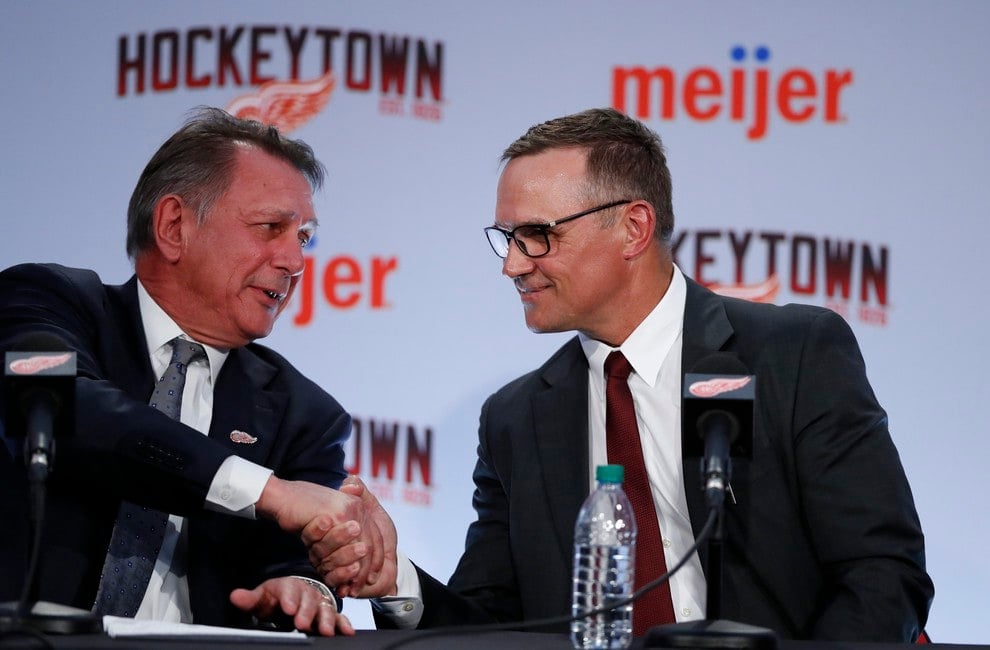
In the wake of Steve Yzerman stepping down as Detroit Red Wings general manager (GM) after seven seasons, there were a handful of people who came to his defense despite never once making the playoffs. Yzerman’s predecessor, Ken Holland, took some heat for the “Yzerplan” failing.
Holland, who is now the Los Angeles Kings’ GM, had some major missteps during his time with the Red Wings, but especially late in his tenure. However, that doesn’t mean Yzerman’s rebuilding plan didn’t fail on its own. Let’s look at shortcomings from both.
Holland’s Downfall: Refusing to Let Go
The Red Wings were hockey’s most enviable team for two decades. In the 1990s, they boasted an all-time great roster that won back-to-back Stanley Cups. In the 2000s, most of that core remained and was able to claim a championship in 2002, and then in 2008, a mostly different cast of core players reclaimed Lord Stanley. In 2009, they were one win short of going back-to-back again.

Slowly but surely, the Red Wings started to collapse. From 2010 to 2016, the team made the playoffs in each campaign, but had home-ice advantage in just one series. Detroit failed to reach a conference final during that span.
The reason for regression was simple: losing talent due to retirement and the salary cap. Stars from the 2009 team such as Marián Hossa, Nicklas Lidström, and Brian Rafalski were all gone by 2012. Some deeper-cut departures over the next few seasons included Kris Draper, Valtteri Filppula, Jiří Hudler, and Mikael Samuelsson.
Even with the downward trajectory, Holland hardly changed his philosophy. You can’t entirely blame him, given the team’s ridiculous run of success, but he operated like it was business as usual. This reached a breaking point in 2016.
In theory, if any team should know how good Pavel Datsyuk is, it’s Detroit. He played over 1,100 total games in Hockeytown, winning two Stanley Cups in the process. The Russian center was the Red Wings.
On June 18, 2016, it was announced that the soon-to-be 38-year-old was headed home to finish his hockey career in Russia. This wasn’t an out-of-the-blue decision for the Hall of Famer, as he made the possibility of retirement clear back in April of that same year.
While Datsyuk was 37 years old during the 2015-16 campaign, he was the Red Wings’ best player when he was on the ice. He’s always been an analytical darling, rivaling legends of the modern era like Sidney Crosby, Connor McDavid, and Alex Ovechkin in that respect. He was still an elite first-line center by the time things ended.
Red Wings management had a decision to make in the 2016 offseason. There was a playoff streak to maintain, but it was hanging on by a thread. In 2015-16, Detroit snuck into the postseason with 93 points and lasted five games. When a mediocre, declining roster with a subpar prospect pool loses its best player, the decision to rebuild should be obvious. Holland had other ideas.
Perhaps there was pressure from ownership, but the Red Wings were moderate buyers in the 2016 offseason. They signed free agent center Frans Nielsen to a six-year, $31.5 million contract and re-upped veterans Danny DeKeyser and Darren Helm for six and five years.
Replacing Datsyuk with Nielsen and making no other moves had the effect you might expect. From that point forward, the Red Wings began what is now the NHL’s longest playoff drought. By the end of his tenure, especially after franchise icon Henrik Zetterberg retired, Holland had his team in arguably the worst spot in hockey. It lacked core players, prospect help, and cap space.
Yzerman’s Downfall: Too Impatient for a Proper Rebuild
As Holland’s Red Wings crumbled, Yzerman’s Tampa Bay Lightning built what went on to be a dynasty, winning Stanley Cups in 2020 and 2021. So, when he was hired to be Detroit’s new GM in April 2019, there was a lot of excitement. The team was in a difficult spot, to be sure, but Yzerman embraced the challenge. “I have a lot of work to do,” he admitted.

To his credit, Yzerman did do the work on paper. From 2017 to 2023, the team had a top-10 pick in each draft class. That’s a solid enough foundation. But when you look at who was actually taken in those classes, as well as their trajectories by the time Yzerman started shifting from “rebuilder” to “buyer,” it can be argued that he jumped the gun.
In 2017 and 2018, the Red Wings had high picks, but they didn’t come away with much. Four out of 21 draftees are active NHLers, and two of them were on waivers last season (Jonatan Berggren, Alec Regula). The other two are Joe Veleno, who was bought out last summer, and Michael Rasmussen, who is still a Red Wing but only in a bottom-six role.
Can Yzerman be blamed for draft picks he didn’t make? Well, kind of, yes. For starters, it was clear somewhat early into his tenure that those classes were a wash. Filip Zadina, taken sixth overall in 2018, was sub-replacement-level by a pretty decent margin in two of his first three NHL campaigns (2018-19 and 2020-21), and he wasn’t ever that productive scoring-wise, either, even while averaging over 16 minutes a night.
So, Yzerman had to have known that he was effectively starting from ground zero, albeit with some younger roster holdovers such as Tyler Bertuzzi, Filip Hronek, Dylan Larkin, and Anthony Mantha. He didn’t really operate with that context in mind, though.
For starters, the Red Wings haven’t had a top-three draft pick since 1990. The only time that the team was definitively terrible was in 2019-20, going 17-49-5. They got unlucky in the draft lottery, falling to fourth overall, but landed star winger Lucas Raymond.
As underwhelming as those 2017 and 2018 classes ended up being, Moritz Seider at sixth overall in 2019 was a grand slam. He was one of the best defensemen in the league in 2025-26, finishing fifth in Norris Trophy voting (far too low, if you ask me). But aside from Raymond and Seider, the team has lacked star power in its draft picks.
It needs to be reiterated that Yzerman was inheriting a mess, and he knew this much. Additionally, the writing was more or less on the wall for those 2017 and 2018 classes by the time Raymond was selected. So, it should have been clear that another game-breaking player or two was required. But Yzerman made no attempt to get one.
In the shortened 2020-21 season, Detroit put up 48 points, which is the equivalent of 70 points across an 82-game campaign—only good enough for the No. 6 pick, used on Simon Edvinsson. The 23-year-old defender is as good or better than most players in the top five of that class, so the team gets a pass there. Especially since they also had the No. 15 pick, which they used on Sebastian Cossa, who was traded for a first-round pick in June 2026. But the next two drafts did boast star talent near the top.
In the 2021-22 and 2022-23 seasons, Detroit had the No. 8 and 9 picks, as well as No. 17 after acquiring it for Hronek. As established, the Red Wings needed another one or two game-breaking pieces—and that’s hardly a hindsight-inspired take. When you look at what they had in the lens of that time period, it wasn’t enough. But unless you’re finding hidden superstars, draft picks outside the top seven just won’t cut it. Unfortunately, the Red Wings don’t seem to have found one.
With those three picks, Detroit selected Marco Kasper, Nate Danielsson, and Axel Sandin-Pellikka. The latter has developed nicely, but none of these three players even feels like a star right now. Kasper and Danielsson had a replacement-level impact last season, and while Sandin-Pellikka was a little better, he merely served in a bottom-pairing role. In the top five of those classes, Connor Bedard, Logan Cooley, Leo Carlsson, Cutter Gauthier, Juraj Slafkovský, and others were taken.
This conundrum wasn’t by accident. In the 2022 offseason, Yzerman made splashes in free agency, landing Ben Chiarot, Andrew Copp, Ville Husso (added via trade, then signed), Dominik Kubalík, Olli Määttä, and David Perron. It was a deliberate attempt to exit that era of losing.
But all Yzerman did was lock himself into a core that wasn’t good enough to win the Stanley Cup. The lineup still had (and has) holes, so the Red Wings over the past few seasons have been perpetually average. Not bad enough to land that much-needed game-breaker, but not good enough to be a real threat in the Eastern Conference even with Raymond and Seider entering their primes and Yzerman trading major draft capital to improve the roster.
In Yzerman’s defense, the team didn’t stop drafting players after 2023. Between the 2024 and 2026 classes, they landed Carter Bear, Michael Brandsegg-Nygård, Eddie Genborg, J.P. Hurlbert, and Max Plante. As promising as they are, however, the Red Wings’ future core objectively falls short of several other teams.
You don’t need to blow up your roster to properly rebuild. But you do need to build an elite future core, and that’s something Yzerman failed at. Holland certainly didn’t make Yzerman’s job any easier, but he had seven years to build a truly enviable core—he never did.
The Red Wings Can Be Salvaged
There is light at the end of the tunnel for Detroit. The team has its holes, but a core of Alex DeBrincat, Raymond, and Seider is most definitely one you can work with. More surrounding stars are needed, especially after Larkin requested a trade in June, but the prospect pool offers some promise in the depth department, and there are enough assets at the team’s disposal to create a real contender.
That’s all easier said than done. Recent trades like the No. 15 pick in the 2026 NHL Draft and more for Justin Faulk cannot happen again. The next GM will have to do a better job of winning on the margins. If they can, things might be looking up in Detroit.
Advanced stats courtesy of Evolving-Hockey (used as a reference)
Free Newsletter
Get Detroit Red Wings coverage delivered to your inbox
In-depth analysis, breaking news, and insider takes – free.
Subscribe Free →