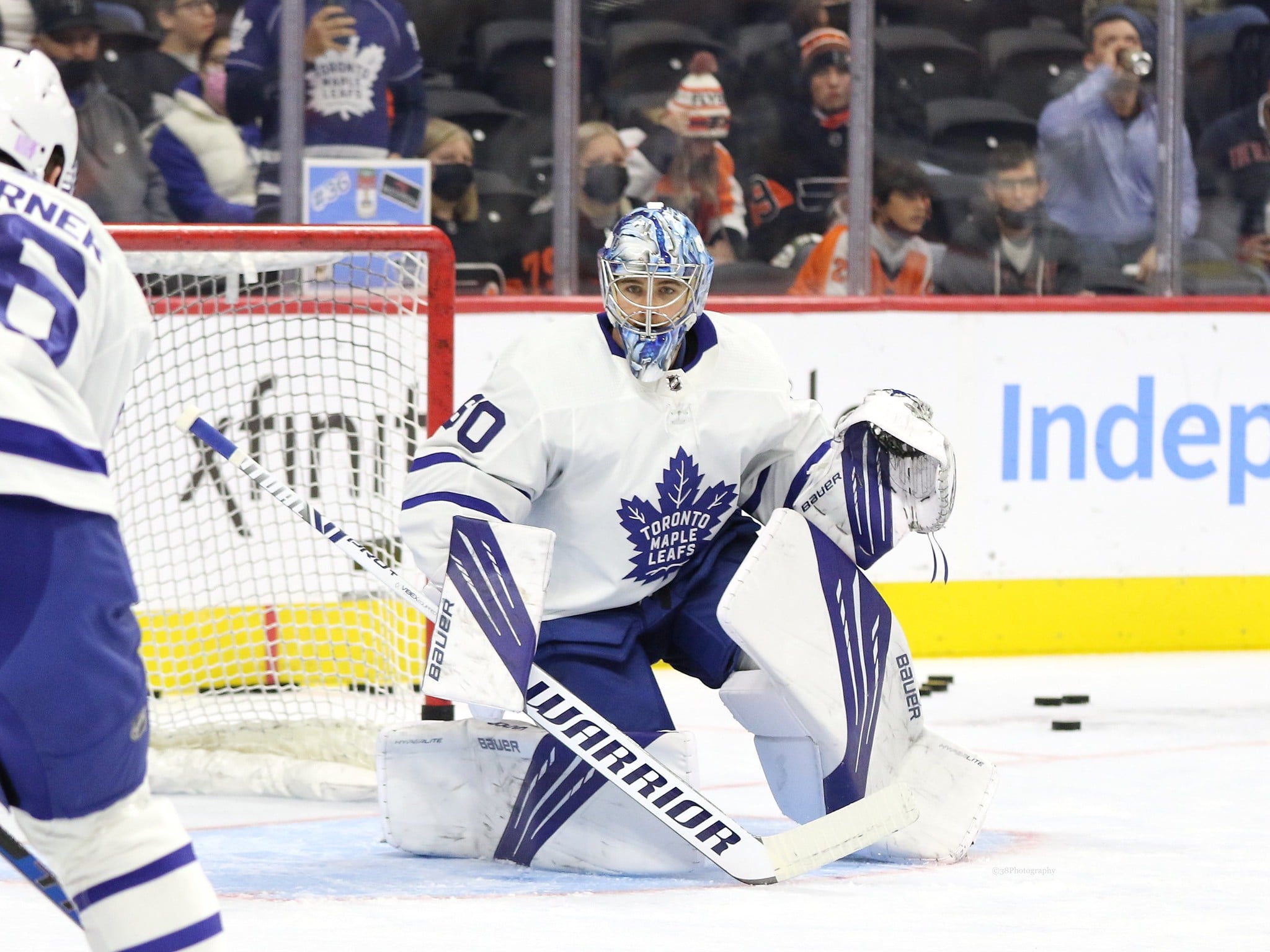
The first salvo of the offseason usually doesn’t come too long after the Stanley Cup is awarded. And less than 48 hours after the Carolina Hurricanes captured their second championship on Sunday, the Philadelphia Flyers and Toronto Maple Leafs fired off the opening shot.
This move doubles John Chayka’s first trade as the Maple Leafs’ general manager, and it’s an intriguing one. They’re hoping Emil Andrae can upgrade their mobility and puck-moving on the backend. The Flyers, meanwhile, get a 27-year-old who looked like one of the NHL’s most underrated netminders before getting caught up in a miserable 2025-26 season for Toronto.
Building a Brick Woll
Yes, it’s the easiest pun in the books, but in 2023-24 and 2024-25, it was true. Those were Joseph Woll‘s first two seasons with significant NHL playing time, and they went very well. Woll was 21st in the NHL in goals saved above expected (GSAE) per MoneyPuck with 7.2 in 25 games, a .294 GSAE per 60-minute rate that ranked 14th (minimum of 20 games). The next season, he was part of arguably the NHL’s best tandem with former Flyer Anthony Stolarz, ranking 11th in the NHL in GSAE and 10th in GSAE per 60.
Despite not entering either the playoffs as the starter, Woll got action both times, as well as in 2022-23 with only 11 regular-season games to his name. His overall performance has been strong, with a .906 save percentage (SV%) across 14 games. If not for his injury at the end of Game 6 in 2024, the Maple Leafs may have finally gotten over the hump against the Boston Bruins. He was on the wrong end of two six-goal-against blowouts in 2025 after replacing an injured Stolarz, but Toronto’s problems ran much deeper than him.
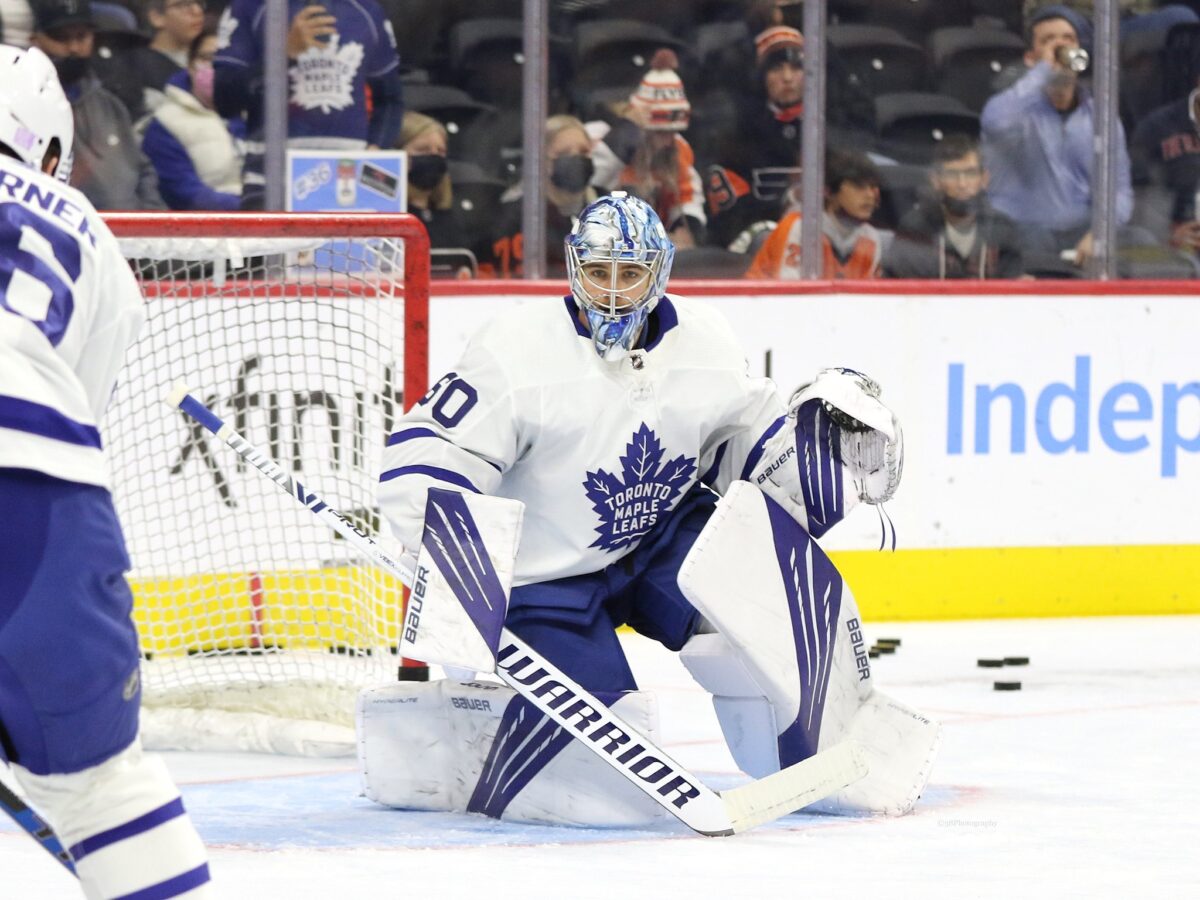
That theme continued in 2025-26, when Woll and Stolarz went from top 10 in GSAE to 50th and 51st, respectively. Injuries have also been an issue with Woll in his career, as he’s missed time each of the last two seasons after a lengthy absence in 2023-24 due to a high ankle sprain (plus his aforementioned playoff injury).
Even with those struggles last season, the 6-foot-3 netminder has a .905 SV% combined over the last three seasons, which ranks tied for 18th in the NHL. His cap, meanwhile, ranks 30th among goalies signed for next season at $3,666,667, per PuckPedia. It also runs through the 2027-28 campaign, so the Flyers have him under contract for two seasons.
It’s an undeniable upgrade over the outgoing goaltender, Sam Ersson. During that same time period, Ersson (who’s one year younger than Woll) was tied with Artūrs Šilovs for the worst SV% among goalies (minimum 35 games played). Even Woll’s down-season SV% was higher than Ersson’s best season in that window and .028 higher in 2025-26. The ceiling and floor of the Flyers’ number-two goaltender increase significantly with this move.
Bigger, Not Better
The Flyers grade out pretty well when looking at the goaltending aspect of this trade. But that’s only roughly half the deal, and it’s no surprise that the Maple Leafs get the edge in the other area.
While Andrae isn’t a perfect player, the 2020 second-round pick has put up solid advanced numbers and chipped in a respectable 13 points in 61 games of third-pair duty in 2025-26. A fractured wrist hampered his playoff efforts as he was limited to four games.
The big concern with Andrae is his size (5-foot-9, 189 pounds), especially in the overall picture of the Flyers’ defense. It’s a bit reductive to boil it down to just that, though, especially after the Hurricanes won it all with a blue line that prioritized mobility over size.
That’s especially true with the player the Flyers got back on the back end in Simon Benoit. The former Anaheim Duck has never graded out well at all by advanced metrics. He endeared himself to the Leafs a fair bit in his first season, scoring a playoff overtime winner and assisting on another, but it was clear after last season it wouldn’t be a long-term situation.
That very well may be the case in Philadelphia, with Benoit just a year away from unrestricted free agency. He carries a $1.35 million cap hit and can deliver more physical punishment than Andrae with his 6-foot-4, 210 pound frame, but there’s no question who the better player is between the two.
If Benoit primarily serves as the team’s seventh defenseman next season, replacing Noah Juulsen, that’s a perfectly fine situation. That’s where he probably slots in right now, with Nick Seeler comfortably ahead of him on the third-pair depth chart and David Jiříček likely to make the team (and Oliver Bonk in the mix as well). Marking him as an every-night player as Toronto did the last two seasons, however, opens the door to negative outcomes.
How Did the Flyers Fare?
In addition to the four players, the Flyers also traded the 85th-overall pick in this year’s draft to Toronto. That leaves Philadelphia with just four picks in 2026 (21st, 53rd, 181st, 213red), tied for the fewest in the NHL and, barring more moves, their fewest in team history.
The team that acquires the best player in a trade usually wins, and Woll is, at minimum, the most accomplished player by a long shot. It’s a move that makes sense for Toronto, as they save salary and have a comfortable NHL tandem left over in Stolarz and Dennis Hildeby. Sometimes, sheltered defensemen with promising underlying metrics like Andrae can blossom in a bigger role. Even if that’s not the case, he’s valuable in his current state and makes up for Toronto not having its 2027 third-round pick.
Both sides have acquired someone they are equipped to put in a role to succeed. They have also each acquired a player who did more bad than good last season, if not longer. But given that Woll has shown the most in the NHL and comes with neither age nor contract concerns (albeit some with durability), the Flyers should feel good about this move.
Free Newsletter
Get Philadelphia Flyers coverage delivered to your inbox
In-depth analysis, breaking news, and insider takes – free.
Subscribe Free →