The Pittsburgh Penguins should enter training camp with Evgeni Malkin, Tommy Novak and Egor Chinakhov established as their second line.
The trio spent 222:55 together at five-on-five last season and controlled 51.8% of expected goals, 52.8% of scoring chances and 52.1% of high-danger chances. Pittsburgh also held a plus-five goal differential during those minutes, giving head coach Dan Muse something the Penguins have too often lacked behind Sidney Crosby: a complete line with proven chemistry.
Those results should remove the combination from Pittsburgh’s list of training-camp experiments. Novak’s ability to carry the puck and create entries reduces Malkin’s workload, while Chinakhov supplies the speed and release required to finish the opportunities they generate.
The Penguins have other forwards who deserve meaningful opportunities. That does not mean every position needs to become an open competition.
Muse should begin camp with the Malkin, Novak and Chinakhov line intact and use the preseason to construct the rest of the lineup around it.
Malkin, Novak and Chinakhov Already Earned the Job
The strongest argument for keeping the line together is straightforward. It worked.
Pittsburgh controlled the quality and quantity of scoring chances with the trio on the ice. Those results came across approximately 30 games rather than one brief stretch created by unusually favorable finishing. The line provided sustained evidence that its structure could work against NHL competition.
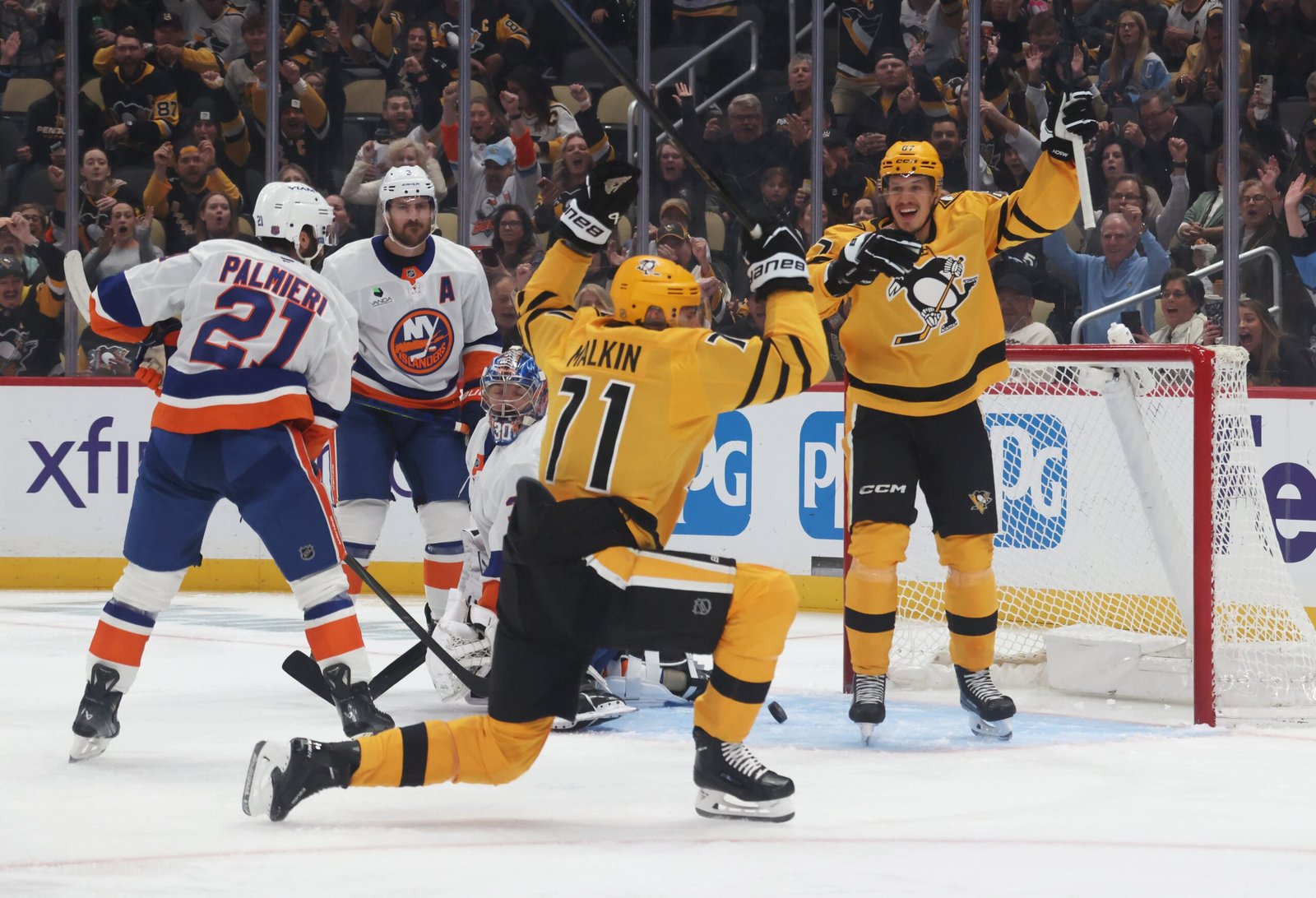
The production also appeared in important individual performances. During a January victory over the Calgary Flames, Malkin and Novak each recorded a goal and an assist, while Chinakhov scored another of Pittsburgh’s four goals. The second line combined for five points and a plus-nine rating in the 4-1 win.
That type of performance demonstrated how difficult the line could become to defend. Opponents had to respect Malkin’s creativity, Novak’s puck transportation and Chinakhov’s ability to score before a defensive structure became settled.
A recent Penguins player projection for Chinakhov argued that he could reach 25 to 30 goals during a complete season beside Malkin and Novak. That projection is ambitious, but it is supported by Chinakhov’s immediate production after joining Pittsburgh.
The Penguins acquired a forward who had struggled to find consistency with the Columbus Blue Jackets. They placed him beside players who complemented his strengths, and he produced 18 goals and 36 points in 43 games with Pittsburgh.
Breaking up that arrangement before another game is played would create change without evidence that change is necessary.
Novak Gives Malkin the Support He Needs
The most important part of the line may be the relationship between Evgeni Malkin and Tommy Novak.
Malkin began last season as Pittsburgh’s second-line center before shifting to the wing during the second half. The adjustment allowed him to remain involved offensively without carrying every responsibility attached to playing through the middle.
Novak makes that structure possible.
He can handle center responsibilities, transport the puck through the neutral zone and support controlled entries. Malkin can still take faceoffs or move into the middle during offensive possessions, but he does not have to begin every transition below Pittsburgh’s goal line.
That matters as Malkin enters his age-40 season. He recorded 19 goals and 61 points in only 56 games last season, proving he remains capable of producing at an elite rate. Injuries and a suspension still limited him to 26 fewer games than the complete schedule.
The Penguins should build a role that maximizes Malkin’s offensive value without requiring him to perform every task he handled during his prime. Novak’s puck carrying and positional flexibility provide that support.
Pittsburgh’s decision to extend Novak for three additional seasons reinforces the importance of finding his best role. His new agreement begins in 2027-28 and keeps him under contract through 2029-30.
The Novak extension carries legitimate risk because he recorded a solid rather than dominant 42 points last season. Placing him between Malkin and Chinakhov gives Pittsburgh the best chance to extract greater value from that commitment.
Chinakhov Gives the Line a Dangerous Finisher
Malkin and Novak can create possession, but the line requires someone capable of turning that possession into goals.
Chinakhov provides that element.
His 18 goals in 43 games with Pittsburgh projected to approximately 34 goals across an 82-game schedule. The NHL will expand to 84 games in 2026-27, creating an even larger opportunity if Chinakhov stays healthy and maintains a top-six role.
Some regression should be expected. Chinakhov converted a high percentage of his opportunities after the trade, and a complete season will expose him to more defensive attention. Reaching 25 goals would still represent a major addition to Pittsburgh’s secondary scoring.
His release is particularly useful beside two playmakers. Malkin can draw defenders toward him before finding open space, while Novak can create chances through controlled entries and lateral puck movement. Chinakhov does not need prolonged possession to become dangerous. He needs the puck to arrive in a shooting position before the goaltender becomes set.
Pittsburgh demonstrated its confidence by signing Chinakhov to a three-year contract carrying a $6.25 million annual value. That agreement runs through the 2028-29 season and establishes him as one of the organization’s most significant forward investments.
The contract creates expectations that extend beyond another promising stretch. Chinakhov must become a dependable top-six scorer.
The best way to test whether he can meet that standard is to preserve the line that helped produce his breakout.
Penguins Should Refine the Line After Its Playoff Struggles
Keeping the trio together does not mean ignoring what happened in the playoffs.
Chinakhov entered the postseason after becoming one of Pittsburgh’s most productive forwards, but he did not score during the six-game loss to the Philadelphia Flyers. Novak also struggled to make a significant offensive impact, while Malkin recorded two goals and three points.
That performance created a legitimate concern. The Penguins need their second line to provide more than encouraging regular-season possession numbers. It must produce when opponents have time to prepare specifically for Pittsburgh’s tendencies.
The solution should be refinement rather than separation.
Muse can use training camp to improve the line’s forecheck, defensive-zone exits and ability to attack when opponents prevent controlled entries. He can also experiment with which defense pair best supports the trio and whether its members should receive more shared power-play time.
The Penguins should examine why the line did not convert enough opportunities against Philadelphia. They should not respond to six playoff games by discarding more than 222 minutes of successful regular-season work.
A previous look at the three most disappointing Penguins in the first-round loss identified Chinakhov as one of the players who needed more. The disappointment existed because his regular-season performance had already established a much higher standard.
Pittsburgh should give the trio an opportunity to respond together.
Training Camp Competition Belongs Elsewhere
The Penguins will have enough genuine lineup competitions without reopening the second line.
Ben Kindel could continue at center or move into a different offensive role. Ville Koivunen needs a legitimate NHL opportunity after receiving an eight-year contract. Rutger McGroarty, Hendrix Lapierre, Nick Robertson and Andrei Kuzmenko will also compete for positions throughout the top nine.
Pittsburgh’s post-free-agency roster projection separated Malkin, Novak and Chinakhov across two lines, demonstrating how many combinations Muse could consider. Flexibility is useful, but it should not become an excuse for unnecessary movement.
The Penguins can create opportunities for their younger forwards around an established top six.
Bryan Rust, Sidney Crosby and Rickard Rakell remain Pittsburgh’s most logical first-line combination. Keeping Malkin, Novak and Chinakhov together would leave the third line as the primary location for competition among Kindel, Koivunen, Kuzmenko, Robertson, Lapierre and McGroarty.
Injuries or poor performance could eventually require changes. Muse should remain willing to adjust when the evidence demands it.
Training camp should not begin with the assumption that every previous combination has been erased.
Muse Should Begin With Proven Chemistry
The Penguins spent years searching for reliable secondary offense behind Crosby’s line.
Malkin, Novak and Chinakhov provided a possible solution. They controlled expected goals, scoring chances and high-danger opportunities across a meaningful sample while producing a positive goal differential.
Their skills also fit together logically. Novak can move the puck through the middle. Malkin can create from the wing without carrying the full burden of playing center. Chinakhov can attack the openings created by both playmakers.
The trio still has something to prove after an ineffective postseason. That challenge should become its motivation entering training camp, not the justification for breaking it apart.
Muse will have plenty of difficult decisions involving Pittsburgh’s young forwards, veteran contracts and crowded top nine. His second line should be one of the easier choices.
The Penguins already found chemistry between Malkin, Novak and Chinakhov. They should stop searching and give it a complete season to grow.
Free Newsletter
Get Pittsburgh Penguins coverage delivered to your inbox
In-depth analysis, breaking news, and insider takes – free.
Subscribe Free →