The Pittsburgh Penguins are not only filling out a roster. They are starting to tell everyone which pieces they believe can matter beyond next season.
That is what makes the new contracts for Egor Chinakhov and Artūrs Šilovs more interesting than a standard restricted free agent update. The numbers matter, but the message behind them matters more. Pittsburgh signed Chinakhov to a three-year contract carrying a $6.25 million average annual value, while Šilovs received a one-year deal worth $2.8 million, according to PensBurgh’s report on the signings.
Those are two very different commitments. One is a real investment in a forward who looked like a breakout piece after arriving in Pittsburgh. The other is a shorter bet on a goaltender who had an uneven regular season, but gave the Penguins something to think about with how he handled the postseason.
Together, they show where the Penguins are right now. They are not fully rebuilding, but they are not simply running everything back either. They are trying to identify which younger players can help stretch the current era while also giving the organization something to build around later.
Chinakhov and Šilovs are now part of that conversation.
Penguins Reward Chinakhov’s Breakout
Chinakhov’s contract is the bigger statement.
The Penguins did not just keep him around for another season. They gave him three years and a significant raise because he earned it. After being acquired from the Columbus Blue Jackets on Dec. 29, Chinakhov became one of Pittsburgh’s most important offensive players. He had 36 points in 43 games with the Penguins, including 18 goals and 18 assists. His goal and point totals both ranked third on the team after the trade, according to the team information cited by PensBurgh.
That is not depth production. That is top-six impact.
Chinakhov’s full season was also the best of his NHL career. He set career highs in games played, goals, assists and points, finishing with 21 goals and 21 assists for 42 points split between Columbus and Pittsburgh. That matters because this was not just a small hot streak. It was the first season where his tools turned into consistent NHL production.
Pittsburgh needed that badly. The Penguins have spent years trying to find younger offensive players who can grow around Sidney Crosby, Evgeni Malkin and the rest of the veteran core. Chinakhov gave them speed, a dangerous shot and the kind of finishing ability that can change how a line looks.
THW previously wrote about Pittsburgh needing younger pieces on the roster, and Chinakhov fits directly into that idea. The Penguins have been searching for players who are not only prospects, but actual NHL contributors. Chinakhov is already past the “maybe someday” stage. He has shown he can produce now.

The risk is that the Penguins are paying for the breakout to continue. Chinakhov’s new deal is not a massive long-term contract, but it is not a cheap bridge deal either. At $6.25 million per season, Pittsburgh is expecting him to be more than a complementary winger.
That is fair. If Chinakhov gives the Penguins anything close to the pace he played at after the trade, the contract can look reasonable quickly. If he settles in as a streaky middle-six winger, the number will feel heavier.
That is the bet Pittsburgh made.
Šilovs Gets a Shorter Test in Goal
Šilovs’ contract says something different.
The Penguins clearly wanted him back, but the one-year term shows they were not ready to make a long commitment in goal. That makes sense. Šilovs had promising moments, but he also had a regular season that was not clean enough to make him an automatic long-term answer.
In 39 games last season, Šilovs went 19-12-8 with a 3.07 goals-against average and an .888 save percentage, according to PensBurgh’s season review. Those numbers are not overwhelming. They show a goalie who had stretches where he kept Pittsburgh afloat, but also one who still has to prove he can handle a larger NHL workload.
Then the playoffs changed the conversation.
Šilovs stepped into a difficult situation against the Philadelphia Flyers and gave the Penguins a chance. In three playoff starts, he posted a 1.52 goals-against average and a .939 save percentage. That does not erase every regular-season concern, but it does matter. The postseason can expose players. It can also reveal something about them. For Šilovs, it gave Pittsburgh a reason to keep looking.
A one-year deal is the right kind of pressure. It gives Šilovs another chance to prove he can be more than a short-term option, while keeping the Penguins from locking themselves into a goalie situation they are not completely sure about.
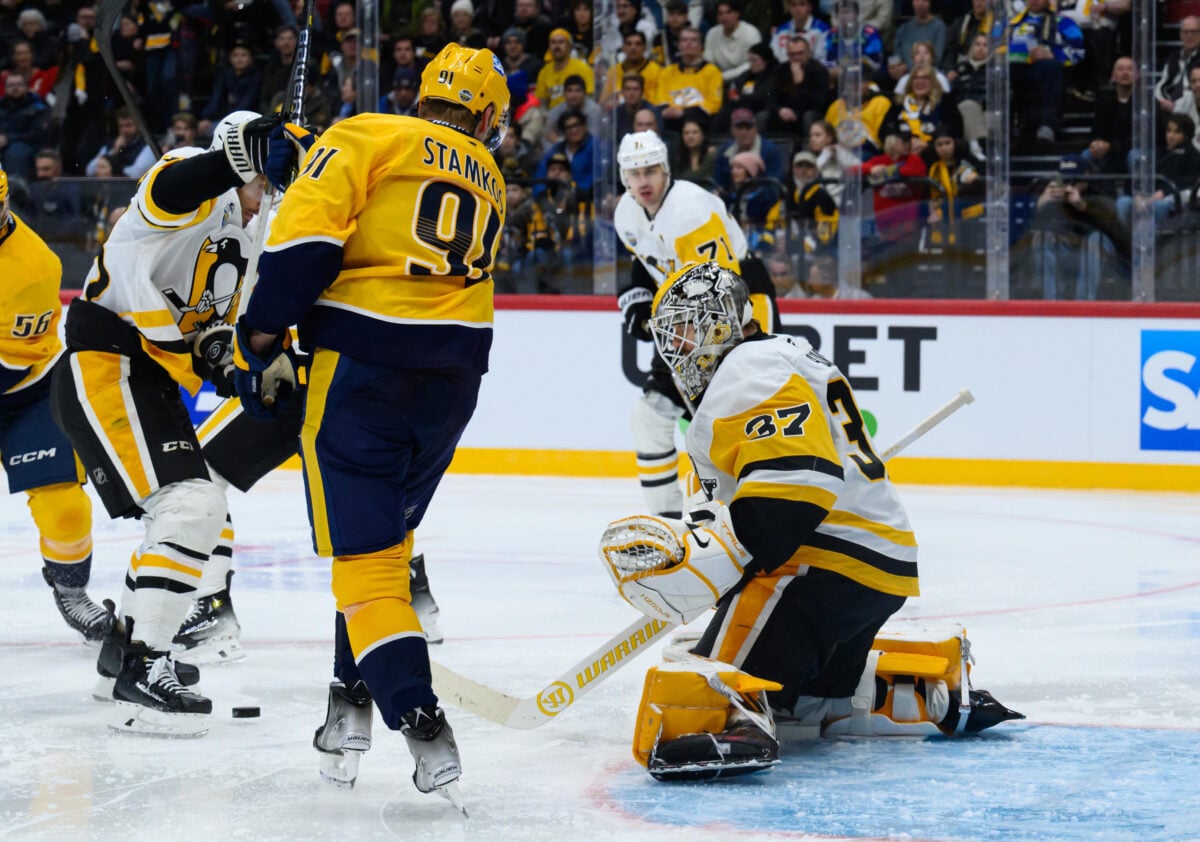
The Penguins’ goaltending picture is still not fully settled. Šilovs may have the inside track to an important NHL role, but Pittsburgh also has to think about Joel Blomqvist and Sergei Murashov. Blomqvist also received a new deal as part of the same wave of signings, while Murashov remains one of the more interesting goalie names in the organization.
That makes Šilovs’ deal less of a final answer and more of a challenge. Pittsburgh is giving him the opportunity. Now he has to take it.
Penguins Made Two Different Kinds of Bets
The contrast between the Chinakhov and Šilovs contracts is what makes this story interesting.
Chinakhov got term because the Penguins believe his breakout can become part of their offensive foundation. Šilovs got one year because the Penguins believe in the upside, but still need more evidence.
Both decisions make sense.
Chinakhov filled a clear need. Pittsburgh needed younger scoring, and he gave it to them almost immediately after arriving. He also fits the age range of a team trying to transition without completely tearing everything down. He is 25, already productive and still young enough to be part of whatever comes next.
Šilovs is also 25, but goalies are different. Their development curves are strange, their performance can swing harder and their contracts can become dangerous if a team guesses wrong. Pittsburgh saw enough to bring him back, but not enough to tie itself to him for several years.
That is careful roster building. It is not the most exciting phrase, but it is what the Penguins need.
For years, Pittsburgh’s biggest challenge has been figuring out how to stay competitive around its veterans while finding younger players who can actually take on meaningful roles. Draft picks and prospects are important, but they only matter if some of them turn into real NHL players. Chinakhov and Šilovs are not guarantees, but they are at least players with enough NHL evidence to justify real opportunity.
The Penguins have already been busy reshaping the roster. They have added players, moved pieces around and created a team that looks different from the one that entered last season. PensBurgh’s updated depth chart showed how crowded and unsettled parts of Pittsburgh’s roster still are after the free agent rush, especially with several forwards competing for roles and the goaltending picture still developing.
That is why these contracts matter. They bring a little more definition to an offseason that still has moving parts.
Chinakhov Can Become a Core Piece
Chinakhov has the cleaner path to becoming part of the next Penguins core.
That does not mean he is suddenly on the level of Crosby or Malkin. It means Pittsburgh now has a forward who can be penciled into the top nine with real offensive expectations. That alone is important.
The Penguins have spent too much time leaning on older players to drive everything. Chinakhov gives them a different type of weapon. He can shoot, skate and finish. He also gives Pittsburgh another player who can play with skilled linemates without looking out of place.
His next step is consistency. It is one thing to explode after a midseason trade when everything feels fresh. It is another to come back the next season with a new contract, higher expectations and a full scouting report from opponents.
That will be the test. If Chinakhov keeps producing, the Penguins may have found one of the most important pieces of their retool. If he slips, the contract becomes a reminder that paying for a breakout always comes with some risk.
Still, this is the kind of risk Pittsburgh should take. Chinakhov is young enough, talented enough and productive enough to justify it.
Šilovs Still Has to Claim the Crease
Šilovs’ challenge is different.
His playoff performance gave him momentum, but the regular season showed why the Penguins still need to be cautious. A one-year contract means he has another season to show whether he can be trusted as a bigger part of the goaltending plan.
That does not mean he has to be perfect. Pittsburgh does not need him to become a Vezina Trophy candidate overnight. It needs him to be steadier, especially over long stretches. It needs fewer nights where the numbers sink the conversation. It needs the playoff version of Šilovs to show up more often.
The good part is that there is still upside. Šilovs has handled pressure before. He was excellent for Latvia at the international level, helped Abbotsford win the Calder Cup in 2025, and showed in the playoffs that he is not overwhelmed by big moments.
Now the Penguins need to find out what that means over a full NHL season.
If Šilovs takes the next step, the one-year deal could become a setup for something bigger. If he does not, Pittsburgh keeps its options open.
Penguins Are Slowly Defining Their Future
These signings are not the end of Pittsburgh’s offseason, but they are important pieces of it.
Chinakhov’s deal gives the Penguins a young scorer they can build with. Šilovs’ deal gives them another year to evaluate a goalie who has flashed real potential. Neither move guarantees anything, but both help clarify the direction.
The Penguins are still trying to walk a difficult line. They want to respect the final years of the veteran core, but they also have to prepare for the next version of the team. That means deciding which players are temporary and which ones can become part of the foundation.
Chinakhov is now closer to the foundation category. Šilovs is still auditioning for it.
That is not a bad place for Pittsburgh to be. The Penguins have spent the last few years needing more young players to force their way into the conversation. Chinakhov already has. Šilovs has started to.
Now both have contracts that give them the chance to prove what comes next.
Free Newsletter
Get Pittsburgh Penguins coverage delivered to your inbox
In-depth analysis, breaking news, and insider takes – free.
Subscribe Free →