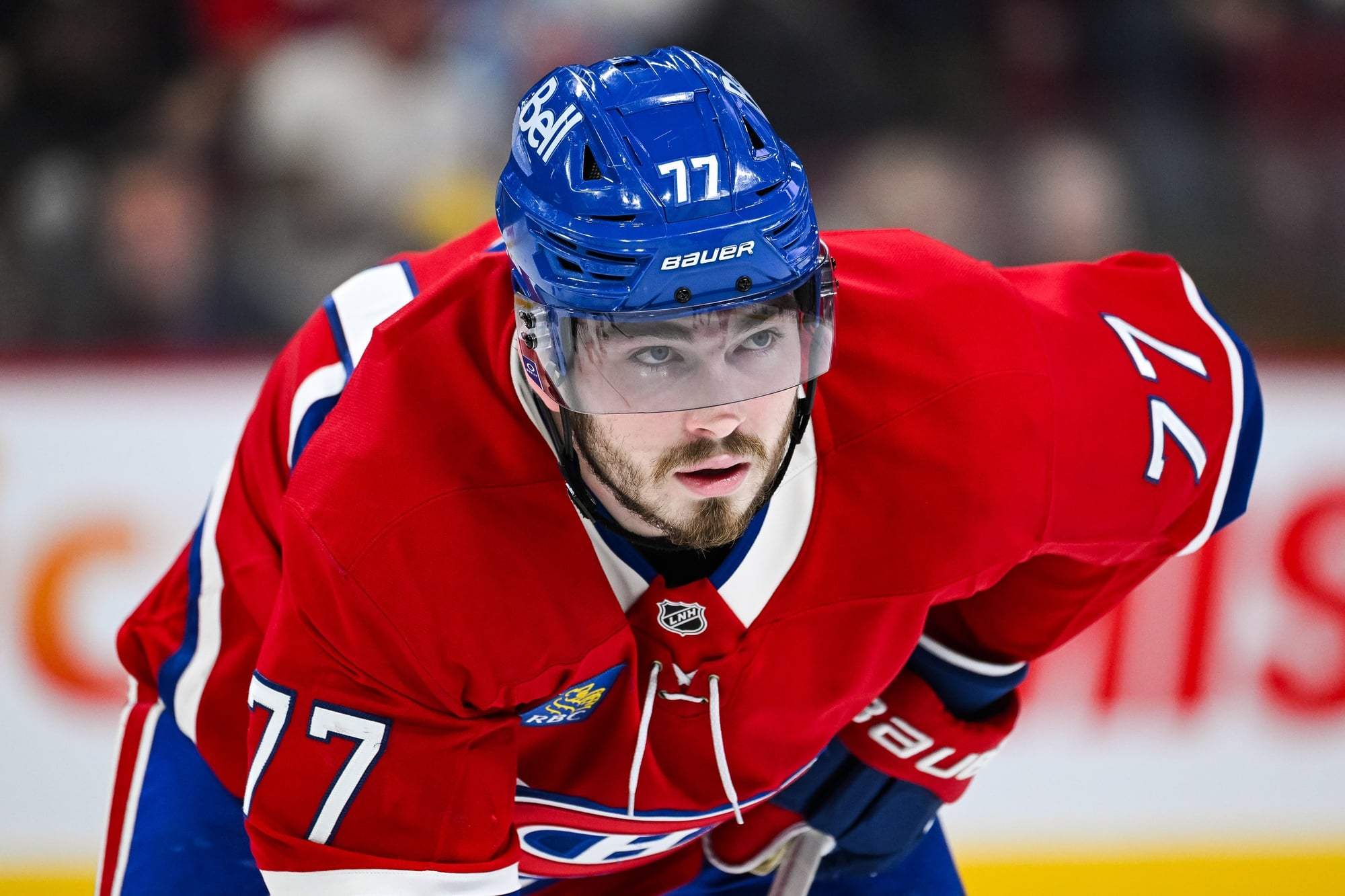
The Montreal Canadiens and Kirby Dach are heading toward an interesting contract negotiation this summer. After extending him a qualifying offer worth $4 million for the 2026-27 season, the Canadiens retained control of the restricted free agent, but Dach elected not to sign the offer and instead filed for salary arbitration.
While arbitration often sounds like the beginning of a messy negotiation, it doesn’t necessarily mean the relationship between the player and team has deteriorated. In fact, many cases are settled before reaching a hearing. Still, with Dach’s injury history and inconsistent production, finding common ground won’t be easy.
The Current Situation
By issuing Dach his $4 million qualifying offer, the Canadiens ensured they would maintain his rights while giving themselves time to negotiate a longer agreement. Dach, meanwhile, chose arbitration rather than accepting the one-year qualifying offer.
That decision isn’t particularly surprising. From the player’s perspective, accepting the qualifying offer would lock him into one season with no future guarantee. Filing for arbitration gives him another avenue to secure a contract that may better reflect what he believes his value is.

The Canadiens also have a difficult evaluation to make. Dach remains one of the most talented forwards on the roster when healthy. At 6-foot-4 with excellent puck skills and playmaking ability, he still possesses the upside that made him the third overall pick in the 2019 NHL Entry Draft.
The problem is availability and consistency. Injuries have repeatedly interrupted his development, making it difficult for Montreal to project exactly what role he will have over the next several seasons. During the Canadiens’ playoff run, Dach mostly found himself in a fourth-line role, producing five points in 19 games. While he contributed in certain situations, he wasn’t the offensive difference-maker many hoped he could become.
What Could a New Deal Look Like?
If the Canadiens and Dach reach an agreement before arbitration, the most logical outcome would likely be a short-term bridge contract.
A two or three-year deal gives both parties exactly what they need. Montreal avoids committing significant money over the long term to a player who has yet to establish himself as a consistent top-six forward, while Dach gets an opportunity to prove he can stay healthy and rebuild his value before negotiating another contract. Financially, something around $3.5 million annually appears to be a reasonable middle ground.
The Canadiens already indicated they were comfortable paying $4 million for one season through the qualifying offer, but extending that figure over multiple years becomes much riskier considering Dach’s injury history. On the other hand, Dach likely believes he deserves more security than a one-year qualifying offer while still betting on himself to produce.
For Montreal, it limits long-term risk while preserving salary cap flexibility as several young stars continue progressing through the organization. For Dach, it provides stability and enough time to re-establish himself as an important member of the Canadiens’ core. Ultimately, this is still a player with intriguing upside. If he finally enjoys a healthy stretch and returns to playing in a top-six role, a $3.5 million cap hit could quickly become a bargain.
Arbitration May Be the Most Likely Outcome
Even though an agreement before the hearing remains possible, arbitration still appears to be the most likely scenario. Neither side has an obvious incentive to compromise significantly. Dach will understandably argue that his talent and potential justify a higher salary, while the Canadiens will point to his lack of production, limited role during the playoffs and lengthy injury history. An independent arbitrator may ultimately be the best person to settle the dispute.
From Montreal’s perspective, that may not be a bad thing. Arbitration removes much of the emotion from negotiations and produces a salary based on comparable players, recent production and overall value. It also prevents the Canadiens from feeling pressured into overpaying based solely on potential.
There is still plenty of talent there, and the Canadiens certainly haven’t given up on him. However, at this point in his career, production has to outweigh projection. Until Dach proves he can consistently stay in the lineup and contribute offensively, Montreal has every reason to remain cautious with its long-term commitment.
Whether the two sides settle beforehand or let an arbitrator make the decision, the Canadiens’ priority should remain the same, finding a contract that rewards Dach’s upside without exposing the organization to unnecessary risk. Given everything we’ve seen over the past few seasons, that balance will be the key to getting this negotiation right.
Free Newsletter
Get Montreal Canadiens coverage delivered to your inbox
In-depth analysis, breaking news, and insider takes – free.
Subscribe Free →