The Ottawa Senators are back in the playoffs for the second straight season. It was touch-and-go for a while, but in the end, they pulled it off. Unfortunately, squeaking into the playoffs means that they are up against the Eastern Conference-leading Carolina Hurricanes, who have made the playoffs for the past eight seasons and haven’t lost a first-round matchup since falling to the Boston Bruins in 2020.
On paper, it’s a mismatch; the Hurricanes finished with 113 points and were one of the most dangerous teams with the puck. However, the advanced stats paint a different picture, with the Senators sitting just behind Carolina in nearly every category. The key difference is the Senators’ defence. While the Hurricanes are skilled producers, Ottawa has made a name for itself as one of the best defensive teams in the NHL. If they can suppress Carolina’s deadly offence, then the Senators may be able to win their first playoff series since 2017.
Senators Have the Defensive Metrics to Win
In a season that was marred by inconsistent goaltending, it’s easy to forget just how good the Senators played. At five-on-five, Ottawa was the stingiest team in the NHL, finishing with 140.72 total expected goals against (xGA), and their average of 2.11 expected goals against per 60 minutes (xGA/60) finished just 0.01 behind the Vegas Golden Knights. A lot of that is thanks to the Senators’ depth. Their top pairing of Jake Sanderson and Artyom Zub finished with 1.87 xGA/60, the lowest in the NHL among lines with 500-plus minutes, despite playing the 14th most minutes of any defensive pair. Tyler Kleven and Jordan Spence, Ottawa’s most consistent third pair, also finished with a 1.87 xGA/60 over 650 minutes together.
When injuries ravaged the Senators’ blueline, Sanderson and Spence were paired up on the top line, and the results were even better. After playing 140.7 minutes together, they had a 1.83 xGA/60, the 12th-lowest total among defensive pairs who logged 120 or more minutes. It was the same story when Spence was paired with Thomas Chabot, with the pair finishing with a 1.91 xGA/60 over nearly 200 minutes. Although Nick Jensen suffered a season-ending injury in March, he and Niklas Matinpalo were also just as effective, finishing with a 1.97 xGA/60 over 217 minutes together. It’s only after them that the first Hurricanes pair shows up, with Alexander Nikishin and Mike Reilly finishing with a 1.99 xGA/60.
On offence, the Senators are just as effective. The team’s third line of Michael Amadio, Shane Pinto, and Claude Giroux had a measly 1.69 xGA/60 this season, the 12th-lowest forward unit average, yet was the third most effective line at shutting down opponents on the team. Top-six forwards Dylan Cozens, Brady Tkachuk, and Drake Batherson combined offensive prowess with defensive dominance, all finishing with less than 2.5 xGA/60.
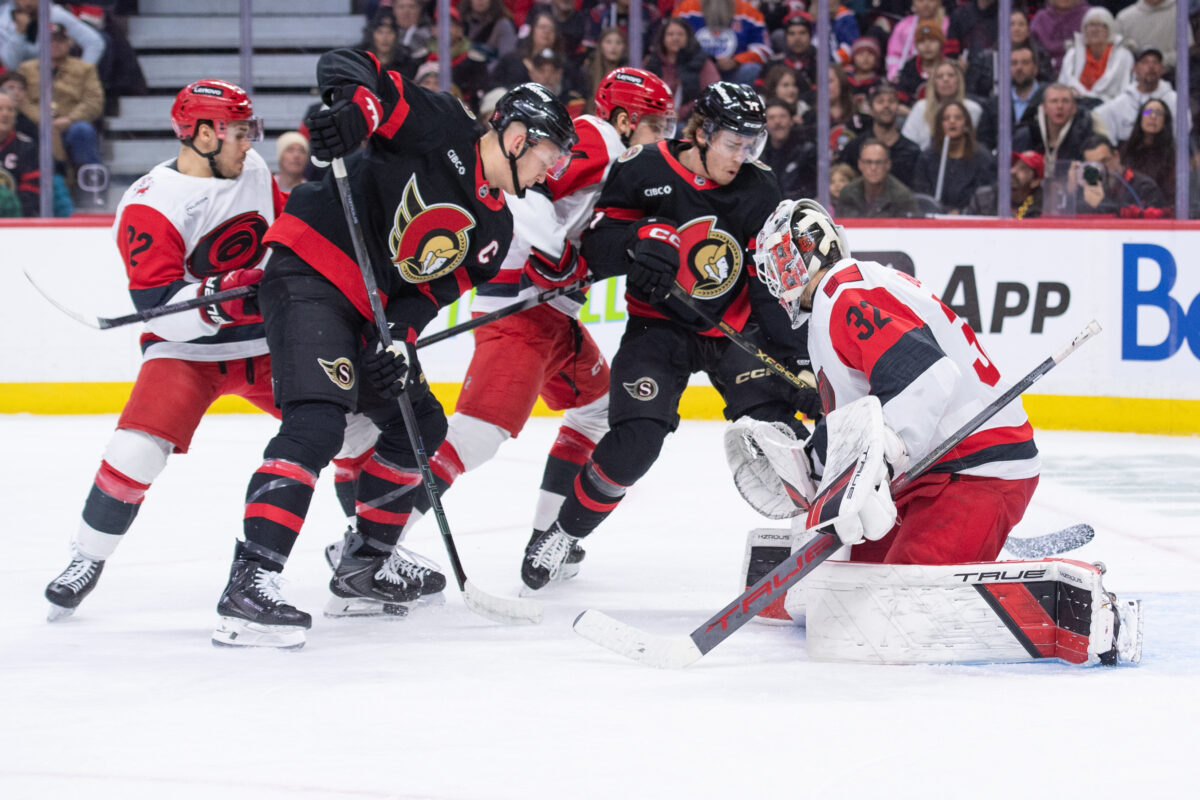
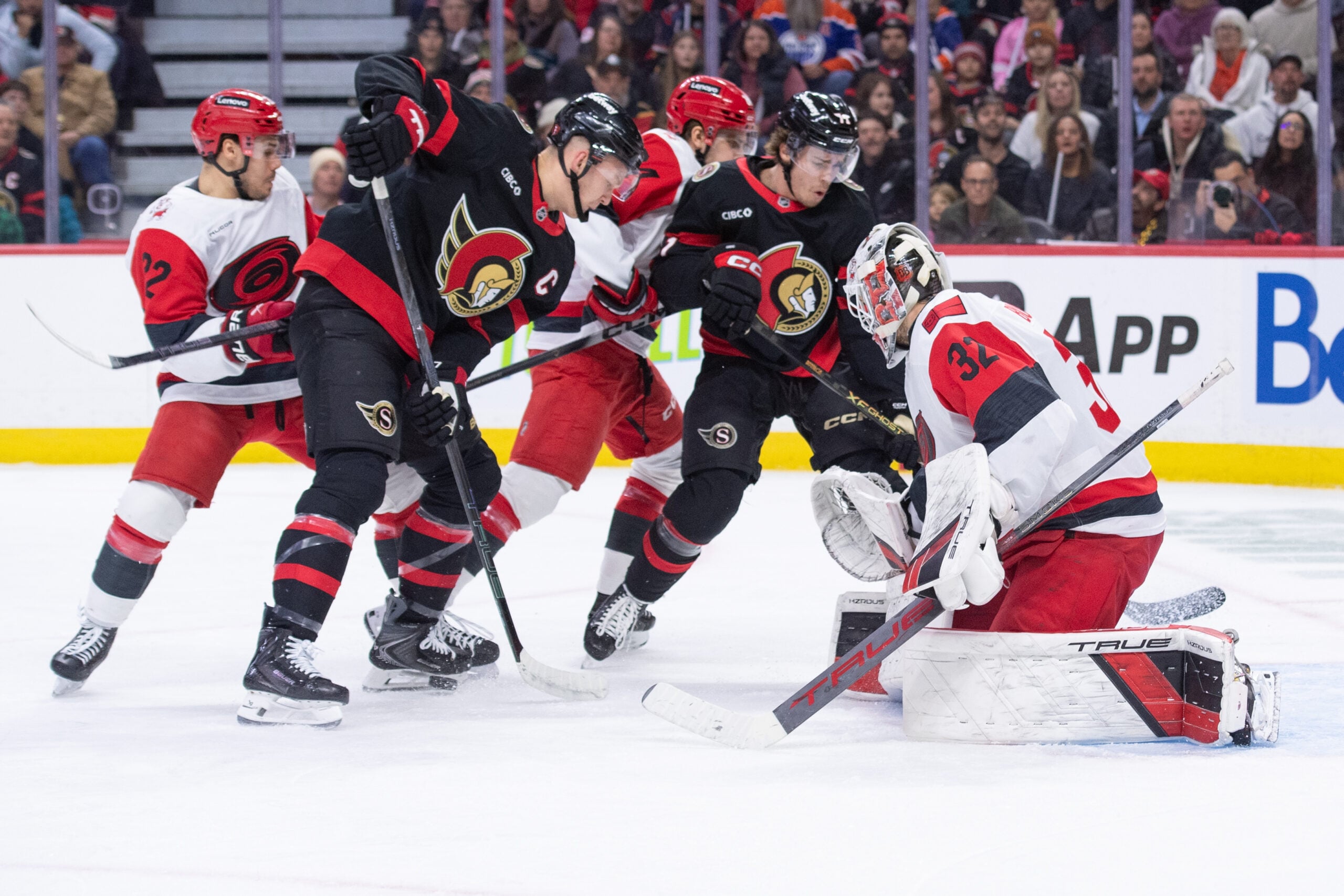
The biggest issue, as alluded to earlier, was in the net. The Senators had some of the strongest defensive lines, but they allowed 22.28 more goals against than expected, the third-highest total this season. Carolina had their own share of goaltending issues, but still finished down in 12th with 2.99 more goals allowed than expected. Ottawa’s offence tried to counteract the weakness and finished with 2.45 more goals scored than expected, but it wasn’t enough to fix all their problems.
Thankfully, the Senators have rallied around their goalie, and over the last month, Linus Ullmark has been one of the NHL’s most effective netminders while also being one of the busiest. Over the past 11 games, he put up a 0.910 save percentage (SV%) and a 7-3-1 record. That’s significantly better than either of the Hurricanes’ goalies; Frederik Andersen and Brandon Bussi both had a 0.879 SV% over eight games.
Another edge the Senators have over the Hurricanes is their physicality. Ottawa finished with the third-most hits this season, while the Hurricanes finished with the most giveaways and led the league with 633 defensive zone giveaways. Considering that Senators’ agitator Ridly Greig finished with the sixth-most penalties drawn, that could give Ottawa the edge they need to grab an early lead, or at the very least, make the Hurricanes a very bad time throughout the series.
Senators and Hurricanes are Gearing Up for a Grind
The NHL Playoffs are always difficult to predict, but it seems that one thing is for certain – this series won’t be kind for either team involved.
“Tough one,” said Senators’ coach Travis Green ahead of their first game. “They are a good team, been a good team for a long time, a lot of playoff experience. We talk a lot here of knowing our game and understanding our game, and I think they are a good example of knowing how they play and how they get to their game. It’s an aggressive game they play.”
“That’s a tough matchup,” echoed Hurricanes’ coach Rod Brind’Amour. “They all are this time of year and moving forward, but that is one of the better teams in the NHL in my opinion. They had a tough start to their season and interesting things going on, but they got it covered, top to bottom. It’s going to be a huge challenge.”
Despite where they finished in the regular season, the Hurricanes and Senators are very evenly matched, and it’s likely that this opening series sees several overtimes and one-goal results. But defence is one of the most important aspects of winning games. Ottawa has proven that they are one of the best in that area, which may give them all the advantages they need in this series.

Free Newsletter
Get Ottawa Senators coverage delivered to your inbox
In-depth analysis, breaking news, and insider takes – free.
Subscribe Free →