
- Markus Ruck, Centre, Medicine Hat Tigers (WHL)
- Tommy Bleyl, Defenceman, Moncton Wildcats (QMJHL)
- Ryan Roobroeck, Centre, Niagara IceDogs (OHL)
- Jaxon Cover, Left Wing, London Knights (OHL)
- Niklas Aaram-Olsen, Left Wing/Right Wing, Örebro HK (Sweden)
- The Verdict
With the 2026 NHL Entry Draft approaching, the Vancouver Canucks find themselves in an intriguing position. Holding the 33rd overall selection — the first pick of the second round — management has a prime opportunity to secure a high-end talent who may have slipped out of the first round.
Historically, this draft slot functions as an extension of the first round, where teams can capitalize on polarized opinions or specific market inefficiencies. Given the current composition of the Canucks’ depth chart, adding versatile forward depth and transition-focused blueliners remains a priority.
Here are five logical targets for the Canucks at pick 33.
Markus Ruck, Centre, Medicine Hat Tigers (WHL)
If the Canucks are looking for a highly tactical playmaker with local ties, Osoyoos native Markus Ruck should be near the top of their board. Ruck completed a highly productive season in the Western Hockey League, showcasing an advanced ability to dictate the pace of play from the centre position.

Ruck is not a bruising forward, but he excels at finding open ice and executing short-area passes under duress. His primary asset is his hockey IQ; he consistently forces opposing defenders out of position by shifting his lanes and delaying on the rush. Off the puck, he reads structural coverage well, making him an effective option on the penalty kill and in transition.
For Vancouver, Ruck represents a projectable middle-six centre who can elevate his wingers. His style aligns with a possession-oriented system that values structural discipline over pure physical mapping.
Tommy Bleyl, Defenceman, Moncton Wildcats (QMJHL)
The modern NHL demands blueliners who can transition the puck efficiently, and Tommy Bleyl is one of the most prolific puck-movers available in this tier of the draft. Playing in the Quebec Maritimes Junior Hockey League, the American-born defender led all league defencemen in scoring and took home rookie of the year honours.
Bleyl relies heavily on elite edge work and lateral mobility to escape forecheckers. He serves as a clean zone-exit machine, preferring to carry the puck or execute precise seam passes rather than chipping it off the glass. On the blue line, he operates comfortably as a power-play quarterback, using an underrated ability to get shots through traffic.
Defensively, Bleyl is a work in progress. He uses a quick stick and gap control to disrupt plays early, but his lighter frame means he can get outmuscled in coverage below the goal line. He would require a steady, defensive-minded partner, but his offensive upside provides the kind of transition utility the Canucks’ back end lacks outside of their top tier.
Ryan Roobroeck, Centre, Niagara IceDogs (OHL)
Should the front office prioritize size and finishing ability, Ryan Roobroeck offers a completely different profile than Ruck or Bleyl. Standing 6-foot-4 and weighing over 210 pounds, the Niagara IceDogs forward possesses the raw physical tools of a classic NHL power forward combined with a high-volume shooting mentality.
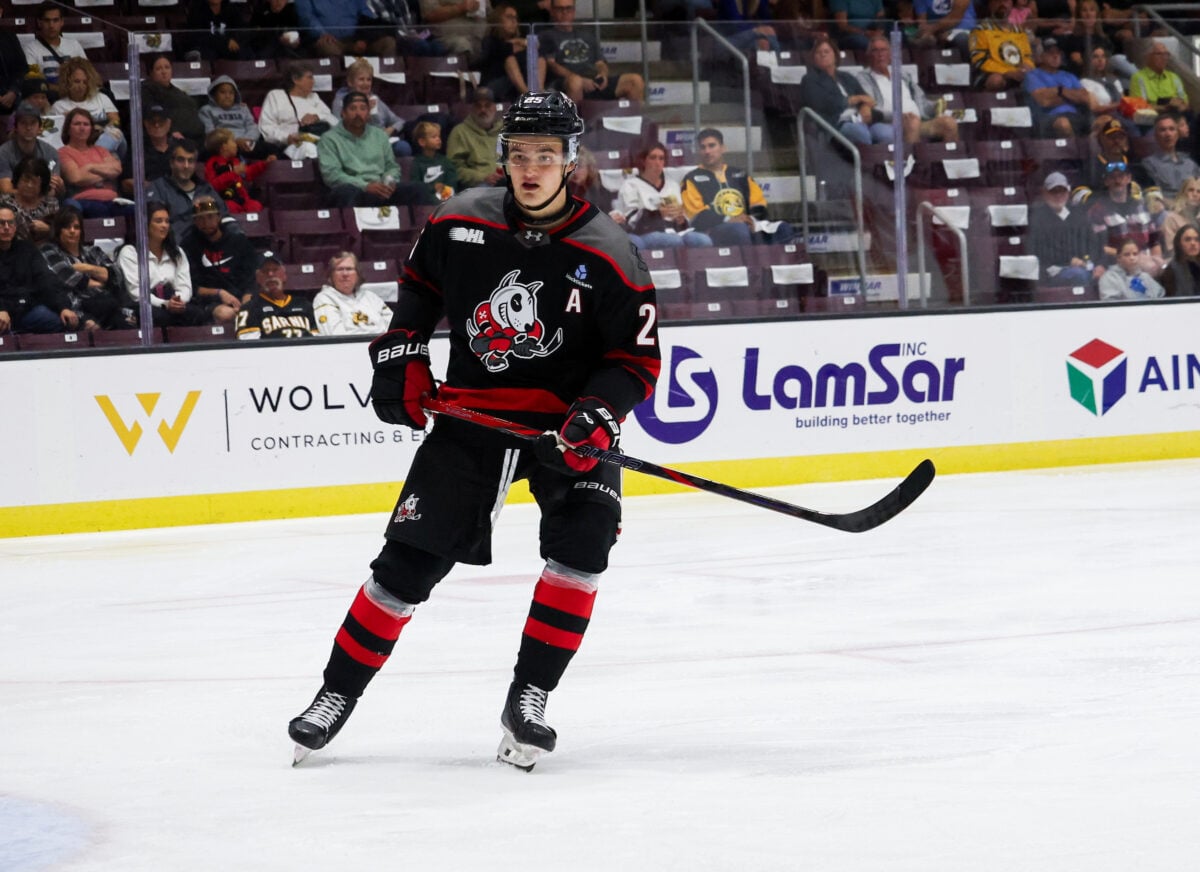
Roobroeck finished second on his team in scoring despite missing time with a lower-body injury. His calling card is a heavy, accurate release that makes him a constant threat from the perimeter and a weapon on the man advantage. Unlike many young players of his stature, Roobroeck does not just rely on size to bully opponents; he processes offensive sequences quickly and finds quiet spaces in the offensive zone to deploy his shot.
The main developmental hurdle for Roobroeck is his consistency and pace. If the Canucks believe their development staff can refine his stride and defensive engagement, Roobroeck offers top-six goal-scoring potential that is rarely available at the start of the second round.
Jaxon Cover, Left Wing, London Knights (OHL)
Jaxon Cover is one of the most intriguing developmental wildcards in the 2026 class. A former competitive inline hockey player, his unconventional path to the London Knights has resulted in a unique, raw skill set that NHL scouts find polarizing but highly appealing.
Cover’s background on wheels is evident in his exceptional puck-handling and small-area creativity. He can manipulate his stick angle to beat defenders in tight spaces, a trait that helped him excel in the bumper position on London’s power play. Despite limited ice time in a deep Knights lineup, Cover displayed an analytical approach to the offensive zone, showing a willingness to battle along the boards and establish net-front position.
Playing under Dale Hunter, Cover has already begun implementing a more responsible two-way framework into his game. He needs to improve his decision-making on entries and use his 6-foot-1 frame more consistently, but his sheer offensive instincts suggest a high ceiling as a middle-six complementary winger.
Niklas Aaram-Olsen, Left Wing/Right Wing, Örebro HK (Sweden)
For an international option, Niklas Aaram-Olsen offers a blend of size, skating, and pure goal-scoring capability. The Norwegian winger spent the majority of his season dominating the Swedish under-20 junior circuit, scoring at a rate well above a point per game, while also earning a 16-game cameo against men in the Swedish Hockey League (SHL).
Aaram-Olsen is a linear attacker who uses straight-line speed to back defenders off. Once inside the blue line, his lateral hands and quick release allow him to generate clean looks out of minimal space. His international performance was equally telling, as he carried the Norwegian junior team offensively to earn them a promotion to the top tier of the upcoming World Junior Championship.
While Aaram-Olsen possesses an NHL-ready frame at 6-foot-1 and 187 pounds, he does not play a particularly physical or aggressive game. He will need to internalize better defensive habits and compete harder on contested pucks to survive at the pro level, but his natural scoring traits make him a strong candidate for a team looking to add scoring depth to its flanks.
The Verdict
The 33rd pick gives the Canucks an opportunity to address specific organizational needs. Whether they prioritize the cerebral playmaking of Ruck, the elite blue-line transition of Bleyl, or the pure goal-scoring upside of Roobroeck, Cover, or Aaram-Olsen, the board is well-positioned for the front office to extract genuine value.
AI tools were used to support the creation or distribution of this content, however, it has been carefully edited and fact-checked by a member of The Hockey Writers editorial team. For more information on our use of AI, please visit our Editorial Standards page.
Free Newsletter
Get NHL Entry Draft coverage delivered to your inbox
In-depth analysis, breaking news, and insider takes – free.
Subscribe Free →