Beau Akey does not need to play an NHL game for this season to be a success. After everything that has interrupted his development, simply putting together a healthy, dependable season with the Edmonton Oilers’ American Hockey League (AHL) affiliate, Bakersfield Condors, might be more valuable.
Akey’s first professional campaign never developed a normal rhythm. An injury delayed his start; he required an early conditioning stint in the ECHL, and a puck to the face cost him multiple teeth and disrupted a stretch in which his game had started to settle. He still recorded two goals and 10 points in 42 AHL games while producing defensive results that impressed Condors head coach Colin Chaulk.
Chaulk recently noted that Akey’s plus/minus was even or better in roughly 35 or 36 of those 42 appearances. Bakersfield’s own coaching release lists the final number at 36, while a fresh report from OilersNation credited Akey with a 57% goal share. Those numbers do not mean the 21-year-old is ready to join the Oilers. They suggest something more useful at this stage: beneath all the interruptions, his first professional season contained a legitimate foundation.
Akey’s First AHL Season Was Better Than 10 Points Suggest
A glance at Akey’s offensive totals would make his rookie season easy to overlook. He scored two goals and eight assists in 42 games, hardly the type of production that generates attention for a second-round selection. Offence was never the most revealing part of his season.
Akey had an even or better plus/minus despite playing for a Bakersfield team that Chaulk acknowledged spent part of the season in the bottom third of the AHL defensively. For a rookie adjusting to professional pace, stronger opponents and a more demanding schedule, avoiding extended stretches of negative results is significant.
The 57% goal share reinforces that point. Goal share can be affected by teammates, goaltending and relatively small samples, so it should not be treated as proof that he dominated his minutes. It does indicate that Bakersfield generally came out ahead on the scoreboard when he was involved at five-on-five.
That fits the type of player Akey appears to be becoming. Earlier in his career, his skating and puck-moving ability created expectations that offence could become a major part of his professional identity. His first AHL season suggested a different path may be developing.
Akey can use his feet to escape pressure, advance possession and prevent problems before they develop without necessarily becoming the defenceman running a power play. That is not a disappointing outcome. Edmonton needs internally developed defencemen capable of playing reliable NHL minutes far more than it needs every prospect to become an offensive specialist.
Injuries Have Taken Development Time From Akey
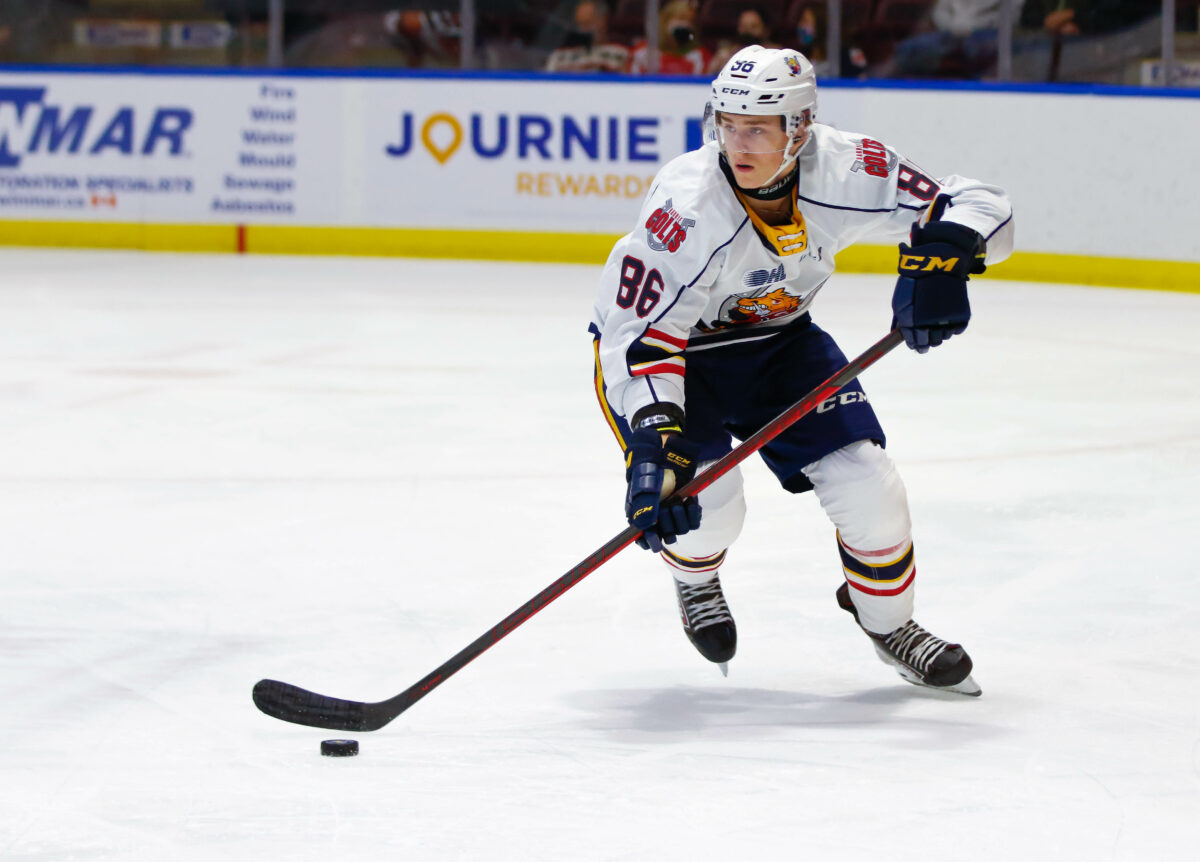
The concern is not a lack of tools. It is how often injuries have prevented him from getting uninterrupted time to sharpen them. His most significant setback came in 2023-24 with the Barrie Colts of the Ontario Hockey League (OHL). A shoulder injury limited him to 14 games and required surgery, costing him almost an entire season at an important stage of his development. THW’s 2024 Prospect Ranking detailed how much hockey he missed before eventually returning for his final junior campaign.
The problem followed him into professional hockey. An injury before the 2025-26 season kept Akey out for approximately a month and forced him to begin with the Fort Wayne Komets before joining Bakersfield. A July feature described his first professional season as anything but linear, even though Akey himself was encouraged by the progress he made learning professional habits.
Then came the puck. He was struck in the face by an errant puck while sitting on the bench in January. Chaulk told OilersNation that Akey lost seven teeth, dropped weight and had difficulty recovering his previous rhythm while playing with additional facial protection.
The Condors still expected him back relatively quickly, and a game preview less than two weeks later noted that he was already third on Bakersfield at plus-12 and had been even or better in all but one game since Dec. 21.
That sequence captures why his development needs patience. Akey was beginning to establish himself, suffered another unusual setback and then had to continue learning professional hockey while recovering physically.
Strength Is Akey’s Next Development Test
Chaulk’s assessment of what comes next was unusually specific. Akey does not need to become substantially heavier or sacrifice the skating that remains one of his best attributes. Chaulk instead wants him stronger, an important distinction for a 6-foot, 173-pound right-shot defenceman trying to defend against professional forwards.
“He just needs to get stronger,” Chaulk told OilersNation while praising Akey as smooth, poised and intelligent.
The challenge makes sense. Professional strength affects much more than delivering hits. Akey needs to hold positioning around the crease, separate heavier forwards from pucks, survive extended defensive-zone possessions and maintain his balance when opponents pressure him along the boards.
His injury history has complicated that process. Chaulk noted that shoulder surgeries have taken away portions of summers that otherwise could have been dedicated to building strength. This offseason therefore matters differently. He does not need to return to training camp dramatically larger. He needs enough functional strength to let his skating and hockey intelligence last deeper into games and across a full AHL schedule.
His own development priorities support that approach. During Edmonton’s 2026 Development Camp, Akey discussed learning how complete professional defencemen have to become and said he wanted to improve his puck possession and decision-making. The Oilers again made him one of the leading defensive prospects on their camp roster.
A stronger player who remains mobile would be considerably more interesting than one who chases size at the expense of the trait that made Edmonton draft him.
Oilers Should Not Rush Akey Toward NHL
The temptation with any notable prospect is to turn every good stretch into a discussion about an NHL promotion. The Oilers should avoid doing that with Beau Akey. They do not need him right now.
Their blue line already has Evan Bouchard, Mattias Ekholm, Connor Murphy, Ryan Shea, Ty Emberson, Spencer Stastney and Shakir Mukhamadullin, giving head coach Mike Babcock enough established options that Akey can remain in Bakersfield without organizational pressure forcing a promotion.
THW’s recent look at Edmonton’s prospect depth made the same broader point. The NHL defence is crowded, while Bakersfield contains several developing options trying to create separation beneath it. That should be treated as an advantage for Akey rather than an obstacle.
His first professional season was about adapting. His second can be about establishing. Instead of receiving sheltered minutes during an NHL recall, he can play regularly for Chaulk and associate coach Keith McCambridge, face stronger AHL competition and continue earning increased responsibility.
McCambridge’s presence is especially valuable. He works primarily with Bakersfield’s defencemen, and the Condors credited him with helping Akey produce those strong even-or-better results while also developing Damien Carfagna and Atro Leppänen. There should be no rush to remove Akey from that environment.
A Healthy Season Could Change Akey’s Projection
Akey’s 2026-27 season should not be judged by whether he records 30 points or receives an NHL call-up. The most important number might simply be games played.
He has already lost too much developmental time to injuries for another disrupted season to be dismissed easily. Shoulder surgery cost him most of one junior campaign, another injury delayed his professional debut, and a puck to the face interrupted arguably his strongest stretch in Bakersfield. A healthy 65-to-70-game AHL season would give Edmonton something it has rarely had with Akey: a long, uninterrupted sample.
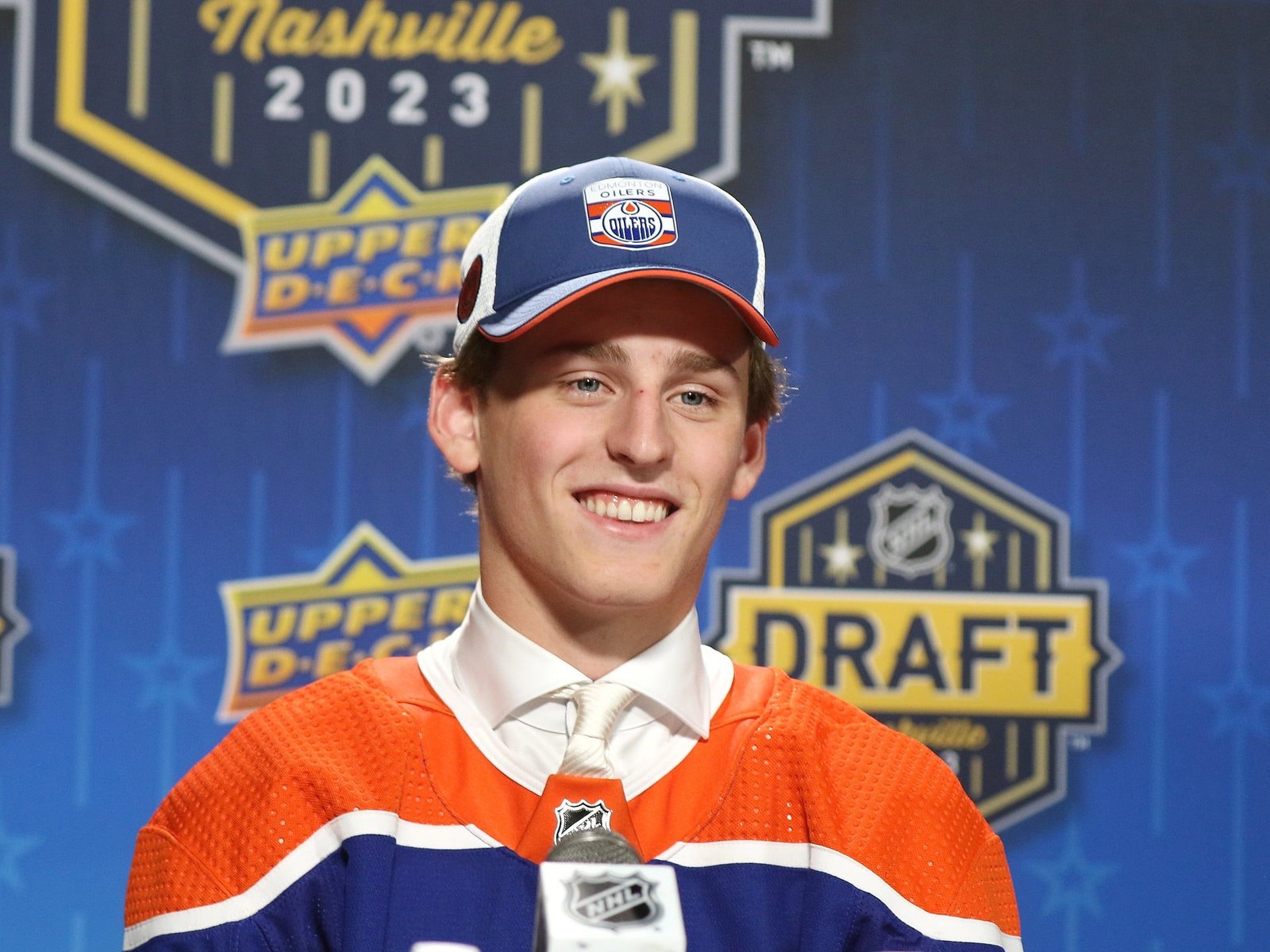
That would also allow the organization to determine whether his 57% goal share reflected sustainable defensive progress, whether increased strength helps him against heavier competition and whether his skating can turn him into a more consistent puck-moving presence. The Oilers already know why they drafted him 56th overall in 2023. His mobility, intelligence and right shot remain attractive traits, and he showed enough in his first professional season to keep an NHL future plausible.
Now they need evidence that those traits can develop without another interruption. Akey does not have to force Edmonton’s hand this season. If he stays healthy, becomes one of Bakersfield’s dependable defencemen and finishes the campaign looking noticeably stronger, the NHL conversation will arrive naturally. After several seasons in which circumstances have dictated his development schedule, 2026-27 needs to be the season Akey finally gets to dictate it himself.
Free Newsletter
Get Edmonton Oilers coverage delivered to your inbox
In-depth analysis, breaking news, and insider takes – free.
Subscribe Free →