The Pittsburgh Penguins’ goaltending situation might be exciting, but that does not make it safe. If anything, it might be the clearest example of where Pittsburgh’s youth movement could either raise the team’s ceiling or make the 2026-27 season much harder than expected.
President of hockey operations and general manager Kyle Dubas has moved the organization toward a younger goalie group. That is understandable. The Penguins needed to get away from expensive uncertainty and build something with more long-term upside. Still, replacing experienced NHL minutes with Artūrs Šilovs, Sergei Murashov and Joel Blomqvist brings a different kind of risk.
Pittsburgh’s goalie situation became even more important after the team decided against experience, and the challenge of replacing veteran goalie inputs should not be ignored. The team might have more upside in net, but they also have fewer proven answers. Here are the three biggest goalie questions facing the Penguins entering 2026-27.
Can Artūrs Šilovs Handle the Bigger Job?
Artūrs Šilovs is the most NHL-tested goalie on the roster, which makes him the first question. That does not mean he is already a clear No. 1. It means the Penguins may need him to become one faster than he is ready for.
Šilovs signed a one-year, $2.8 million contract before he becomes a restricted free agent this summer. His contract status gives the Penguins one season to evaluate whether he is a short-term bridge, a longer-term answer or simply part of a larger tandem plan.
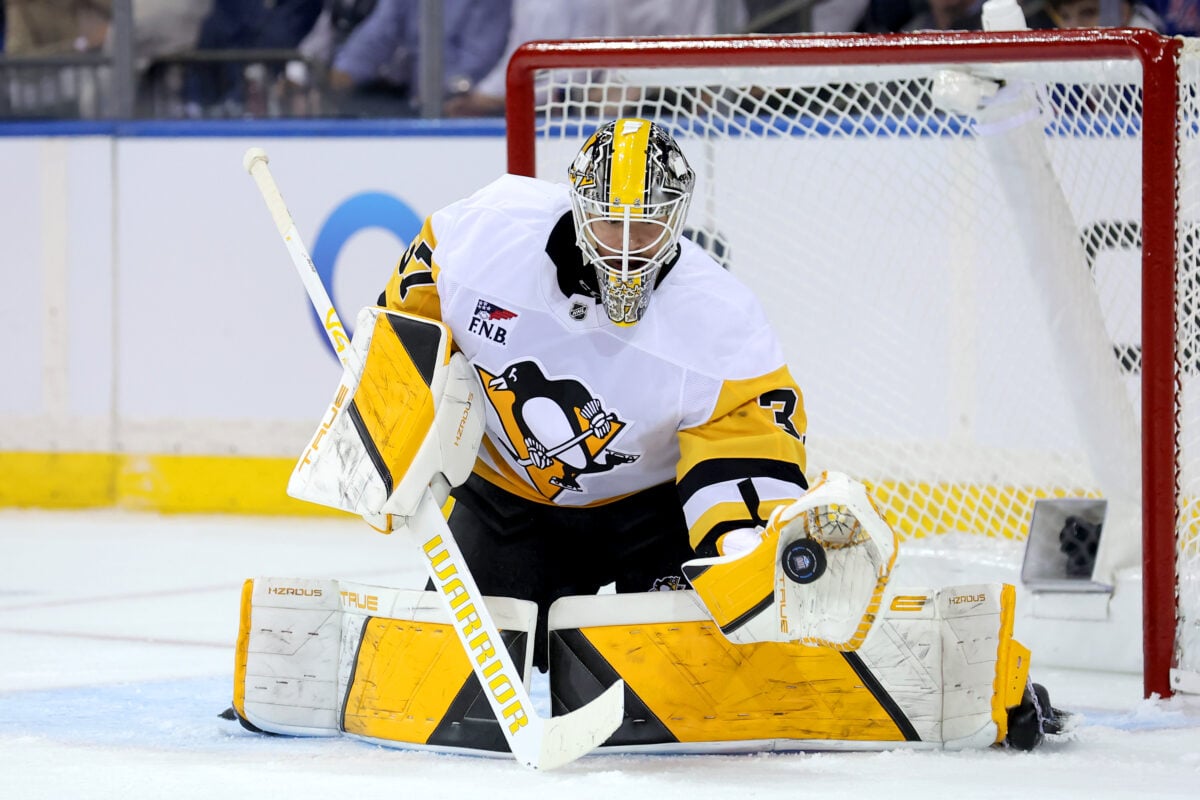
The concern is consistency. Šilovs went 19-12-8 last season with a 3.07 goals-against average and an .887 save percentage in 39 games, which is not enough to remove doubt. His playoff moments and athletic tools are real, but his regular-season numbers still make this a major bet. The Penguins already committed to giving him another look, and his one-year deal keeps the pressure on.
That is why his role matters so much. If Šilovs becomes a steady 1A option, the team’s entire season looks more stable. If he remains volatile, the Penguins could be forced to accelerate Murashov’s timeline or lean harder on Blomqvist than planned.
How Close Is Sergei Murashov?
Murashov is the most exciting goalie in the organization, but excitement is not the same as readiness. The Penguins have to decide whether he is close enough to push for NHL work now or whether another stretch with the team’s American Hockey League (AHL) affiliate, Wilkes-Barre/Scranton Penguins, is still the smarter play.
Murashov made a strong case last season. His 2025-26 season review showed how dominant he was in the AHL, where he posted a .919 save percentage and 2.20 goals-against average in 38 regular-season games. He was also named to the AHL Top Prospects Team after one of the best goalie seasons in the league.
That is the upside. The caution is that his NHL sample size is tiny. Murashov played only five NHL games, and the Penguins cannot assume AHL dominance means NHL reliability, and rushing a young goalie can create problems that take longer to fix than expected.
Murashov’s three-year entry-level contract, with a cap hit under $900,000, makes him exactly the kind of cheap internal piece the Penguins need if they are going to stay flexible while reshaping the roster. If he wins a job, that value becomes huge. If he needs more time, management can be patient enough to let him keep building.
The best outcome is simple: Murashov forces the issue in camp. The more difficult outcome is the one Pittsburgh has to prepare for, where he looks close but not quite ready. That would leave them balancing development with NHL needs.
Where Does Joel Blomqvist Fit?
Joel Blomqvist is easy to overlook because Šilovs has more NHL momentum and Murashov has more prospect buzz. That does not mean Blomqvist is out of the picture.
His new contract is the reason he still matters. Blomqvist signed a two-year deal with an $875,000 cap hit, and the contract structure keeps him in Pittsburgh’s plans beyond this season. The deal is also useful because it allows the Penguins to keep a credible third goalie close to the NHL roster without making a bigger commitment.
Blomqvist’s AHL numbers also support the idea that he deserves to stay in the conversation. His Wilkes-Barre/Scranton profile lists a 2.40 goals-against average and .913 save percentage from last season, which is strong enough to keep him relevant even if Murashov is the higher-upside name.
That is why Blomqvist’s path is complicated but not closed. His new deal already hinted at a bigger goalie plan, and that same idea remains true entering 2026-27. He may start as the No. 3 option, but goalie depth changes quickly. Injuries happen, young players struggle and teams often need more than two goalies to get through a long season.
The question is whether Blomqvist is only insurance or a real challenger. If Šilovs struggles and Murashov needs more time, Blomqvist could become more important than expected. If both move ahead of him cleanly, he still gives Pittsburgh valuable depth at a manageable number.
Penguins Need Stability From an Unproven Group
The Penguins’ goalie questions are all connected. Šilovs has to prove he can handle more responsibility. Murashov has to show whether his AHL dominance is ready to translate. Blomqvist has to stay close enough to matter while avoiding getting squeezed by the two names ahead of him.
That is a lot of uncertainty for one position.
Pittsburgh’s recent Šilovs decision was not only about keeping a goalie. It was about giving the organization one more season to evaluate whether he can become part of the answer. Murashov’s rise gives the Penguins more upside, and Blomqvist’s contract gives them another layer of protection.
Still, protection is not the same as certainty. The Penguins are asking a young goalie group to replace more experienced NHL minutes while the roster in front of them still has defensive questions. That could work if one goalie takes a major step. It could also become one of the reasons Pittsburgh struggles to keep pace in the Metropolitan Division.
That is why goaltending may define the Penguins’ floor. If the young group holds up, the team has a chance to be more competitive than expected. If it does not, the rest of the roster may not be strong enough to cover the damage.
The upside is real. So is the risk.
Entering 2026-27, the Penguins do not need every goalie question answered immediately. They do need one of Šilovs, Murashov or Blomqvist to make the crease feel less uncertain than it does right now.
Free Newsletter
Get Pittsburgh Penguins coverage delivered to your inbox
In-depth analysis, breaking news, and insider takes – free.
Subscribe Free →