PHILADELPHIA – Major League Baseball Commissioner Rob Manfred, in a wide-ranging press conference with the Baseball Writers’ Association of America on Tuesday, continued to push his case for a salary cap, framing the league’s collective bargaining proposal as a fan-driven fix for competitive imbalance.
As Manfred spoke about ongoing negotiations with the players’ union before the Collective Bargaining Agreement expires on Dec. 1, he said: “I have an ownership group that is more united than any group in my entire time in baseball.”
MLBPA interim executive director Bruce Meyer, who spoke with the BBWAA before Manfred on Tuesday, came out strongly against some of the league’s tactics in trying to gain public support for a salary cap, including advertisements on MLB.TV.
“Our game is in a great place,” Meyer said. “I have watched over the last few years the owners, the commissioner’s office, try to convince fans, the consumers of their product, that their product is broken.
“I think it’s perverse.”
Asked directly about the state of CBA talks, Manfred struck an upbeat tone.
“Look, I am an optimist,” Manfred said. “With respect to collective bargaining, I truly believe that if people engage in the process, that you find ways through things. I think that it’s important to point out that what we put forward is a system that has been beneficial in all the other major professional sports. It has resulted in player earnings that are higher, growing faster, than the ones in Major League Baseball.”
Manfred pointed to a recent NHL agreement that added roughly $170 million in player compensation as evidence that a salary cap would benefit the MLBPA. Manfred also noted that MLB has already made concessions toward union priorities, including agreeing to streamline paths to free agency, and argued that the league’s overall proposal is built to address the MLBPA’s core issues rather than dismiss them.
“I think the proposal that we have made has put us in a position to address all the major issues that the MLBPA brought to the table in their initial proposals,” Manfred said.

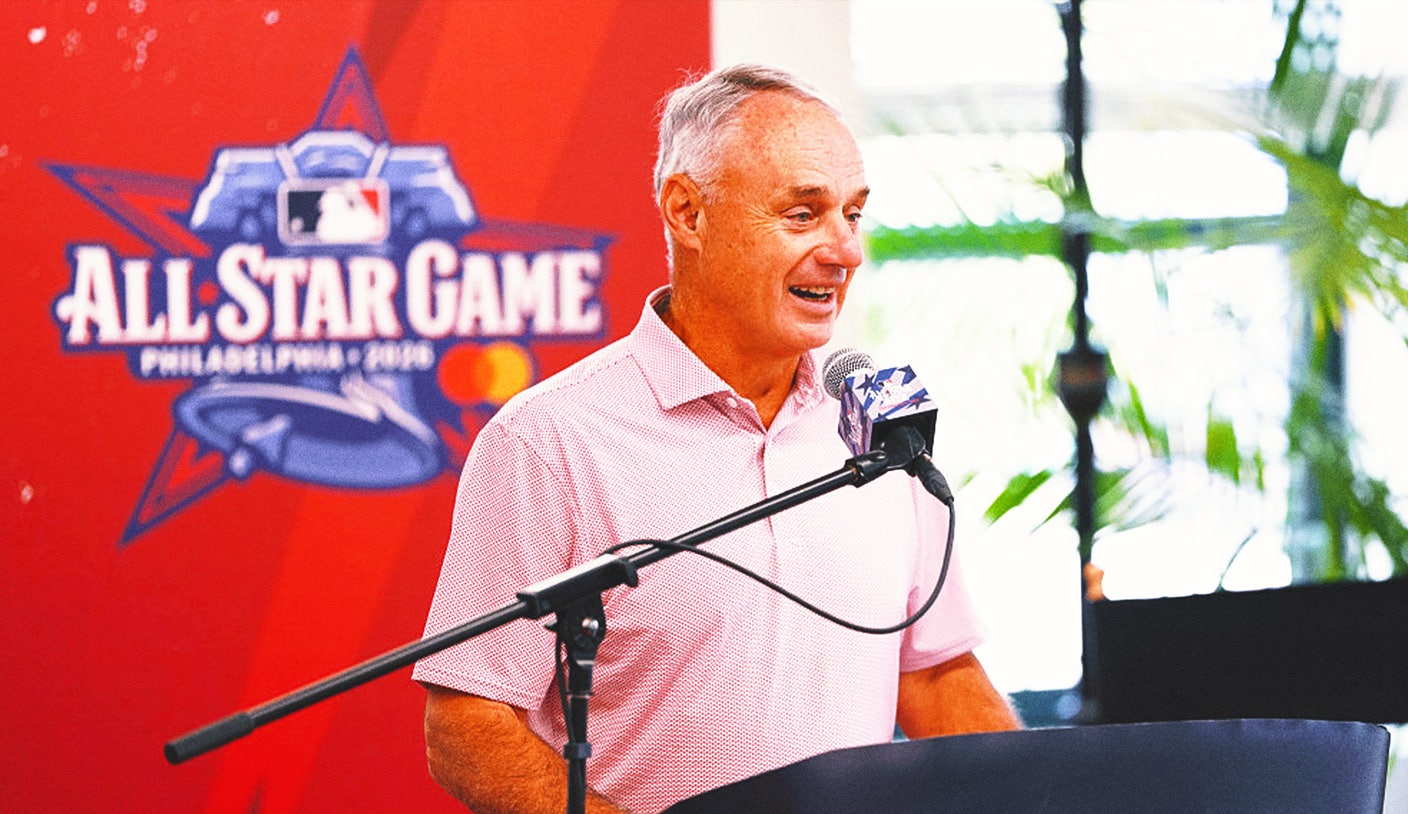
Commissioner Rob Manfred has taken MLB’s salary cap case to the public in advance of the end of the current CBA with the players’ union. (Photo by Mary DeCicco/MLB Photos via Getty Images)
The heart of Manfred’s press conference centered on how the league is constantly “listening to the fans.” It’s a strategy that the MLBPA has so far struggled to replicate, in that the union has yet to explain how its demands benefit the fans. Asked how, exactly, MLB is gathering fan opinion, Manfred said the league’s process is “very sophisticated.” It involves relying on professional pollsters and focus groups based on age and demographics, including small- and big-market cities.
Manfred reiterated that fans are most concerned about payroll disparity and how that impacts the ability to retain star players or sign expensive free agents at the top of their class.
The commissioner cited a payroll gap of more than $400 million between baseball’s highest and lowest spending teams, arguing that the disparity erodes what he called “hope” among fans in smaller markets before a season even begins.
“The number from top to bottom in our sport in terms of payroll, the gap is $441 million,” Manfred said. “It defies human experience to ask a fan to think the bottom end of that gap gets the same opportunity to win as the top end. There is no question that everybody in any sport is not going to win once every 30–32 years, depending on how many teams you have.
“But the data in our sport is stark. Your opportunity to make the playoffs if you are a larger-market team is dramatically higher. And your opportunity to proceed to the subsequent rounds, that advantage grows with each round.”
Meyer argued that if the league is going to make claims about enormous payroll gaps, then club owners must open their books and make their finances available to the public. He said that request has been part of the MLBPA’s proposals.
He also pushed back on comparisons to leagues like the NBA and NFL, where a handful of teams tend to dominate despite salary caps. Meyer noted that NBA and NFL players are still getting squeezed out of more earnings even after agreeing to salary caps.
Two outcomes, Manfred said, would define a healthier system. Small-market fans should have real confidence that homegrown, developed players can be retained through free agency. And there should be a “more robust free-agent market,” so players uninterested in signing with large markets like New York or Los Angeles still have access to competitive contract offers elsewhere.
Pressed on why the league doesn’t simply address the payroll gap by redistributing more revenue among owners, Manfred said revenue sharing alone can’t solve the problem. He pointed to the growing disparity in ownership groups’ personal wealth as a structural issue that revenue sharing can’t fully offset. No sport, he added, has solved competitive-balance problems purely through the mechanics of revenue distribution.